
[Paper Review] Direct Laser Cooling of Polyatomic Molecules
This review presents direct laser cooling of polyatomic molecules as a transformative approach to achieving ultracold, quantum-controlled states, leveraging optical cycling in molecules with favorable electronic, vibrational, and rotational structures. The key contribution is identifying design principles—such as diagonal Franck-Condon factors and manageable selection rules—that enable efficient photon scattering and sub-Doppler cooling, while highlighting vibronic coupling to dark states as a major loss mechanism limiting cooling efficiency.
Over the past decade, tremendous progress has been made to extend the tools of laser cooling and trapping to molecules. Those same tools have recently been applied to polyatomic molecules (molecules containing three or more atoms). In this review, we discuss the scientific drive to bring larger molecules to ultralow temperatures, the features of molecular structure that provide the most promising molecules for this pursuit, and some technical aspects of how lasers can be used to control the motion and quantum states of polyatomic molecules. We also present opportunities for and challenges to the use of polyatomic molecules for science and technology.
Motivation & Objective
- To establish direct laser cooling as a viable method for achieving ultracold polyatomic molecules with controlled quantum states.
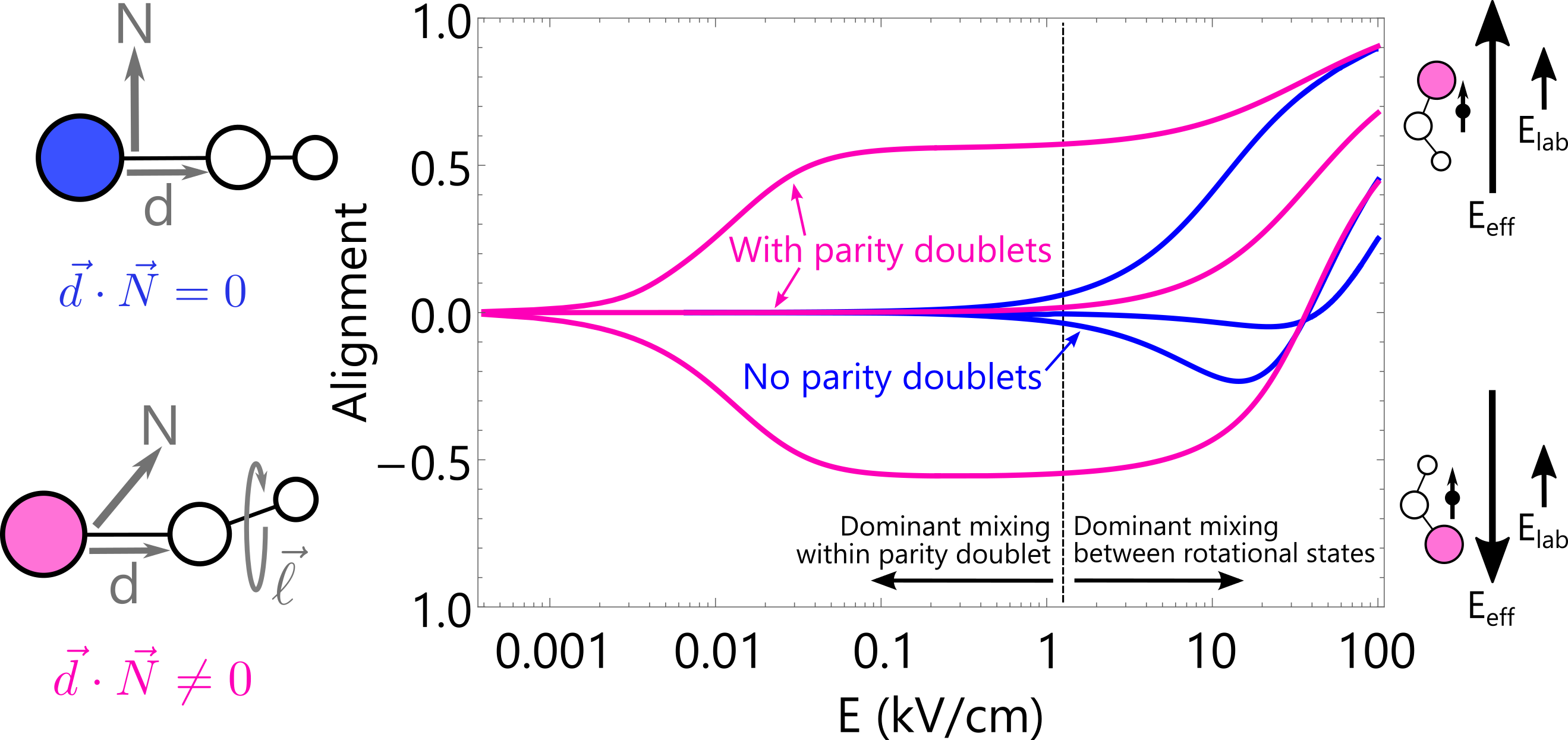
- To identify molecular structural features—such as diagonal Franck-Condon factors and favorable rotational selection rules—that enable efficient optical cycling.
- To address the challenge of population loss due to vibronic coupling to dark states in excited electronic manifolds.
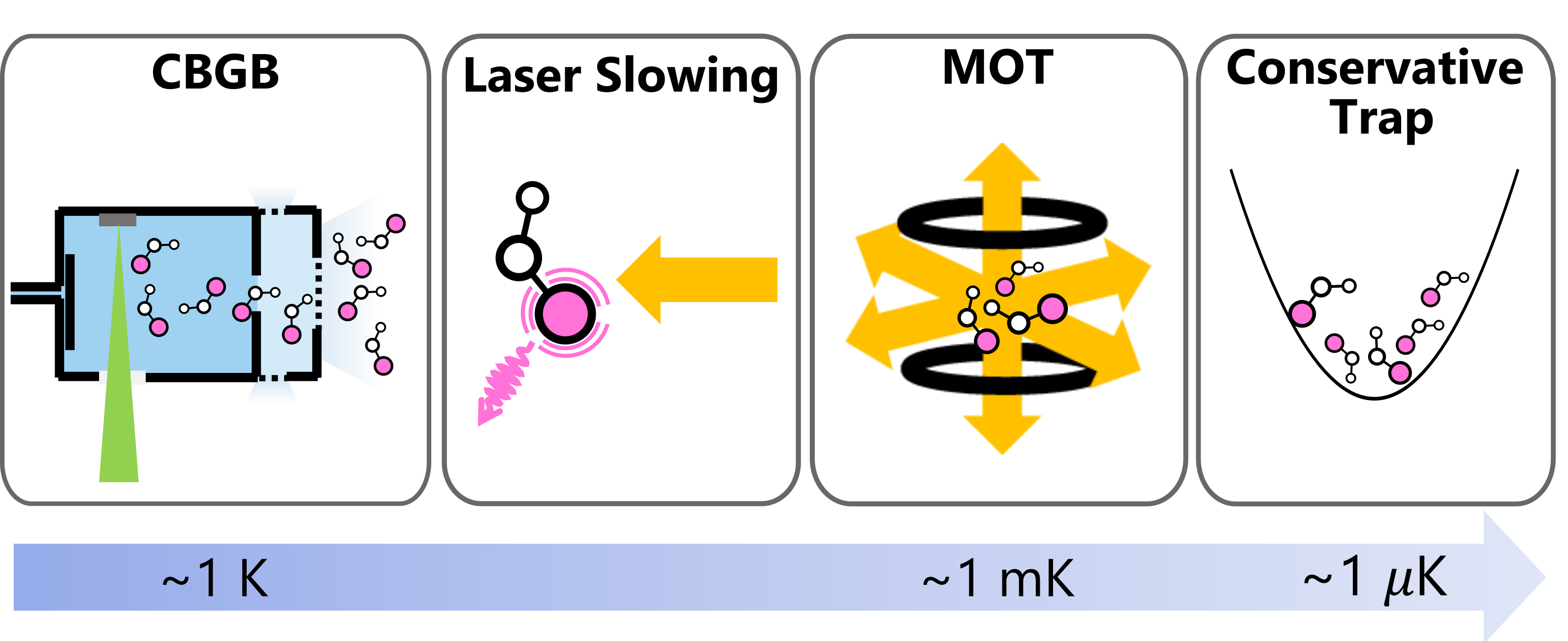
- To outline experimental techniques including cryogenic buffer-gas beams, magneto-optical trapping, and sub-Doppler cooling methods like grey molasses.
- To guide future molecular design toward laser-coolable species with large electric dipole moments and long coherence times for quantum technologies.
Proposed method
- Utilizing optical cycling by driving closed, cycling transitions between ground and excited electronic states with precisely tuned lasers.
- Designing molecular systems with diagonal Franck-Condon factors to maximize photon scattering efficiency and minimize non-radiative decay.
- Applying sub-Doppler cooling techniques such as grey molasses and Λ-enhanced grey molasses to cool molecules below the Doppler limit.
- Employing cryogenic buffer-gas beams to produce slow, cold molecular beams suitable for laser cooling and trapping.
- Implementing Zeeman-Sisyphus and radiative slowing techniques for decelerating molecular beams prior to trapping.
- Modeling loss mechanisms via vibronic coupling between bright excited states and dark manifolds using Fermi’s golden rule and density of states estimates.
Experimental results
Research questions
- RQ1Which molecular structural features enable efficient optical cycling and direct laser cooling in polyatomic molecules?
- RQ2How do vibronic couplings to dark states limit photon scattering rates and cause apparent population loss in laser cooling experiments?
- RQ3What is the role of rotational structure and selection rules in determining the feasibility of closed cycling transitions?
- RQ4Can sub-Doppler cooling techniques like grey molasses be effectively applied to polyatomic molecules with complex level structures?
- RQ5To what extent can molecular design—such as tuning electron-nuclear coupling—reduce unwanted vibronic coupling and enhance cooling efficiency?
Key findings
- Polyatomic molecules with diagonal Franck-Condon factors and favorable rotational selection rules are prime candidates for direct laser cooling, enabling efficient optical cycling.
- The presence of vibronic coupling between bright excited states and dark manifolds can lead to rapid population leakage, with timescales τbd as short as ~1 ns if coupling matrix elements exceed ~10−9 cm−1.
- Losses due to dark state population are most severe when τbd ≪ τb and τreturn ≫ τb, conditions that can severely limit photon scattering rates.
- A crude Fermi’s golden rule estimate shows that even weak coupling (⟨V²⟩ ~ 10−18 cm²) with a high vibrational density of states (ρ ~ 10¹⁴ cm⁻¹) can cause significant loss.
- Molecular design offers a potential pathway to reduce coupling matrix elements by decoupling the metal-centered valence electron from high-density vibrational modes.
- Theoretical and experimental studies are urgently needed to quantify vibronic coupling in large molecules like CaOR, where such effects may dominate cooling efficiency.
Read this paper
Open the full text in the Nubint reader and ask about any passage as you read.
Read this paper on NubintThis review was generated by AI from the original paper. Please check the paper before citing it.