
[Paper Review] DKPROMPT: Domain Knowledge Prompting Vision-Language Models for Open-World Planning
DKPrompt proposes a vision-language model framework that integrates domain knowledge from PDDL-based classical planners to enable robust, open-world task planning in robotics. By prompting VLMs with action preconditions and effects as visual question-answering queries, DKPrompt detects failures and re-plans dynamically, achieving a 66.5% task success rate—significantly outperforming baselines like VLM-planner (2.2%) and classical planners (17.1%) in open-world simulations.
Vision-language models (VLMs) have been applied to robot task planning problems, where the robot receives a task in natural language and generates plans based on visual inputs. While current VLMs have demonstrated strong vision-language understanding capabilities, their performance is still far from being satisfactory in planning tasks. At the same time, although classical task planners, such as PDDL-based, are strong in planning for long-horizon tasks, they do not work well in open worlds where unforeseen situations are common. In this paper, we propose a novel task planning and execution framework, called DKPROMPT, which automates VLM prompting using domain knowledge in PDDL for classical planning in open worlds. Results from quantitative experiments show that DKPROMPT outperforms classical planning, pure VLM-based and a few other competitive baselines in task completion rate.
Motivation & Objective
- To address the limitations of pure VLMs in long-horizon, open-world task planning where unforeseen situations disrupt execution.
- To overcome the rigidity of classical planners (e.g., PDDL) in open-world environments lacking predefined state transitions.
- To automate the detection of action failures and affordance verification without manual engineering.
- To bridge symbolic reasoning in classical planners with visual perception in VLMs using domain knowledge as a prompting interface.
- To evaluate the framework in a realistic, open-world simulation environment with structured world knowledge and unforeseen situations.
Proposed method
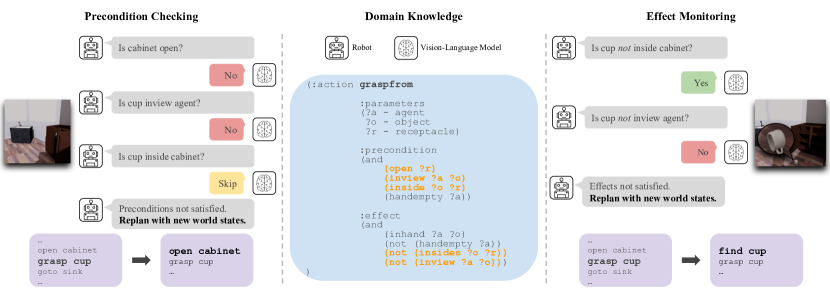
- DKPrompt uses PDDL-defined action preconditions and effects as domain knowledge to prompt vision-language models (VLMs) via visual question-answering (VQA) style queries.
- The system queries the VLM about whether current visual observations satisfy the preconditions of the next action in the plan.
- It also verifies whether expected action effects (e.g., object being open, placed) are achieved post-execution.
- If preconditions are not met or effects are not observed, DKPrompt triggers re-planning using the classical planner with updated world states.
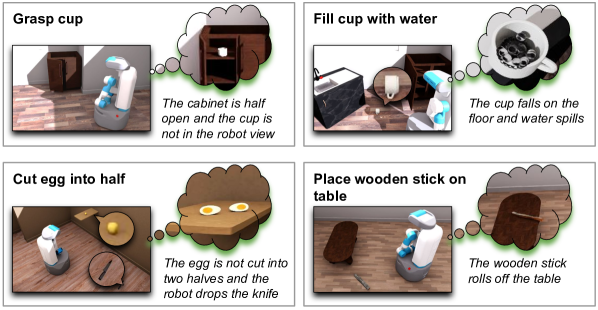
- The framework dynamically adapts plans in response to novel situations such as partial object visibility or failed grasps.
- It leverages off-the-shelf VLMs (e.g., GPT-4, Gemini-1.5, Claude-3) to minimize architectural changes while maximizing perception-grounding.
Experimental results
Research questions
- RQ1Can VLMs effectively detect action failures and verify affordances in open-world robotic planning without manual intervention?
- RQ2How does integrating PDDL domain knowledge into VLM prompting improve task success rates in open-world environments?
- RQ3Does DKPrompt outperform pure VLM-based planning, classical planners, and hybrid baselines in handling unforeseen situations?
- RQ4What is the impact of using different VLMs (e.g., GPT-4, Gemini, Claude-3) on the robustness and success of the planning pipeline?
- RQ5Can the framework generalize across diverse long-horizon tasks with minimal reconfiguration?
Key findings
- DKPrompt achieved a 66.5% task success rate across five diverse tasks in the OmniGibson simulator, significantly outperforming the next best baseline, Suc.-QA, at 54.0%.
- The VLM-planner baseline achieved only 2.2% average success rate, highlighting the limitations of pure VLM-based planning in open-world settings.
- DKPrompt with GPT-4 achieved 12/18 success in boiling water, 18/20 in bringing in an empty bottle, and 15/20 in cooking a frozen pie—demonstrating strong generalization.
- Ablation studies showed that using only effect verification (Eff.-only) yielded 53.0% success, while only precondition checking (Pre.-only) achieved 41.5%, proving both components are essential.
- DKPrompt with Gemini-1.5 achieved 44.0% success, and with Claude-3, 33.9%, indicating model choice significantly affects performance.
- The framework successfully detected and recovered from unforeseen situations such as partially opened cabinets, dropped objects, and navigation failures.
Read this paper
Open the full text in the Nubint reader and ask about any passage as you read.
Read this paper on NubintThis review was generated by AI from the original paper. Please check the paper before citing it.