
[Paper Review] Do Generated Data Always Help Contrastive Learning?
This paper challenges the assumption that generated data always improve contrastive learning, revealing that naive data inflation can degrade performance. It proposes Adaptive Inflation (AdaInf), a data-centric method that adaptively combines data reweighting and weak augmentations to improve generalization without extra computation, achieving 94.70% linear accuracy on CIFAR-10 with SimCLR—setting a new SOTA for self-supervised learning.
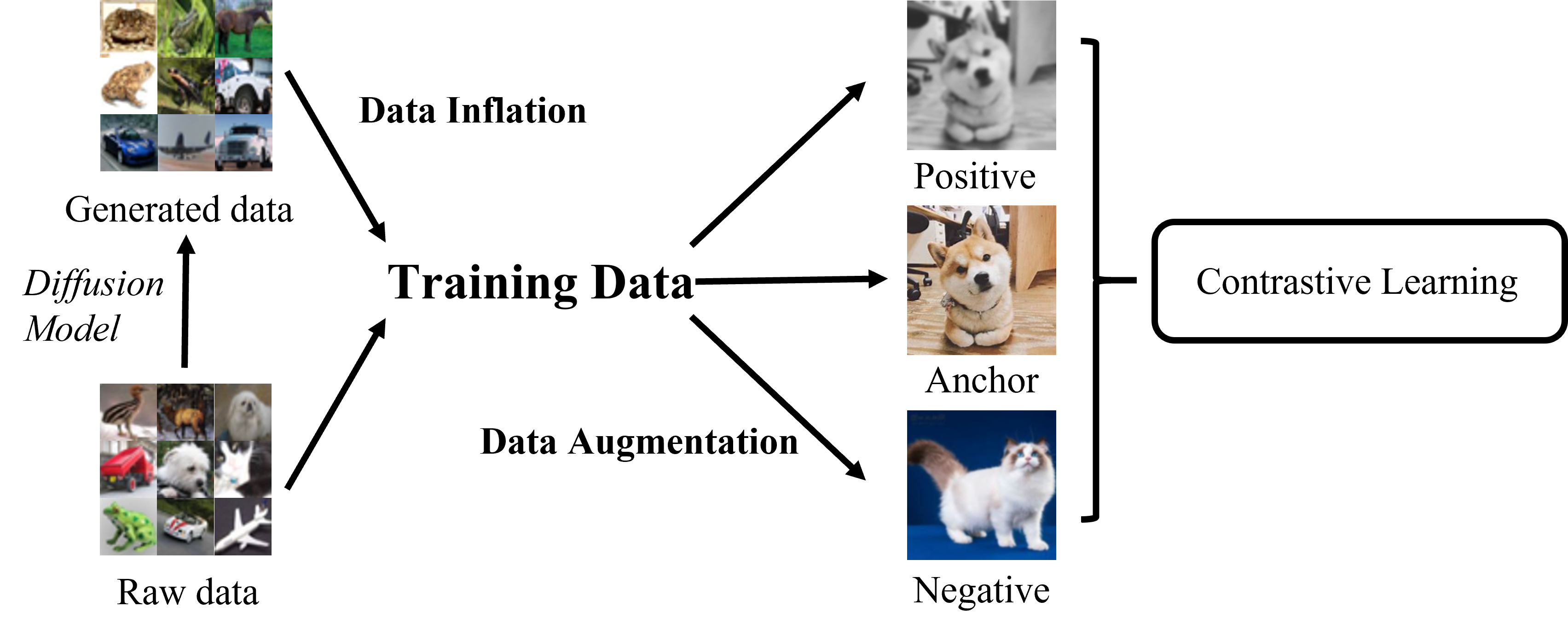
Contrastive Learning (CL) has emerged as one of the most successful paradigms for unsupervised visual representation learning, yet it often depends on intensive manual data augmentations. With the rise of generative models, especially diffusion models, the ability to generate realistic images close to the real data distribution has been well recognized. These generated high-equality images have been successfully applied to enhance contrastive representation learning, a technique termed ``data inflation''. However, we find that the generated data (even from a good diffusion model like DDPM) may sometimes even harm contrastive learning. We investigate the causes behind this failure from the perspective of both data inflation and data augmentation. For the first time, we reveal the complementary roles that stronger data inflation should be accompanied by weaker augmentations, and vice versa. We also provide rigorous theoretical explanations for these phenomena via deriving its generalization bounds under data inflation. Drawing from these insights, we propose Adaptive Inflation (AdaInf), a purely data-centric strategy without introducing any extra computation cost. On benchmark datasets, AdaInf can bring significant improvements for various contrastive learning methods. Notably, without using external data, AdaInf obtains 94.70% linear accuracy on CIFAR-10 with SimCLR, setting a new record that surpasses many sophisticated methods. Code is available at https://github.com/PKU-ML/adainf.
Motivation & Objective
- To investigate why generated data in data inflation can sometimes harm contrastive learning performance.
- To identify the root causes of performance degradation from both data inflation and data augmentation perspectives.
- To theoretically analyze the generalization behavior of contrastive learning under data inflation.
- To develop a practical, computation-free strategy that adaptively optimizes data inflation for improved downstream performance.
- To demonstrate the effectiveness of the proposed method in data-scarce scenarios.
Proposed method
- Proposes Adaptive Inflation (AdaInf), a data-centric strategy that dynamically adjusts the mixing ratio between real and generated data.
- Introduces data reweighting to assign higher importance to real samples, mitigating distribution shift from generated data.
- Employs weak data augmentations (e.g., small crops) in combination with inflated data, counterintuitively improving performance.
- The method operates without additional computation cost, relying only on reweighting and adaptive augmentation strength.
- Theoretical analysis derives generalization bounds for inflated contrastive learning, revealing complementary roles between data inflation and augmentation.
- AdaInf is implemented as a plug-in solution compatible with existing contrastive learning frameworks like SimCLR.
Experimental results
Research questions
- RQ1Why does data inflation with high-quality generated data sometimes degrade contrastive learning performance?
- RQ2What role does data augmentation strength play when combined with inflated data?
- RQ3How do data reweighting and weak augmentations jointly affect the generalization of contrastive learning under data inflation?
- RQ4Can theoretical guarantees be derived for contrastive learning with inflated data, and what insights do they provide?
- RQ5Is there a data-centric strategy that improves performance without introducing additional computational cost?
Key findings
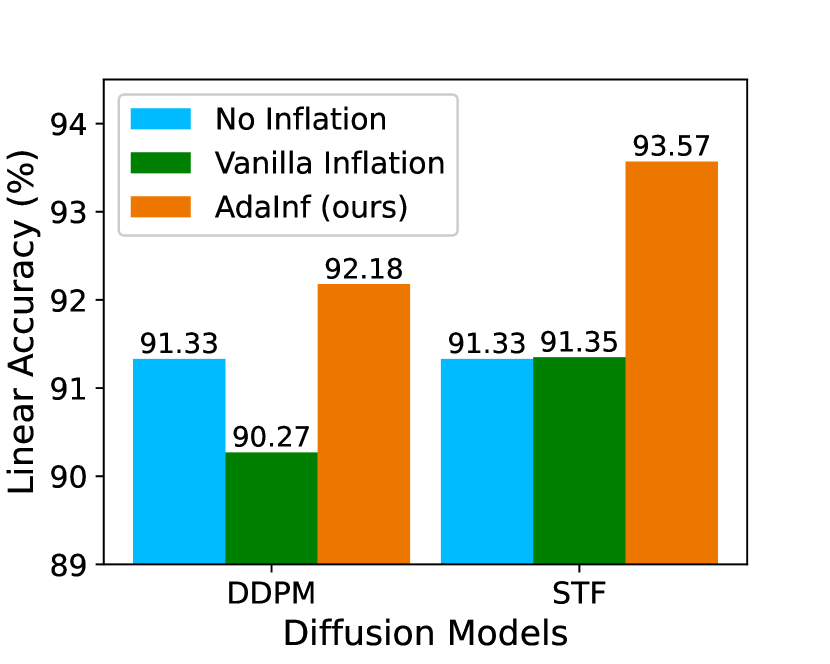
- AdaInf achieves 94.70% linear accuracy on CIFAR-10 using only SimCLR, setting a new SOTA for self-supervised learning.
- Vanilla data inflation with 1M DDPM-generated samples reduces linear accuracy to 91.33%, worse than non-inflated training (90.27%).
- Weak augmentations contribute the most to performance gain, improving accuracy by approximately +2% when used with AdaInf.
- Data reweighting and weak augmentation are more critical than generation quality—reweighting alone improves accuracy from 91.33% to 91.92%.
- In data-scarce scenarios (5,000-image CIFAR-10 subset), AdaInf improves accuracy by +4.32% over standard training and +2.2% over vanilla inflation.
- The learning curve shows AdaInf consistently outperforms non-inflated training throughout the entire training process, even after saturation.
Read this paper
Open the full text in the Nubint reader and ask about any passage as you read.
Read this paper on NubintThis review was generated by AI from the original paper. Please check the paper before citing it.