
[Paper Review] Domain adaptation using optimal transport for invariant learning using histopathology datasets
This paper proposes a novel optimal transport (OT)-based domain adaptation method for histopathology image analysis that improves model generalization to unseen institutions by penalizing distributional differences between institutional data batches in the feature space. Unlike standard adversarial domain adaptation that operates on individual images, the OT loss captures global distributional shifts, leading to significantly better performance on rare or underrepresented phenotypes—especially in low-resource or unseen domains—without requiring labels or retraining.
Histopathology is critical for the diagnosis of many diseases, including cancer. These protocols typically require pathologists to manually evaluate slides under a microscope, which is time-consuming and subjective, leading to interest in machine learning to automate analysis. However, computational techniques are limited by batch effects, where technical factors like differences in preparation protocol or scanners can alter the appearance of slides, causing models trained on one institution to fail when generalizing to others. Here, we propose a domain adaptation method that improves the generalization of histopathological models to data from unseen institutions, without the need for labels or retraining in these new settings. Our approach introduces an optimal transport (OT) loss, that extends adversarial methods that penalize models if images from different institutions can be distinguished in their representation space. Unlike previous methods, which operate on single samples, our loss accounts for distributional differences between batches of images. We show that on the Camelyon17 dataset, while both methods can adapt to global differences in color distribution, only our OT loss can reliably classify a cancer phenotype unseen during training. Together, our results suggest that OT improves generalization on rare but critical phenotypes that may only make up a small fraction of the total tiles and variation in a slide.
Motivation & Objective
- To address domain shift in histopathology images caused by batch effects from different scanners, staining protocols, and institutions.
- To improve model generalization to unseen institutions without requiring labels or retraining on new data.
- To overcome limitations of standard adversarial domain adaptation, which focuses on individual image-level differences and fails on rare or underrepresented phenotypes.
- To develop a method that captures global distributional shifts between institutional data batches rather than local, frequent differences.
- To enable robust deployment of deep learning models in clinical settings across diverse, real-world histopathology data sources.
Proposed method
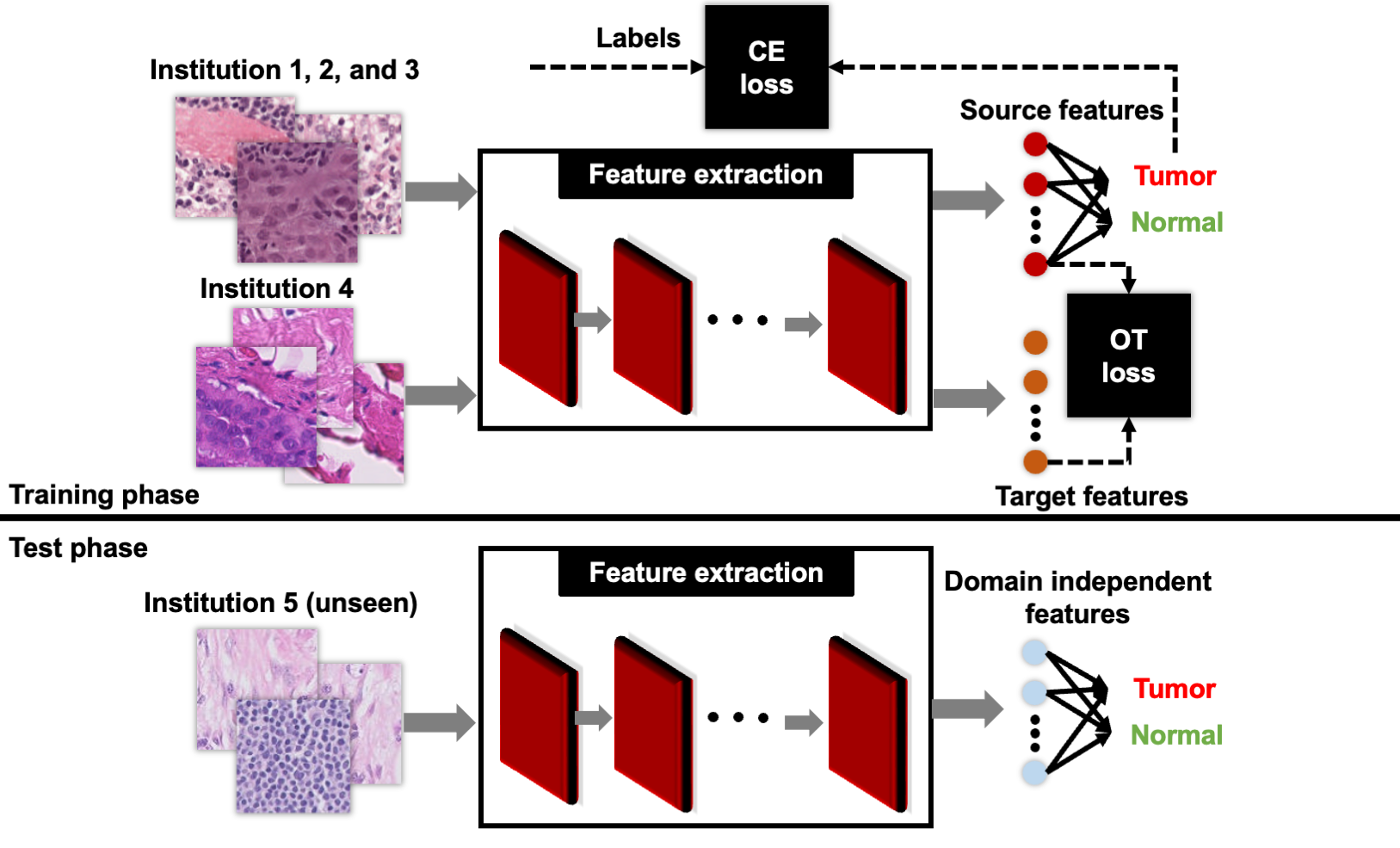
- Introduces a new optimal transport (OT) loss that compares the full distribution of feature embeddings from image batches across different institutions.
- Uses OT to quantify and penalize representational differences between institutional data distributions during model training.
- Extends adversarial domain adaptation by replacing instance-level domain classification with batch-level distributional alignment via OT.
- Applies the OT loss as a regularizer in a deep neural network training pipeline, encouraging domain-invariant representations.
- Employs a ResNet-50 backbone pre-trained on ImageNet for feature extraction, with domain discrimination head for OT-based regularization.
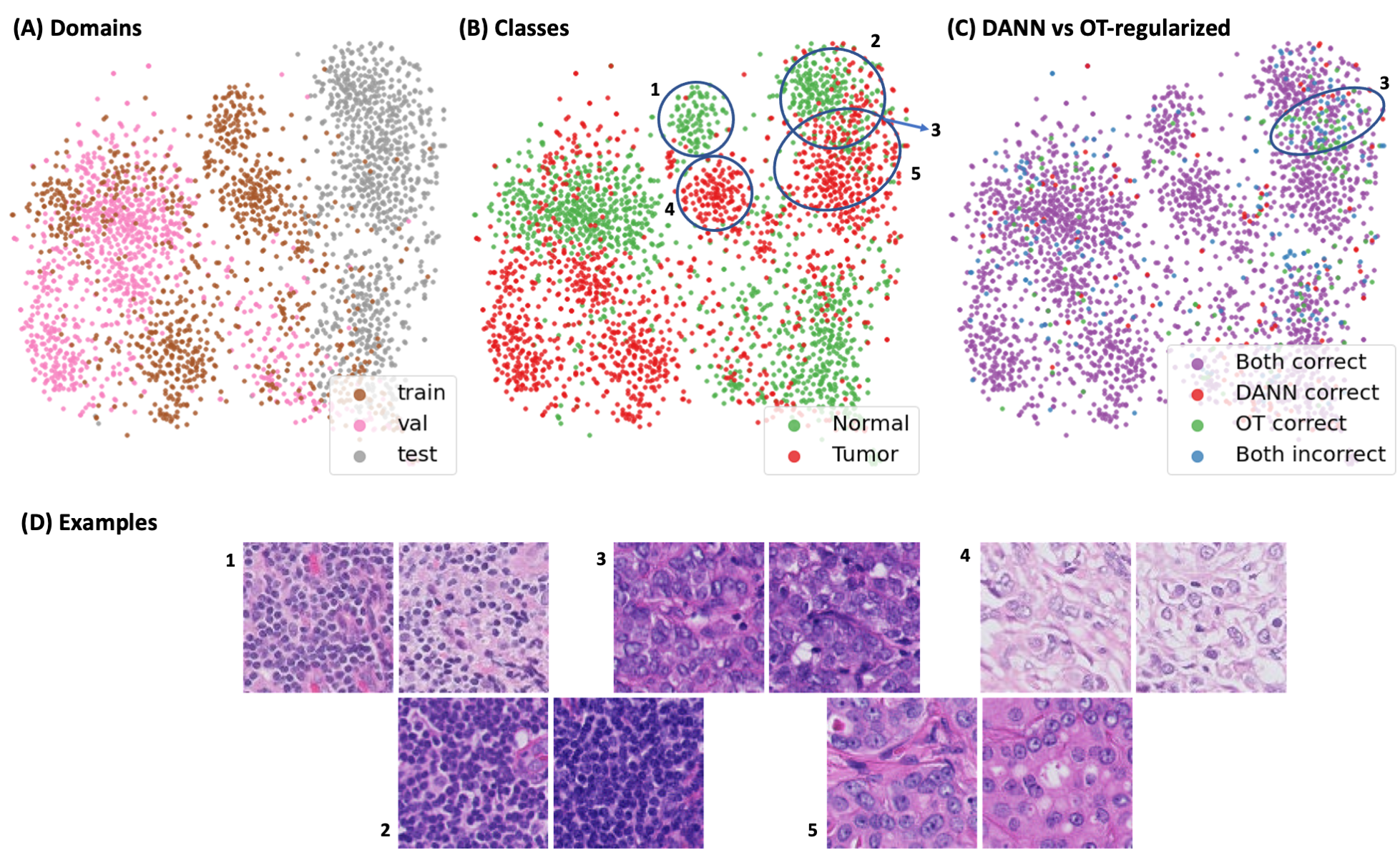
- Leverages t-SNE visualization and cluster analysis to validate that OT-based models learn more robust and generalizable feature representations across biological and technical variations.
Experimental results
Research questions
- RQ1Can optimal transport-based domain adaptation improve model generalization to unseen institutions in histopathology datasets compared to standard adversarial domain adaptation?
- RQ2Does the OT-based method better handle subpopulation shifts and underrepresented phenotypes in histopathology image tiles?
- RQ3How does the OT loss perform relative to other state-of-the-art domain adaptation methods on the Camelyon17 benchmark?
- RQ4Can the OT-based method maintain performance when the unseen institution is used as the validation set, indicating robustness to domain shift?
- RQ5What is the impact of OT-based regularization on feature space distributions, particularly in regions with low training data coverage?
Key findings
- The OT-regularized model achieved 89.1% accuracy on the test set (0.019 standard deviation), significantly outperforming the ERM baseline (70.3%) and other baselines like CORAL (59.5%) and IRM (68.4%).
- On the Camelyon17 dataset, the OT method showed superior performance on rare or poorly represented phenotypes, particularly in cluster 3, where DANN failed but OT succeeded.
- The OT-based model generalized robustly when the roles of validation and test institutions were switched, maintaining strong performance regardless of which institution was unseen.
- t-SNE visualization revealed that the OT method better preserves the full distribution of biological and technical variability in feature space, especially in low-coverage regions.
- The method demonstrated improved robustness to subpopulation shifts, suggesting that batch-level distributional alignment via OT mitigates failures caused by sparse or imbalanced training data.
- While not outperforming the most advanced methods (e.g., MBDG, SGD (Freeze-Embed)), the OT method shows strong potential for synergy with existing approaches like stain augmentation and vision transformers.
Read this paper
Open the full text in the Nubint reader and ask about any passage as you read.
Read this paper on NubintThis review was generated by AI from the original paper. Please check the paper before citing it.