
[Paper Review] Double-Ended Synthesis Planning with Goal-Constrained Bidirectional Search
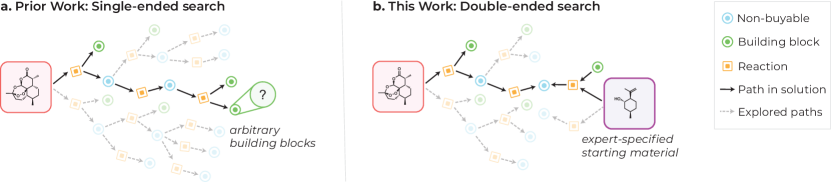
This paper introduces Double-Ended Synthesis Planning (DESP), a bidirectional search algorithm that accelerates synthesis planning under starting material constraints by simultaneously expanding from the target (retrosynthetic) and from specified starting materials (forward). It uses a goal-conditioned synthetic distance network trained on expert reaction trajectories to guide search, achieving higher solve rates and fewer node expansions than prior methods on constrained benchmarks.
Computer-aided synthesis planning (CASP) algorithms have demonstrated expert-level abilities in planning retrosynthetic routes to molecules of low to moderate complexity. However, current search methods assume the sufficiency of reaching arbitrary building blocks, failing to address the common real-world constraint where using specific molecules is desired. To this end, we present a formulation of synthesis planning with starting material constraints. Under this formulation, we propose Double-Ended Synthesis Planning (DESP), a novel CASP algorithm under a bidirectional graph search scheme that interleaves expansions from the target and from the goal starting materials to ensure constraint satisfiability. The search algorithm is guided by a goal-conditioned cost network learned offline from a partially observed hypergraph of valid chemical reactions. We demonstrate the utility of DESP in improving solve rates and reducing the number of search expansions by biasing synthesis planning towards expert goals on multiple new benchmarks. DESP can make use of existing one-step retrosynthesis models, and we anticipate its performance to scale as these one-step model capabilities improve.
Motivation & Objective
- To address the gap in computer-aided synthesis planning (CASP) where existing algorithms do not handle real-world constraints requiring specific starting materials.
- To formulate synthesis planning with starting material constraints as a double-ended search problem, reflecting practical use cases like semi-synthesis and sustainable feedstock utilization.
- To develop a bidirectional search algorithm that interleaves retrosynthetic and forward expansions while ensuring constraint satisfaction.
- To train a goal-conditioned cost network (synthetic distance network) offline from reaction data to guide search toward expert-specified goals without reinforcement learning.
- To release new benchmarks for evaluating constrained synthesis planning, including real-world data from the Pistachio database to address redundancies in existing datasets.
Proposed method
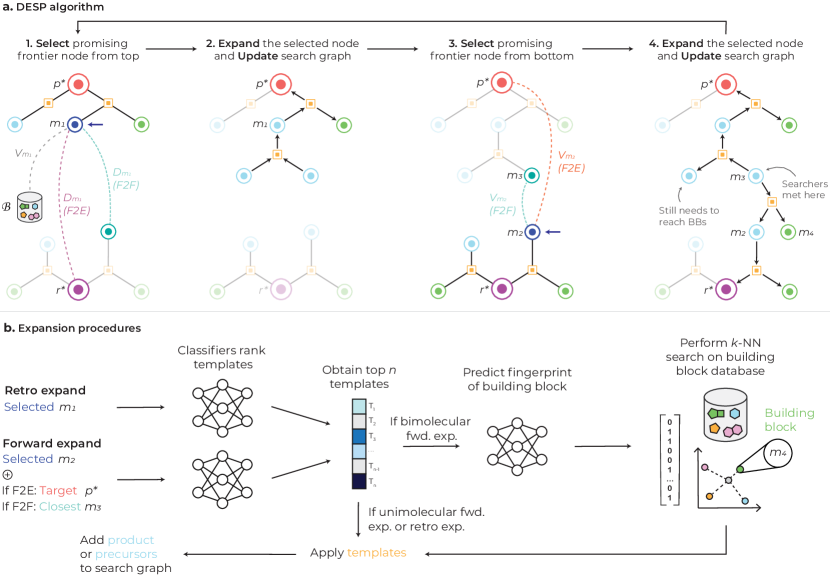
- DESP employs a bidirectional AND-OR graph search, expanding from the target molecule (retrosynthesis) and from specified starting materials (forward synthesis) in an interleaved manner.
- Two variants are proposed: F2E (front-to-end), where each search is conditioned on the root of the opposing graph, and F2F (front-to-front), where nodes are selected based on proximity to the opposing graph.
- A synthetic distance network is trained offline using expert reaction trajectories, estimating the distance from any molecule to a specified goal molecule, bypassing the need for self-play RL.
- The network is trained on positive pairs (molecules connected via known reaction paths) and negative pairs (molecules with no known path), using a contrastive loss objective.
- Forward expansions use k-NN search over 23M building blocks via Faiss with 256D Morgan fingerprints and product quantization for speed and memory efficiency.
- The algorithm integrates with existing one-step retrosynthesis models, using their plausibility scores to compute action costs as $-\log p$.
Experimental results
Research questions
- RQ1Can a bidirectional search strategy improve solve rates and reduce search effort in synthesis planning when constrained to use specific starting materials?
- RQ2How effective is a goal-conditioned synthetic distance network trained on expert reaction data in guiding search toward desired starting materials without reinforcement learning?
- RQ3Does double-ended search outperform single-ended or unidirectional approaches in terms of node expansions and solution quality under starting material constraints?
- RQ4To what extent do the proposed benchmarks, derived from real-world data, reveal limitations in existing CASP algorithms under constrained conditions?
- RQ5Can the integration of a pre-trained one-step model with a bidirectional search framework lead to more efficient and accurate synthesis planning?
Key findings
- DESP achieves higher solve rates than existing methods on constrained benchmarks, including the new Pistachio-based dataset, which addresses redundancies in the USPTO-190 test set.
- DESP reduces the number of node expansions required to find solutions, demonstrating improved search efficiency compared to baseline algorithms like Retro* and GRASP.
- The F2E variant of DESP finds shorter routes on average than F2F, suggesting that conditioning on the root of the opposing graph leads to better route quality.
- The synthetic distance network, trained without reinforcement learning, effectively guides search toward expert-specified starting materials, improving constraint satisfaction.
- The use of GPU-accelerated k-NN search over 23 million building blocks enables fast forward expansion, with forward steps taking ~50% more time than retro steps due to template reversibility checks.
- Despite limitations in handling convergent routes due to the unidirectional nature of the forward search, DESP demonstrates strong empirical performance and scalability with improved one-step models.
Read this paper
Open the full text in the Nubint reader and ask about any passage as you read.
Read this paper on NubintThis review was generated by AI from the original paper. Please check the paper before citing it.