
[Paper Review] Dynamics and Resilience of the Charge Density Wave in a bilayer kagome metal
The paper uses ARPES, DFT, and time-resolved optical spectroscopy to show that the CDW in bilayer ScV6Sn6 is predominantly lattice-driven with marginal electronic gaps, featuring a ~1.42 THz amplitude mode that persists under high photoexcitation.
Long-range electronic order descending from a metallic parent state constitutes a rich playground to study the intricate interplay of structural and electronic degrees of freedom. With dispersive and correlation features as multifold as topological Dirac-like itinerant states, van-Hove singularities, correlated flat bands, and magnetic transitions at low temperature, kagome metals are located in the most interesting regime where both phonon and electronically mediated couplings are significant. Several of these systems undergo a charge density wave (CDW) transition, and the van-Hove singularities, which are intrinsic to the kagome tiling, have been conjectured to play a key role in mediating such an instability. However, to date, the origin and the main driving force behind this charge order is elusive. Here, we use the topological bilayer kagome metal ScV6Sn6 as a platform to investigate this puzzling problem, since it features both kagome-derived nested Fermi surface and van-Hove singularities near the Fermi level, and a CDW phase that affects the susceptibility, the neutron scattering, and the specific heat, similarly to the siblings AV3Sb5 (A = K, Rb, Cs) and FeGe. We report on our findings from high-resolution angle-resolved photoemission, density functional theory, and time-resolved optical spectroscopy to unveil the dynamics of its CDW phase. We identify the structural degrees of freedom to play a fundamental role in the stabilization of charge order. Along with a comprehensive analysis of the subdominant impact from electronic correlations, we find ScV6Sn6 to feature an instance of charge density wave order that predominantly originates from phonons. As we shed light on the emergent phonon profile in the low-temperature ordered regime, our findings pave the way for a deeper understanding of ordering phenomena in all CDW kagome metals.
Motivation & Objective
- Investigate the origin and driving forces of the CDW in the bilayer kagome metal ScV6Sn6.
- Characterize how structural (lattice) and electronic degrees of freedom couple during CDW formation and dynamics.
- Determine whether electronic gaps open at the Fermi level and assess spectral weight changes across the CDW transition.
Proposed method
- High-resolution ARPES to map electronic structure above and below TCDW along high-symmetry directions.
- Density functional theory calculations to predict band structure, van-Hove singularities, and CDW-induced gaps.
- Time-resolved optical spectroscopy to probe the dynamics of electronic and lattice responses and extract relaxation times and amplitudes.
- DFT-based phonon analysis to estimate the CDW amplitude-mode frequency and its temperature dependence.
- Fluence-dependent TR-OS to separate electronic and lattice contributions by observing saturation, damping, and frequency shifts of the amplitude mode.
Experimental results
Research questions
- RQ1Does ScV6Sn6 exhibit substantial Fermi-level gaps upon CDW ordering, or is the CDW primarily mediated by lattice degrees of freedom?
- RQ2What is the role of phonons and electron-phonon coupling in stabilizing the CDW in this bilayer kagome system?
- RQ3How do electronic and lattice responses decouple temporally after photoexcitation, and what does this reveal about the driving mechanism?
- RQ4What is the energy scale of electronic states most coupled to the CDW, and how does this relate to observed optical and ARPES features?
Key findings
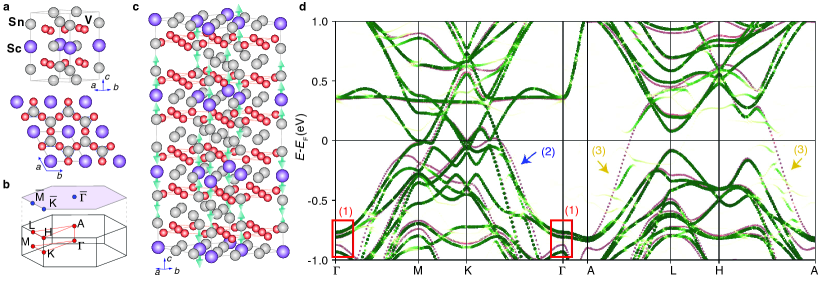
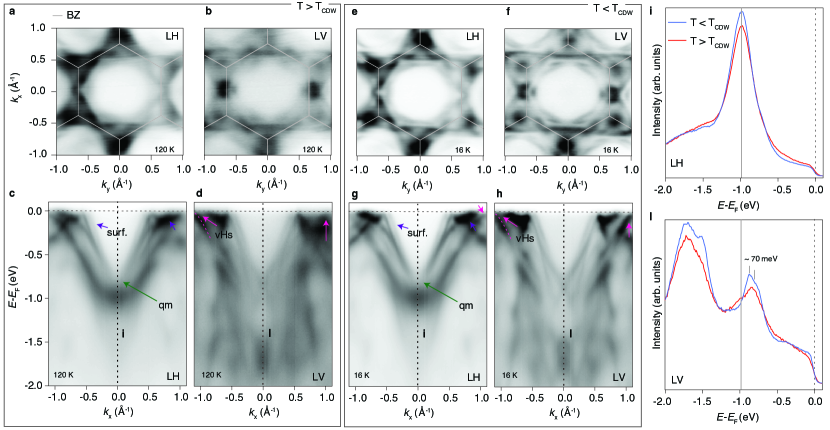
- DFT and ARPES show that the Dirac-like states and van-Hove singularities near EF are largely unaffected by CDW, with major changes localized away from EF along certain k-paths.
- CDW induces several energy gaps along the A-H and A-L directions, but spectral weight remains near the poles of the bands above TCDW, making gaps hard to resolve experimentally.
- TR-OS reveals an amplitude mode at ~1.45 THz with a ~6% softening and increasing damping as T approaches TCDW, consistent with CDW AM behavior.
- Incoherent electronic relaxation (tau1) increases with temperature and does not diverge at TCDW, indicating a non-conventional, lattice-robust CDW mechanism.
- Fluence-dependent measurements show electronic parts saturate at moderate fluence, while AM oscillations persist up to ~700 μJ/cm2 and disappear only near ~1000 μJ/cm2, signaling strong lattice resilience.
Read this paper
Open the full text in the Nubint reader and ask about any passage as you read.
Read this paper on NubintThis review was generated by AI from the original paper. Please check the paper before citing it.