
[Paper Review] Earliest Galaxies in the JADES Origins Field: Luminosity Function and Cosmic Star-Formation Rate Density 300 Myr after the Big Bang
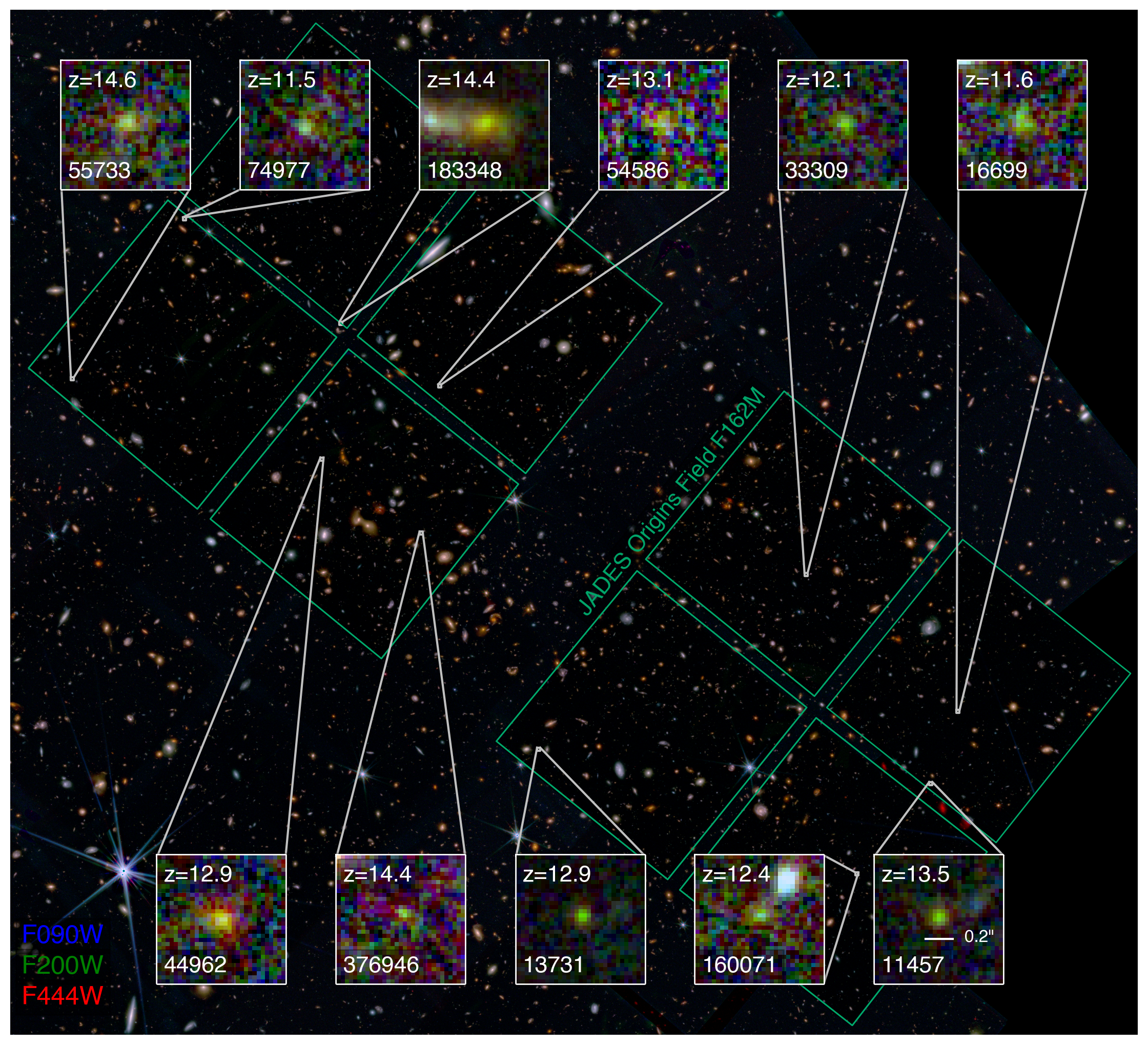
The study uses JWST/JADES Origins Field data to identify eight galaxy candidates at z = 11.5–15, forward-model the evolving UV luminosity function, and constrain the cosmic star-formation rate density up to z ~ 14–15.
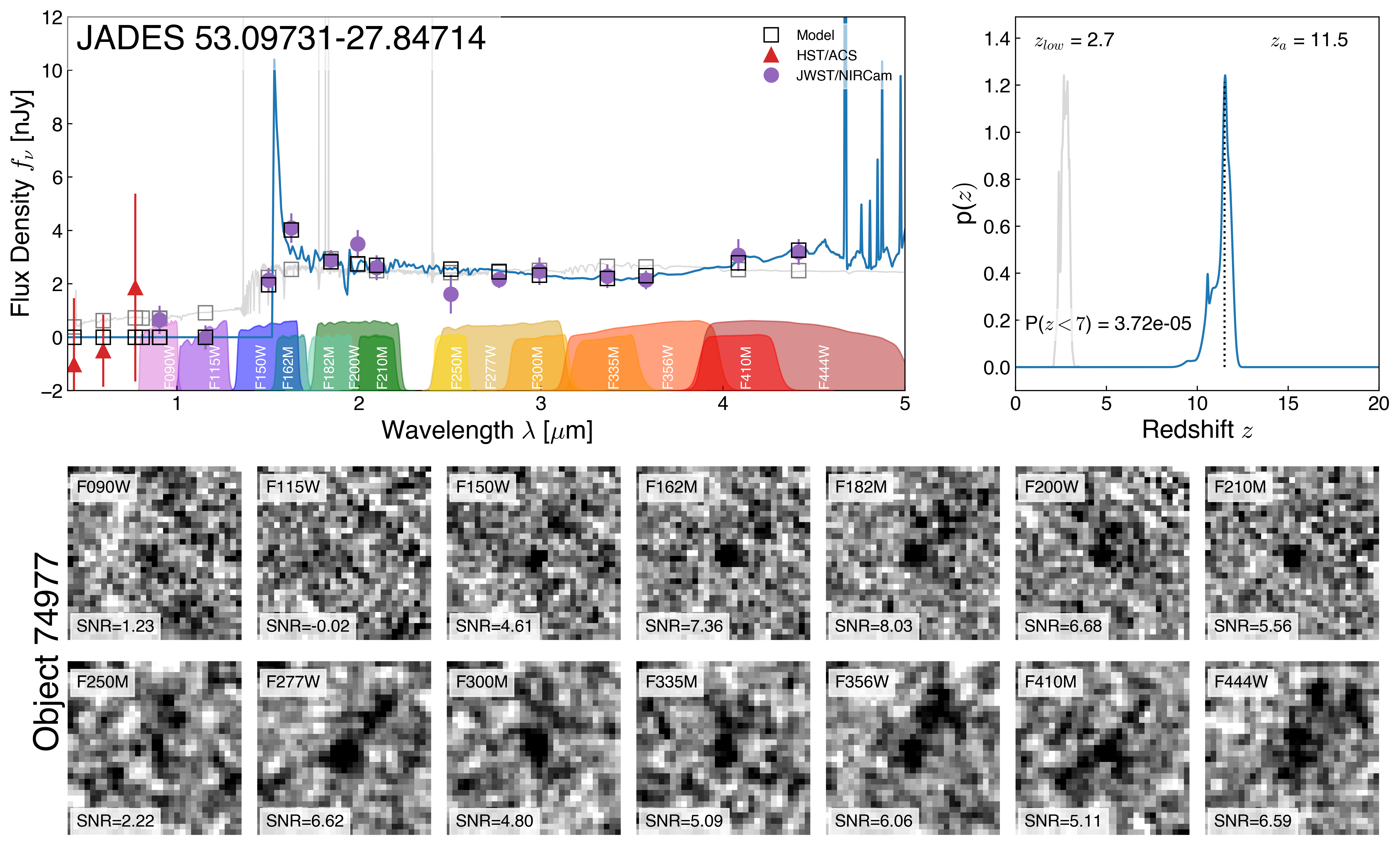
We characterize the earliest galaxy population in the JADES Origins Field (JOF), the deepest imaging field observed with JWST. We make use of the ancillary Hubble optical images (5 filters spanning $0.4-0.9μ\mathrm{m}$) and novel JWST images with 14 filters spanning $0.8-5μ\mathrm{m}$, including 7 medium-band filters, and reaching total exposure times of up to 46 hours per filter. We combine all our data at $>2.3μ\mathrm{m}$ to construct an ultradeep image, reaching as deep as $\approx31.4$ AB mag in the stack and 30.3-31.0 AB mag ($5σ$, $r=0.1"$ circular aperture) in individual filters. We measure photometric redshifts and use robust selection criteria to identify a sample of eight galaxy candidates at redshifts $z=11.5-15$. These objects show compact half-light radii of $R_{1/2}\sim50-200$pc, stellar masses of $M_{\star}\sim10^7-10^8 M_{\odot}$, and star-formation rates of $\mathrm{SFR}\sim0.1-1\,M_{\odot}\,\mathrm{yr}^{-1}$. Our search finds no candidates at $15
Motivation & Objective
- Characterize the earliest galaxy population in the JADES Origins Field (JOF) using JWST and ancillary HST data.
- Measure photometric redshifts and select robust z>11 galaxy candidates with minimal contamination.
- Forward-model the evolving UV luminosity function without redshift or luminosity binning.
- Infer the UV luminosity density and its evolution to z~20 and discuss implications for early structure formation.
Proposed method
- Combine 14-filter JWST/NIRCam imaging (0.8–5 μm) with HST optical data (0.4–0.9 μm) to create the deepest imaging at >2 μm.
- Perform photometric redshift estimation with EAZY using templates that include strong emission lines and various UV continua.
- Apply stringent high-z selection criteria to identify robust z>11 candidates while accounting for non-detections.
- Forward-model the galaxy population to infer the evolving luminosity function, marginalizing over photometric redshift uncertainties.
- Model surface brightness profiles with Forcepho to extract structural parameters (e.g., half-light radius).
- Validate photometry via zeropoint checks, PSF modeling, and cross-checks with independent HST reductions.
Experimental results
Research questions
- RQ1What is the abundance and properties of galaxies at z>12 in the JOF given the deepest JWST/NIRCam data?
- RQ2How does the UV luminosity function evolve from z~12 to higher redshifts (z~14–20)?
- RQ3What is the corresponding UV luminosity density and implied cosmic star-formation rate density in the earliest epochs?
- RQ4Do the observed abundances align with predictions from dark matter halo mass function evolution and galaxy formation models?
Key findings
- Identified eight galaxy candidates at z=11.5–15 within the JOF Main Sample after quality cuts.
- Measured compact half-light radii of R1/2 ~ 50–200 pc and stellar masses M⋆ ~ 10^7–10^8 Msun with star-formation rates ~0.1–1 Msun yr^−1.
- No candidates found at 15<z<20, yielding upper limits in this redshift range.
- Forward-modeling indicates the z=12 UV luminosity function is in good agreement with prior results, and the UV luminosity density declines by a factor of ~2.5 from z=12 to z=14.
- The inferred luminosity function normalization evolves with redshift, informing the early growth of the galaxy population and its connection to the dark matter halo mass function.
- Field-area considerations: effective survey area after quality cuts is approximately 7.06 square arcminutes, with auxiliary/contributing samples at lower redshifts.
Read this paper
Open the full text in the Nubint reader and ask about any passage as you read.
Read this paper on NubintThis review was generated by AI from the original paper. Please check the paper before citing it.