
[Paper Review] Efficient Long-Range Entanglement using Dynamic Circuits
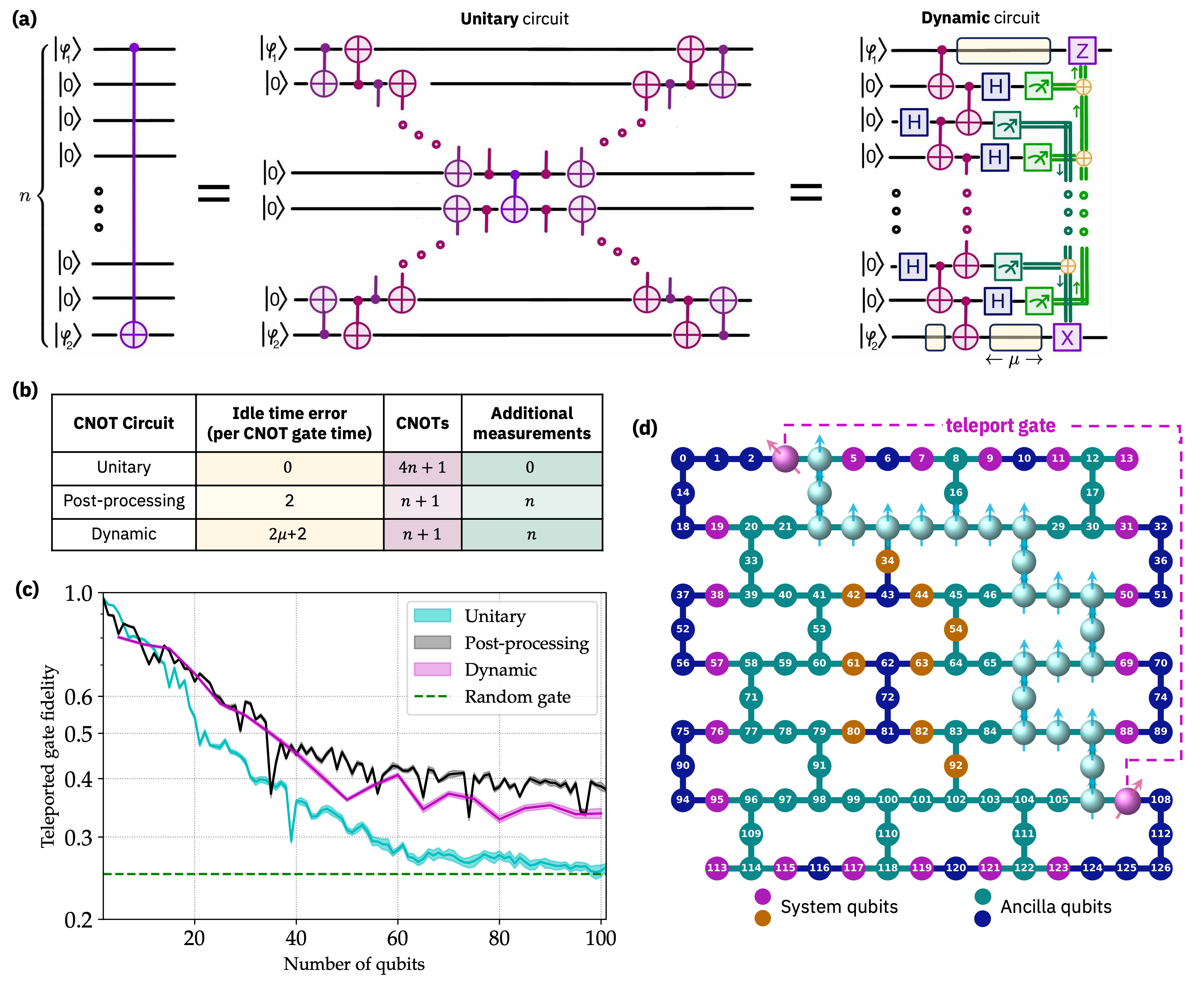
The paper demonstrates shallow dynamic circuits with mid-circuit measurements and feed-forward to achieve long-range entanglement, showing CNOT gate teleportation over up to 101 qubits and GHZ state preparation with a detailed error budget.
Quantum simulation traditionally relies on unitary dynamics, inherently imposing efficiency constraints on the generation of intricate entangled states. In principle, these limitations can be superseded by non-unitary, dynamic circuits. These circuits exploit measurements alongside conditional feed-forward operations, providing a promising approach for long-range entangling gates, higher effective connectivity of near-term hardware, and more efficient state preparations. Here, we explore the utility of shallow dynamic circuits for creating long-range entanglement on large-scale quantum devices. Specifically, we study two tasks: CNOT gate teleportation between up to 101 qubits by feeding forward 99 mid-circuit measurement outcomes, and the preparation of Greenberger-Horne-Zeilinger (GHZ) states with genuine entanglement. In the former, we observe that dynamic circuits can outperform their unitary counterparts. In the latter, by tallying instructions of compiled quantum circuits, we provide an error budget detailing the obstacles that must be addressed to unlock the full potential of dynamic circuits. Looking forward, we expect dynamic circuits to be useful for generating long-range entanglement in the near term on large-scale quantum devices.
Motivation & Objective
- Motivate dynamic circuits as a non-unitary alternative to unitary evolution for generating long-range entanglement on noisy, large-scale quantum devices.
- Demonstrate CNOT gate teleportation across long qubit chains (up to 101 qubits) using mid-circuit measurements and feed-forward.
- Investigate preparation of GHZ states with dynamic circuits and quantify the obstacles via an error budget.
- Provide an analysis of when dynamic circuits outperform unitary circuits and outline conditions for practical advantages.
Proposed method
- Describe and implement a dynamic circuit for long-range CNOT gate teleportation with n mid-circuit measurements and an ancilla bus.
- Compare dynamic-circuit teleportation to unitary decompositions, using an error budget to predict regimes of advantage.
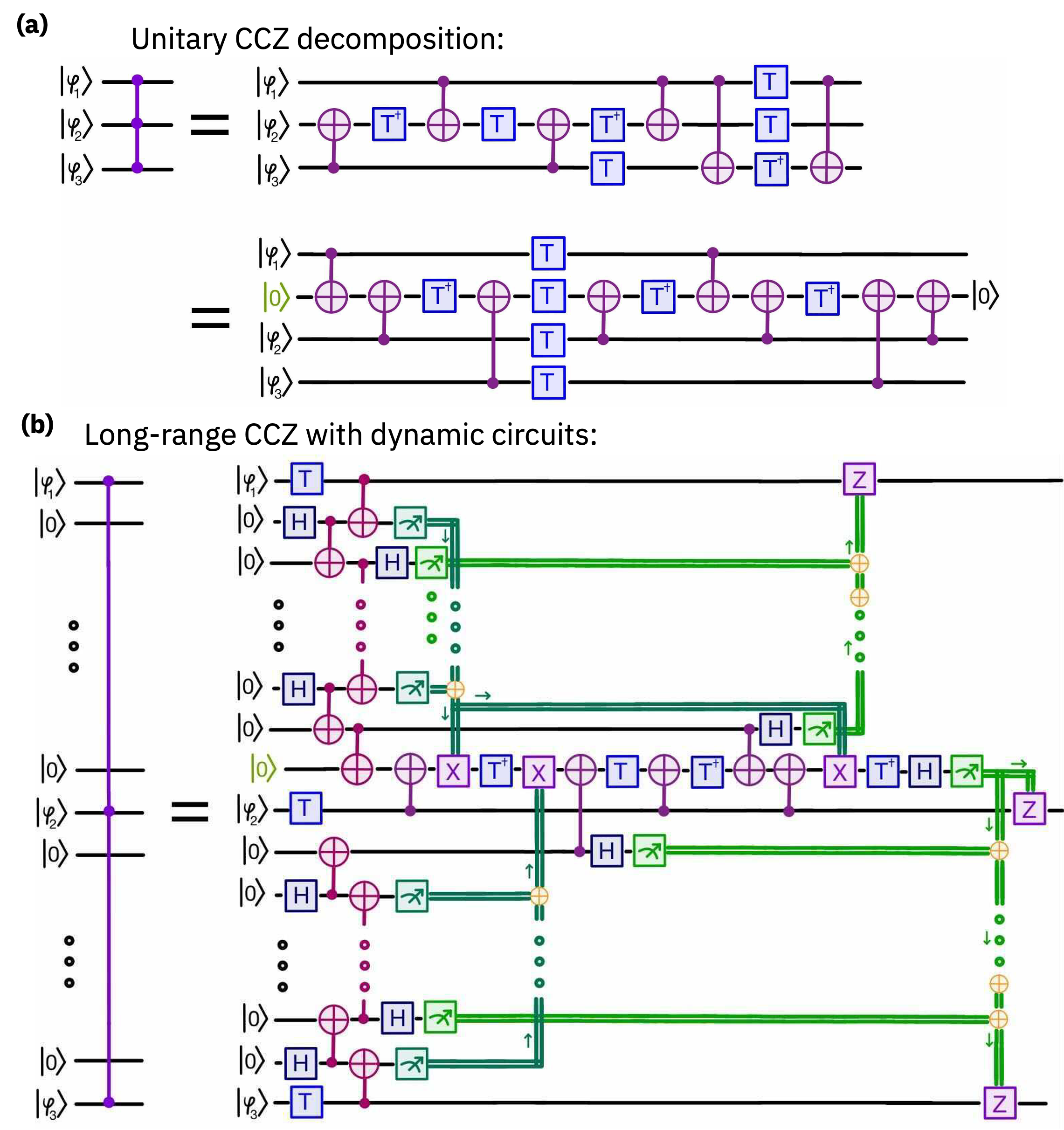
- Generalize the approach to multi-qubit gates such as CCZ/Toffoli via teleported CNOTs.
- Prepare GHZ states with dynamic circuits and apply error mitigation to assess genuine multipartite entanglement.
- Use Monte Carlo process certification and Pauli-based state certification to estimate fidelities and entanglement.
Experimental results
Research questions
- RQ1Can shallow dynamic circuits with mid-circuit measurements outperform unitary circuits for long-range entanglement generation?
- RQ2What is the fidelity regime for CNOT gate teleportation across increasingly long qubit distances on a superconducting processor?
- RQ3To what extent can dynamic circuits enable GHZ state preparation with genuine multipartite entanglement on large devices?
- RQ4What are the main hardware- and protocol-related obstacles that limit the practical advantage of dynamic circuits, and how can they be mitigated?
Key findings
- Dynamic circuits can outperform unitary circuits for CNOT gate teleportation when entangling qubits over long distances (up to 101 qubits observed).
- The measured fidelity of the dynamic CNOT teleported gates converges to values near 0.4, consistent with the derived error budget.
- GHZ-state preparation with dynamic circuits demonstrates genuine multipartite entanglement up to 6 qubits unmitigated and up to 17 qubits with dynamical decoupling for unitary circuits; dynamic circuits show improvements but no clear crossing advantage under current conditions.
- An error-budget analysis highlights idle time, mid-circuit measurements, and feed-forward as key contributors to performance, and suggests near-term conditions under which dynamic circuits will be advantageous.
- The work outlines that dynamic circuits provide effective all-to-all connectivity by using ancilla qubits as a bus, enabling long-range entanglement on devices with limited connectivity.
Read this paper
Open the full text in the Nubint reader and ask about any passage as you read.
Read this paper on NubintThis review was generated by AI from the original paper. Please check the paper before citing it.