
[Paper Review] Efficient quantum algorithm for nonlinear reaction-diffusion equations and energy estimation
This paper presents an efficient quantum algorithm for solving nonlinear reaction-diffusion equations using an improved Carleman linearization technique that leverages the ℓ∞ norm to define a milder convergence condition, R_D < 1, which is independent of spatial grid size. The method enables quantum speedup for solving high-dimensional PDEs and allows postprocessing to estimate kinetic energy from derivative information in the solution state.
Nonlinear differential equations exhibit rich phenomena in many fields but are notoriously challenging to solve. Recently, Liu et al. [1] demonstrated the first efficient quantum algorithm for dissipative quadratic differential equations under the condition $R < 1$, where $R$ measures the ratio of nonlinearity to dissipation using the $\ell_2$ norm. Here we develop an efficient quantum algorithm based on [1] for reaction-diffusion equations, a class of nonlinear partial differential equations (PDEs). To achieve this, we improve upon the Carleman linearization approach introduced in [1] to obtain a faster convergence rate under the condition $R_D < 1$, where $R_D$ measures the ratio of nonlinearity to dissipation using the $\ell_{\infty}$ norm. Since $R_D$ is independent of the number of spatial grid points $n$ while $R$ increases with $n$, the criterion $R_D<1$ is significantly milder than $R<1$ for high-dimensional systems and can stay convergent under grid refinement for approximating PDEs. As applications of our quantum algorithm we consider the Fisher-KPP and Allen-Cahn equations, which have interpretations in classical physics. In particular, we show how to estimate the mean square kinetic energy in the solution by postprocessing the quantum state that encodes it to extract derivative information.
Motivation & Objective
- To develop an efficient quantum algorithm for nonlinear reaction-diffusion equations, a class of PDEs with broad applications in physics, biology, and data science.
- To overcome the limitations of prior quantum algorithms that required a stringent R < 1 condition based on the ℓ2 norm, which worsens with grid refinement.
- To improve the Carleman linearization approach by introducing an ℓ∞-norm-based convergence criterion R_D < 1, ensuring stability under spatial grid refinement.
- To enable quantum computation of classical observables such as mean square kinetic energy through postprocessing of the quantum solution state.
- To explore the feasibility of achieving super-polynomial quantum speedups for classical outputs in nonlinear PDEs using amplitude estimation and derivative state preparation.
Proposed method
- Adapt the Carleman linearization framework to map nonlinear reaction-diffusion equations into an infinite-dimensional linear system, preserving the structure of the original PDE.
- Introduce a new convergence criterion R_D < 1 based on the ℓ∞ norm of the solution, which remains bounded under spatial grid refinement, unlike the ℓ2-based R < 1 condition.
- Use quantum phase estimation and amplitude amplification to prepare a quantum state encoding the solution of the linearized system with complexity poly(log n, T, 1/ε).
- Apply amplitude estimation to extract classical information such as the mean square kinetic energy from the quantum state, which encodes derivative information via a controlled derivative preparation procedure.
- Leverage the maximum principle and solution regularity to ensure boundedness and stability of the solution in the ℓ∞ sense, enabling the new convergence condition.
- Design a quantum algorithm that maintains efficiency under grid refinement by minimizing dependence on the ℓ2 norm of the solution, which typically grows with grid points.
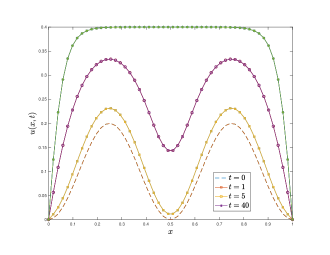
Experimental results
Research questions
- RQ1Can the convergence condition of quantum Carleman linearization be improved to be independent of spatial grid size in PDEs?
- RQ2Does using the ℓ∞ norm instead of the ℓ2 norm for measuring nonlinearity-to-dissipation ratio lead to a more robust and scalable quantum algorithm for reaction-diffusion equations?
- RQ3Can quantum algorithms efficiently estimate classical observables like kinetic energy from the solution state without incurring exponential overhead?
- RQ4Is it possible to achieve super-polynomial quantum speedup for classical outputs in nonlinear PDEs using amplitude estimation and derivative state preparation?
- RQ5How does the algorithm’s performance scale with grid refinement, and can it be made fully insensitive to spatial discretization?
Key findings
- The algorithm achieves a convergence condition R_D < 1 based on the ℓ∞ norm, which is independent of the number of spatial grid points n, making it significantly milder than the ℓ2-based R < 1 condition.
- The complexity scales as O(T²q/(gε) · poly(log T, log n, log 1/ε)), representing a quadratic improvement in time over prior quantum algorithms for nonlinear ODEs.
- The algorithm enables efficient estimation of the mean square kinetic energy by preparing a quantum state encoding derivative information and applying amplitude estimation.
- The method maintains stability and convergence under grid refinement due to the ℓ∞-norm-based criterion, addressing a key limitation of previous approaches.
- The algorithm is applicable to physically relevant equations such as Fisher-KPP and Allen-Cahn, which model phenomena like population dynamics and phase separation.
- The framework suggests a path toward quantum advantage in solving high-dimensional nonlinear PDEs, provided classical outputs can be extracted efficiently via postprocessing.

Read this paper
Open the full text in the Nubint reader and ask about any passage as you read.
Read this paper on NubintThis review was generated by AI from the original paper. Please check the paper before citing it.