
[Paper Review] Enhanced triplet superconductivity in next generation ultraclean UTe2
This study reports enhanced spin-triplet superconductivity in next-generation ultraclean UTe2 crystals grown via a salt flux method, demonstrating a significantly expanded angular region of field-reinforced superconductivity near the hard b-axis. The results reveal that crystalline disorder strongly suppresses magnetic fluctuations responsible for tuning between distinct triplet superconducting phases, with ultraclean samples exhibiting a robust SC2 phase up to 35 T and enhanced field-reinforced behavior due to suppressed disorder-induced scattering.
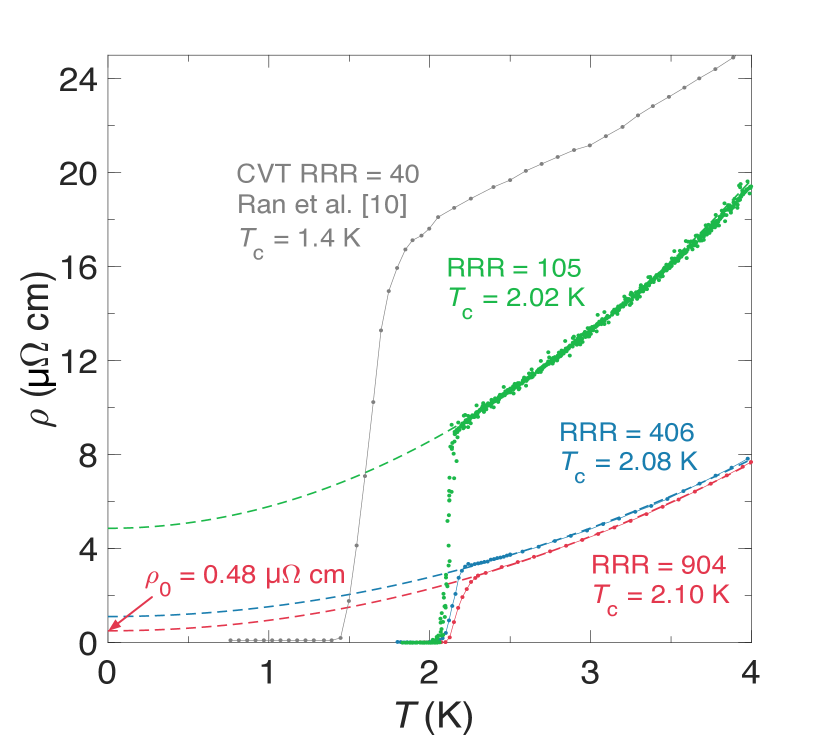
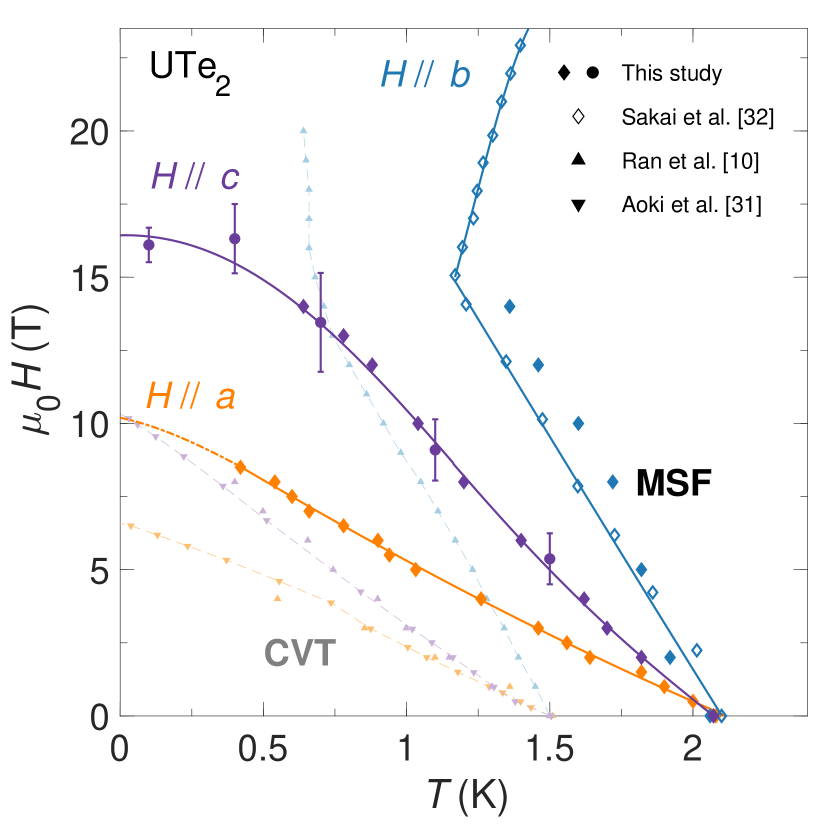
The unconventional superconductor UTe$_2$ exhibits numerous signatures of spin-triplet superconductivity -- a rare state of matter which could enable quantum computation protected against decoherence. UTe$_2$ possesses a complex phase landscape comprising two magnetic field-induced superconducting phases, a metamagnetic transition to a field-polarised state, along with pair- and charge-density wave orders. However, contradictory reports between studies performed on UTe$_2$ specimens of varying quality have severely impeded theoretical efforts to understand the microscopic origins of the exotic superconductivity. Here, we report a comprehensive suite of high magnetic field measurements on a new generation of pristine quality UTe$_2$ crystals. Our experiments reveal a significantly revised high magnetic field superconducting phase diagram in the ultraclean limit, showing a pronounced sensitivity of field-induced superconductivity to the presence of crystalline disorder. We employ a Ginzburg-Landau model that excellently captures this acute dependence on sample quality. Our results suggest that in close proximity to a field--induced metamagnetic transition the enhanced role of magnetic fluctuations -- that are strongly suppressed by disorder -- is likely responsible for tuning UTe$_2$ between two distinct spin-triplet superconducting phases.
Motivation & Objective
- To resolve conflicting reports on UTe2's superconducting properties by studying next-generation ultraclean single crystals.
- To investigate the role of crystalline disorder in suppressing magnetic fluctuations that tune between spin-triplet superconducting phases.
- To characterize the field-reinforced superconducting state (SC2) in high magnetic fields and its angular dependence near the b-axis.
- To establish a link between enhanced superconducting critical temperature and field strength in ultraclean UTe2.
- To clarify the microscopic origin of the field-reinforced superconducting state via comparison with disordered samples.
Proposed method
- High magnetic field resistivity and specific heat measurements were performed on ultraclean UTe2 single crystals grown via a salt flux technique.
- Angle-dependent resistivity measurements were conducted with magnetic field applied near the hard b-axis to map the angular extent of the field-reinforced superconducting state.
- A weak-coupling BCS-type model with field-dependent self-energy corrections was used to describe the superconducting gap function, incorporating disorder via an electron decay rate Γₑ.
- The self-consistency gap equation was derived using Matsubara frequency summation and included both transverse (d⊥) and longitudinal (d∥) components of the order parameter relative to the magnetic field.
- The model incorporated a phenomenological form factor c(θ,φ) to weight the contribution of the parallel component of the order parameter to the gap equation.
- The critical temperature Tc was calculated as a function of magnetic field and disorder strength using the digamma function ψ to account for field and disorder effects on the electron Green’s functions.
Experimental results
Research questions
- RQ1How does crystalline disorder affect the stability and extent of the field-reinforced superconducting phase (SC2) in UTe2 near the b-axis?
- RQ2What is the role of magnetic fluctuations in stabilizing the SC2 phase in high magnetic fields?
- RQ3Why do previous studies report conflicting superconducting transitions in UTe2, and how does sample quality resolve this?
- RQ4To what extent does the upper critical field in UTe2 exceed the Pauli limit, and what does this imply about the pairing symmetry?
- RQ5How does the angular dependence of superconductivity change in ultraclean versus disordered UTe2 samples?
Key findings
- Ultraclean UTe2 crystals exhibit a significantly enhanced field-reinforced superconducting phase (SC2) with a broader angular extent near the b-axis compared to previous samples.
- The critical temperature Tc in the SC2 phase is enhanced in ultraclean crystals, indicating stronger superconducting pairing due to reduced disorder scattering.
- For magnetic fields aligned close to the b-axis, superconductivity persists up to μ₀H ≈ 35 T, consistent with a spin-triplet pairing mechanism robust against Pauli paramagnetic limiting.
- The angular extent of the field-reinforced SC2 phase is markedly increased in ultraclean crystals, suggesting that magnetic fluctuations—suppressed by disorder—are key to stabilizing this phase.
- The suppression of magnetic fluctuations by disorder is directly linked to the disappearance or weakening of the field-reinforced superconducting state, as evidenced by the contrast with earlier disordered samples.
- Theoretical modeling using a field- and disorder-dependent gap equation with a phenomenological form factor c(θ,φ) successfully reproduces the observed angular and field dependence of Tc, confirming the role of magnetic fluctuations in tuning the superconducting state.
Read this paper
Open the full text in the Nubint reader and ask about any passage as you read.
Read this paper on NubintThis review was generated by AI from the original paper. Please check the paper before citing it.