
[Paper Review] Enhancing Multivariate Time Series-based Solar Flare Prediction with Multifaceted Preprocessing and Contrastive Learning
This paper proposes a multifaceted preprocessing pipeline and a novel contrastive learning-based GRU classifier (ContReg) to enhance multivariate time series-based solar flare prediction. By integrating missing value imputation, normalization, SMOTE-RUS sampling, near-decision-boundary sample removal, feature selection, and a dual-loss GRU architecture, the method achieves a mean True Skill Statistic (TSS) of 0.846, significantly outperforming prior approaches.
Accurate solar flare prediction is crucial due to the significant risks that intense solar flares pose to astronauts, space equipment, and satellite communication systems. Our research enhances solar flare prediction by utilizing advanced data preprocessing and classification methods on a multivariate time series-based dataset of photospheric magnetic field parameters. First, our study employs a novel preprocessing pipeline that includes missing value imputation, normalization, balanced sampling, near decision boundary sample removal, and feature selection to significantly boost prediction accuracy. Second, we integrate contrastive learning with a GRU regression model to develop a novel classifier, termed ContReg, which employs dual learning methodologies, thereby further enhancing prediction performance. To validate the effectiveness of our preprocessing pipeline, we compare and demonstrate the performance gain of each step, and to demonstrate the efficacy of the ContReg classifier, we compare its performance to that of sequence-based deep learning architectures, machine learning models, and findings from previous studies. Our results illustrate exceptional True Skill Statistic (TSS) scores, surpassing previous methods and highlighting the critical role of precise data preprocessing and classifier development in time series-based solar flare prediction.
Motivation & Objective
- Address the critical challenge of accurate solar flare prediction to mitigate risks to space assets and astronauts.
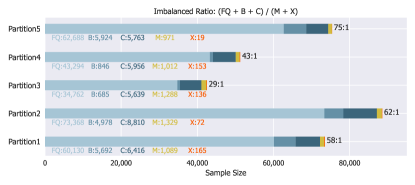
- Overcome inherent data quality issues in the SWAN-SF multivariate time series dataset, including missing values, class imbalance, and feature redundancy.
- Develop a robust preprocessing pipeline that systematically improves model generalization and performance on imbalanced, noisy solar flare data.
- Design a novel deep learning classifier, ContReg, that leverages both contrastive and regression learning to enhance classification of flare intensity and peak flux.
- Demonstrate superior performance over existing machine learning and deep learning models across multiple train-test splits of the SWAN-SF dataset.
Proposed method
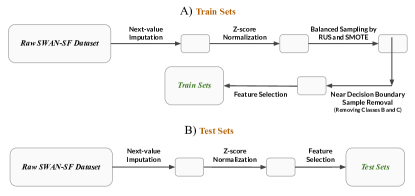
- Implement a hybrid missing value imputation strategy combining next-value and previous-value techniques to preserve temporal continuity.
- Apply global z-score normalization to standardize multivariate magnetic field parameters across the time series.
- Employ SMOTE and random under-sampling (RUS) for balanced sampling to mitigate class imbalance in flare intensity classes.
- Introduce near-decision-boundary sample removal (NDBSR) to eliminate ambiguous training samples near classification boundaries.
- Conduct GRU-based feature importance analysis to perform informed feature selection, reducing noise and improving model efficiency.
- Develop ContReg, a dual-branch GRU model combining triplet loss for contrastive learning and mean squared error loss for regression, with an integrated loss function that jointly optimizes flare category and peak flux prediction.
Experimental results
Research questions
- RQ1To what extent does a comprehensive preprocessing pipeline improve solar flare prediction performance on the SWAN-SF dataset?
- RQ2How does each component of the preprocessing pipeline (imputation, normalization, sampling, NDBSR, feature selection) contribute incrementally to the TSS score?
- RQ3Can a contrastive learning-based GRU classifier (ContReg) outperform standard deep learning and traditional machine learning models in multivariate time series solar flare prediction?
- RQ4How does the integration of flare category and peak soft X-ray flux in the loss function enhance classification performance compared to binary classification alone?
- RQ5Does the proposed method maintain consistent performance across different train-test splits of the SWAN-SF dataset?
Key findings
- The complete preprocessing pipeline achieved a mean TSS of 0.801, significantly outperforming Ahmadzadeh et al. (2021) (TSS = 0.613) and Alshammari et al. (2024) (TSS = 0.693).
- Each stage of the preprocessing pipeline contributed incrementally to TSS: from 0.173 (imputation only) to 0.801 (full pipeline), with normalization and balanced sampling being major contributors.
- The NDBSR technique improved TSS by reducing class overlap, demonstrating its value in handling ambiguous training samples.
- The ContReg classifier, when combined with the full preprocessing pipeline, achieved a mean TSS of 0.846 and a mean recall of 0.975, surpassing all prior studies and baseline models.
- The ContReg model consistently outperformed standard RNN, LSTM, GRU, SVM, k-NN, and Random Forest models across all train-test combinations.
- Balanced sampling (SMOTE + RUS) yielded better TSS than SMOTE alone, indicating reduced overfitting and improved generalization in imbalanced data settings.
Read this paper
Open the full text in the Nubint reader and ask about any passage as you read.
Read this paper on NubintThis review was generated by AI from the original paper. Please check the paper before citing it.