
[Paper Review] Eryn : A multi-purpose sampler for Bayesian inference
Eryn is a versatile, open-source Markov Chain Monte Carlo (MCMC) sampler that integrates reversible jump MCMC with parallel tempering to enable efficient Bayesian inference across dynamic parameter spaces, particularly for complex gravitational-wave data analysis. It successfully recovers 8 out of 10 injected ultra-compact binary signals in a simulated LISA-like environment, demonstrating its capability for trans-dimensional sampling in source confusion-limited scenarios.
In recent years, methods for Bayesian inference have been widely used in many different problems in physics where detection and characterization are necessary. Data analysis in gravitational-wave astronomy is a prime example of such a case. Bayesian inference has been very successful because this technique provides a representation of the parameters as a posterior probability distribution, with uncertainties informed by the precision of the experimental measurements. During the last couple of decades, many specific advances have been proposed and employed in order to solve a large variety of different problems. In this work, we present a Markov Chain Monte Carlo (MCMC) algorithm that integrates many of those concepts into a single MCMC package. For this purpose, we have built { t Eryn}, a user-friendly and multipurpose toolbox for Bayesian inference, which can be utilized for solving parameter estimation and model selection problems, ranging from simple inference questions, to those with large-scale model variation requiring trans-dimensional MCMC methods, like the LISA global fit problem. In this paper, we describe this sampler package and illustrate its capabilities on a variety of use cases.
Motivation & Objective
- To develop a general-purpose, user-friendly MCMC toolbox capable of handling complex Bayesian inference problems with dynamic parameter dimensions.
- To address the computational challenge of model selection and parameter estimation in high-dimensional, trans-dimensional problems such as the LISA global fit.
- To enable efficient sampling in scenarios with overlapping signals, such as the confusion foreground from millions of ultra-compact binaries in LISA data.
- To provide a flexible, extensible framework that supports both standard and trans-dimensional MCMC sampling beyond specialized, single-purpose tools.
- To support the development of a full LISA data analysis pipeline capable of resolving individual sources from a dense foreground of overlapping signals.
Proposed method
- Employs a reversible jump MCMC algorithm to enable trans-dimensional moves between models of varying dimensionality, allowing joint inference over model space and parameter space.
- Integrates parallel tempering to enhance mixing and convergence in high-dimensional, multimodal posterior distributions.
- Uses B-spline-based spectral models to enable shape-agnostic inference for unknown signal waveforms, crucial for detecting signals with poorly known morphology.
- Combines iterative search phases with fixed-source modeling to identify and isolate bright sources before applying trans-dimensional sampling to weaker signals.
- Implements dimension-matching techniques and adaptive proposal distributions to ensure smooth transitions between models of different dimensions.
- Leverages the GBGPU package for efficient computation of ultra-compact binary waveforms in the LISA frequency band.
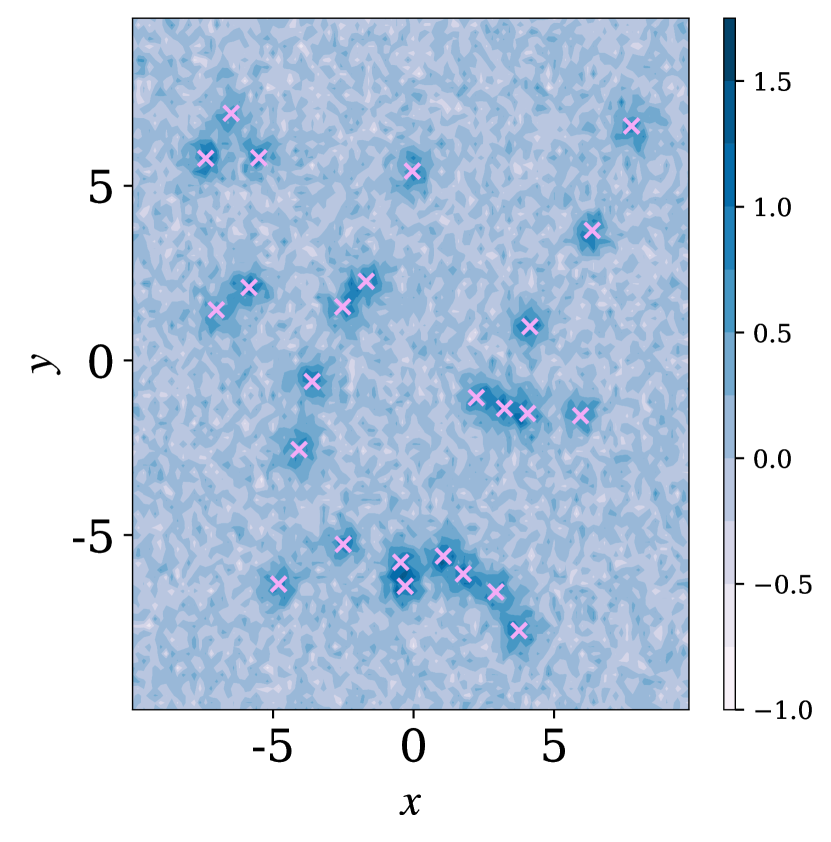
Experimental results
Research questions
- RQ1Can a single, general-purpose MCMC sampler effectively handle both standard parameter estimation and trans-dimensional model selection in complex gravitational-wave data?
- RQ2How well can a reversible jump MCMC sampler with parallel tempering recover weak, overlapping signals in a confusion-limited environment like LISA?
- RQ3What is the performance of a shape-agnostic spectral model (e.g., B-spline) in detecting signals with unknown waveforms in simulated LISA data?
- RQ4Can iterative source extraction followed by trans-dimensional sampling improve convergence and accuracy in dense signal fields?
- RQ5How does Eryn compare to existing specialized tools like bilby in handling dynamic parameter spaces and model selection tasks?
Key findings
- Eryn successfully recovers 8 out of 10 injected ultra-compact binary signals in a simulated one-year LISA observation with a narrowband focus at 4 mHz.
- The sampler achieves robust convergence even in the presence of signal overlap and low signal-to-noise ratios, particularly for sources with optimal SNR below 10.
- The combination of iterative source fixing and reversible jump MCMC enables faster convergence and improved detection of weaker signals in the residual data.
- Eryn’s B-spline-based spectral model enables effective detection of signals with unknown waveforms, demonstrating its utility in shape-agnostic inference.
- The tool outperforms existing libraries like bilby in trans-dimensional sampling tasks, as it is specifically architected for dynamic model space exploration.
- Eryn has already been applied in multiple published and upcoming studies, validating its robustness and versatility in real-world gravitational-wave data analysis.
Read this paper
Open the full text in the Nubint reader and ask about any passage as you read.
Read this paper on NubintThis review was generated by AI from the original paper. Please check the paper before citing it.