
[Paper Review] EVA-CLIP-18B: Scaling CLIP to 18 Billion Parameters
EVA-CLIP-18B is a 18-billion-parameter contrastive language-image pretraining model that achieves state-of-the-art zero-shot accuracy of 80.7% across 27 image classification benchmarks, demonstrating consistent performance gains with model scaling despite using only 6 billion training samples from LAION-2B and COYO-700M. The model leverages EVA-style weak-to-strong visual scaling, achieving SOTA results in image, video, and 3D representation learning with publicly available weights.
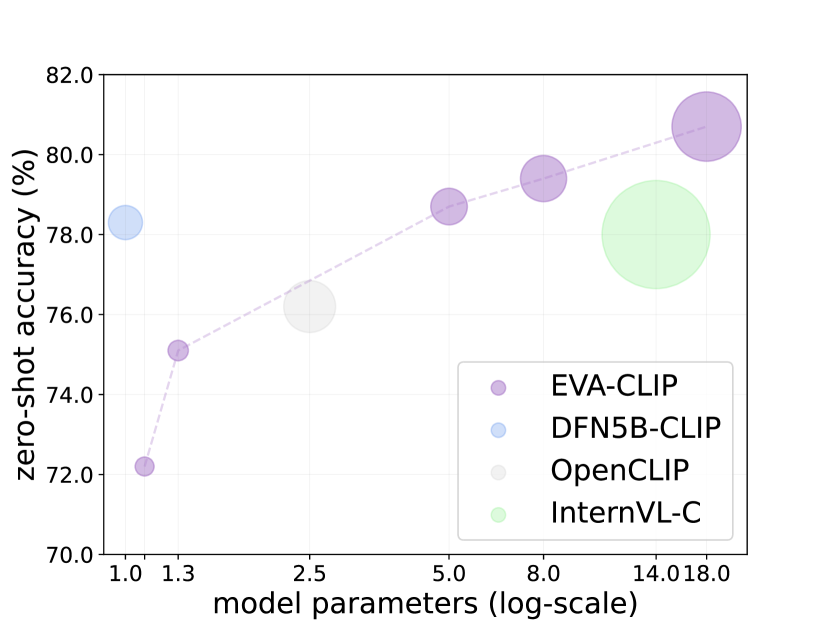
Scaling up contrastive language-image pretraining (CLIP) is critical for empowering both vision and multimodal models. We present EVA-CLIP-18B, the largest and most powerful open-source CLIP model to date, with 18-billion parameters. With only 6-billion training samples seen, EVA-CLIP-18B achieves an exceptional 80.7% zero-shot top-1 accuracy averaged across 27 widely recognized image classification benchmarks, outperforming its forerunner EVA-CLIP (5-billion parameters) and other open-source CLIP models by a large margin. Remarkably, we observe a consistent performance improvement with the model size scaling of EVA-CLIP, despite maintaining a constant training dataset of 2-billion image-text pairs from LAION-2B and COYO-700M. This dataset is openly available and much smaller than the in-house datasets (e.g., DFN-5B, WebLI-10B) employed in other state-of-the-art CLIP models. EVA-CLIP-18B demonstrates the potential of EVA-style weak-to-strong visual model scaling. With our model weights made publicly available, we hope to facilitate future research in vision and multimodal foundation models.
Motivation & Objective
- To scale CLIP models to unprecedented size (18B parameters) while maintaining high performance on diverse vision benchmarks.
- To investigate whether consistent performance gains can be achieved through model scaling without increasing training data size.
- To validate the effectiveness of EVA-style weak-to-strong visual scaling in large-scale contrastive pretraining.
- To demonstrate that larger CLIP models can achieve superior zero-shot performance in image, video, and 3D representation learning.
- To release a powerful, open-source foundation model to accelerate research in vision and multimodal AI.
Proposed method
- The model is trained using a contrastive learning objective on a curated dataset of 2 billion image-text pairs from LAION-2B and COYO-700M, with no in-house data.
- EVA-CLIP-18B employs a vision transformer backbone with 18 billion parameters, trained with a global batch size of 108k on 360 A100 GPUs.
- The model uses a dual-stream architecture with separate vision and text encoders, jointly optimized via contrastive loss to align image and text embeddings.
- Training includes data augmentation and mixed-precision training to improve convergence and efficiency.
- The model is evaluated using zero-shot transfer protocols on 27 image classification, 4 video classification, and 2 retrieval benchmarks.
- The model is fine-tuned and evaluated at multiple resolutions (224×224, 336×336, 448×448) to study resolution effects.
Experimental results
Research questions
- RQ1Does scaling up CLIP models to 18 billion parameters lead to consistent performance gains across diverse vision benchmarks, even with a fixed dataset size?
- RQ2Can EVA-style weak-to-strong visual scaling principles be effectively applied to large-scale CLIP models to achieve SOTA performance?
- RQ3How does the performance of EVA-CLIP-18B compare to other open-source and proprietary CLIP models in zero-shot image, video, and 3D classification?
- RQ4What is the impact of increasing input resolution on zero-shot accuracy for EVA-CLIP-18B and its smaller counterparts?
- RQ5Does incorporating video data during pretraining improve zero-shot video classification performance?
Key findings
- EVA-CLIP-18B achieves a new SOTA zero-shot top-1 accuracy of 80.7% averaged across 27 widely used image classification benchmarks.
- Despite using only 6 billion training samples, EVA-CLIP-18B outperforms its 5-billion-parameter predecessor and other open-source CLIP models by a significant margin.
- The model demonstrates consistent performance improvement with increasing model size, even when training data remains constant at 2 billion image-text pairs.
- In linear probing on ImageNet-1K, EVA-CLIP-18B achieves 88.9% top-1 accuracy, surpassing InternVL-C by 0.7 percentage points.
- In 3D representation learning, EVA-CLIP-18B as a teacher improves zero-shot performance on ModelNet40 and ScanObjectNN, achieving 87.6% and 65.3% top-1 accuracy respectively.
- Adding video data during pretraining improves zero-shot video classification by +0.7 (1-frame) and +0.8 (8-frame) on Kinetics and UCF-101 benchmarks.
Read this paper
Open the full text in the Nubint reader and ask about any passage as you read.
Read this paper on NubintThis review was generated by AI from the original paper. Please check the paper before citing it.