
[Paper Review] Evaluating the World Model Implicit in a Generative Model
The paper formalizes how to evaluate whether generative sequence models recover an underlying deterministic finite automaton (world model) using Myhill-Nerode inspired metrics, and shows standard next-token probes can be misleading across domains like navigation, games, and logic puzzles.
Recent work suggests that large language models may implicitly learn world models. How should we assess this possibility? We formalize this question for the case where the underlying reality is governed by a deterministic finite automaton. This includes problems as diverse as simple logical reasoning, geographic navigation, game-playing, and chemistry. We propose new evaluation metrics for world model recovery inspired by the classic Myhill-Nerode theorem from language theory. We illustrate their utility in three domains: game playing, logic puzzles, and navigation. In all domains, the generative models we consider do well on existing diagnostics for assessing world models, but our evaluation metrics reveal their world models to be far less coherent than they appear. Such incoherence creates fragility: using a generative model to solve related but subtly different tasks can lead to failures. Building generative models that meaningfully capture the underlying logic of the domains they model would be immensely valuable; our results suggest new ways to assess how close a given model is to that goal.
Motivation & Objective
- Formalize world-model evaluation for deterministic finite automata (DFA) underlying real domains (logic, navigation, games, chemistry).
- Propose Myhill-Nerode inspired metrics to assess world-model recovery in sequence models.
- Demonstrate metrics across multiple domains showing fragility of next-token based evaluations.
- Provide open benchmark data and tools for evaluating world-model coherence in generative models.
Proposed method
- Define a DFA-based framework linking generative models to world models.
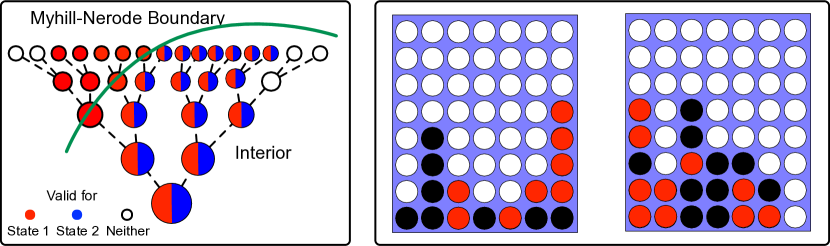
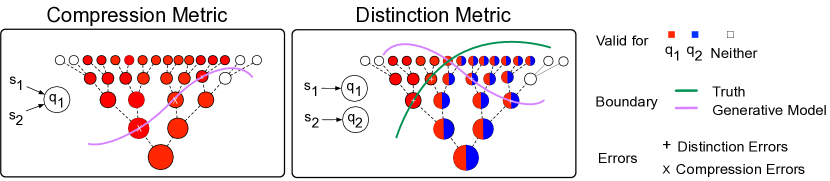
- Introduce two metrics: sequence compression (same state should yield same continuations) and sequence distinction (distinct states should yield distinct continuations).
- Relate exact next-token prediction to recovery of the DFA (Proposition 2.3).
- Apply graph reconstruction to visualize implicit maps recovered by models.
- Use three domains (NYC taxi turn sequences for navigation, Othello, logic puzzles) to illustrate evaluation metrics.
- Provide model-agnostic procedures to compute metrics given access to the true DFA.
Experimental results
Research questions
- RQ1Can a generative sequence model recover the underlying DFA (world model) governing a domain?
- RQ2Are existing next-token or probe-based diagnostics sufficient to assess world-model recovery?
- RQ3Do Myhill-Nerode inspired metrics reveal incoherence or fragility in models that pass traditional diagnostics?
- RQ4How do different data-generating processes (shortest paths, noisy paths, random walks) affect the recovered world model?
- RQ5What is the impact of imperfect world-model recovery on downstream tasks like detour robustness?
Key findings
- Standard next-token diagnostics can be misleading about world-model recovery; models can have valid next-token predictions yet incoherent global structure.
- Two Myhill-Nerode inspired metrics—sequence compression precision and sequence distinction precision—reveal incoherence not captured by existing probes.
- Transformers trained on NYC taxi directions can predict valid next moves and even shortest paths, yet reconstruct maps that are structurally incompatible with the real Manhattan street network.
- Models with incoherent world models show detour fragility: their ability to re-route degrades under detours, unlike some models trained on random walks.
- Across Othello and logic puzzles, models can perform well on traditional metrics while failing to capture the true underlying state structure, illustrating broader fragility of conventional diagnostics.
- The authors provide a dataset and software for evaluating world-model recovery.
Read this paper
Open the full text in the Nubint reader and ask about any passage as you read.
Read this paper on NubintThis review was generated by AI from the original paper. Please check the paper before citing it.