
[Paper Review] Explaining black box text modules in natural language with language models
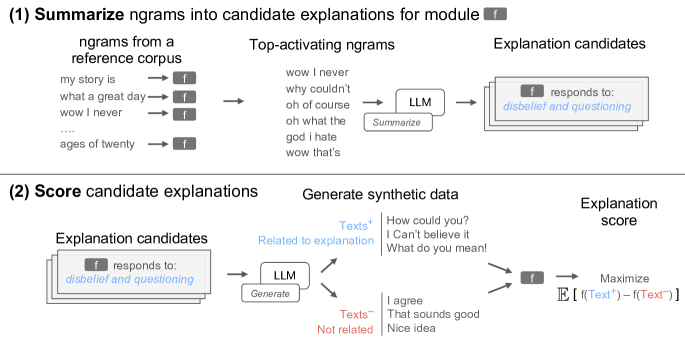
This paper proposes SASC, a method that automatically generates natural language explanations for black-box text modules—functions mapping text to scalar values—using a two-stage process: (1) summarizing high-activating ngrams via a pre-trained language model, and (2) scoring explanations by generating synthetic text and testing module responses. SASC successfully recovers ground-truth explanations in synthetic settings, explains BERT neurons meaningfully, and generates semantically grounded explanations for fMRI voxels, revealing distinct selectivity patterns in brain regions.
Large language models (LLMs) have demonstrated remarkable prediction performance for a growing array of tasks. However, their rapid proliferation and increasing opaqueness have created a growing need for interpretability. Here, we ask whether we can automatically obtain natural language explanations for black box text modules. A "text module" is any function that maps text to a scalar continuous value, such as a submodule within an LLM or a fitted model of a brain region. "Black box" indicates that we only have access to the module's inputs/outputs. We introduce Summarize and Score (SASC), a method that takes in a text module and returns a natural language explanation of the module's selectivity along with a score for how reliable the explanation is. We study SASC in 3 contexts. First, we evaluate SASC on synthetic modules and find that it often recovers ground truth explanations. Second, we use SASC to explain modules found within a pre-trained BERT model, enabling inspection of the model's internals. Finally, we show that SASC can generate explanations for the response of individual fMRI voxels to language stimuli, with potential applications to fine-grained brain mapping. All code for using SASC and reproducing results is made available on Github.
Motivation & Objective
- To address the interpretability crisis in large language models (LLMs) and other black-box text modules, where internal mechanisms remain opaque.
- To develop an automated, black-box method that generates human-readable, natural language explanations for text modules without requiring model internals or human annotation.
- To evaluate the method across diverse domains: synthetic modules, BERT model internals, and fMRI-based brain encoding models.
- To demonstrate that explanations are both semantically meaningful and grounded in actual module behavior, especially in neuroscience applications.
- To provide a scalable, open-source tool for interpretability in high-stakes domains like medicine and cognitive science.
Proposed method
- SASC uses a two-stage pipeline: first, it identifies top-activating ngrams from a corpus and summarizes them into candidate explanations using a pre-trained language model.
- Second, it evaluates each candidate by generating synthetic text based on the explanation and measuring the target module’s response to it, assigning a reliability score.
- The method uses a helper LLM for summarization and text generation, with the goal of reducing hallucination by decoupling explanation generation from evaluation.
- It applies dictionary learning to extract interpretable components from BERT, then uses SASC to explain individual neurons or submodules.
- For fMRI, SASC explains individual voxel responses by treating each voxel’s response as a text module, using narrative or WikiText as the ngram corpus.
- Explanation reliability is scored via response consistency: higher scores indicate that the explanation reliably predicts strong module activation.
Experimental results
Research questions
- RQ1Can SASC automatically generate accurate, natural language explanations for black-box text modules without access to internal model parameters?
- RQ2How well does SASC recover ground-truth explanations in synthetic modules with known underlying patterns?
- RQ3Can SASC produce explanations for BERT neurons that are comparable in quality to human-annotated explanations, and do they align with downstream task semantics?
- RQ4Do explanations for fMRI voxels reflect meaningful semantic selectivity, and do they differ from those of BERT modules?
- RQ5Can SASC-generated explanations predict actual fMRI responses, even with minimal overlap in ngrams?
Key findings
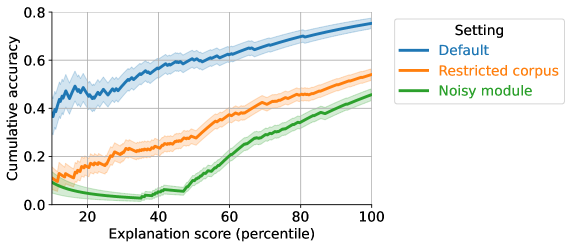
- In synthetic modules, SASC recovered ground-truth explanations with high accuracy across multiple experimental conditions, demonstrating strong fidelity.
- For BERT modules, SASC explanations were of comparable quality to human-annotated explanations, with many capturing task-relevant semantics such as sentiment or named entities.
- BERT modules showed selectivity for diverse phenomena, from individual words to abstract semantic concepts, consistent with known linguistic roles.
- fMRI voxel explanations were significantly more focused on social concepts (e.g., relationships, family) than BERT module explanations, suggesting distinct functional organization in the brain.
- The explanation score remained significantly above zero for fMRI voxels, indicating reliable explanation quality.
- A simple distance-based prediction using explanation text achieved a Spearman correlation of 0.033 ± 0.002 with actual fMRI responses, which was significantly above zero (p < 0.001), showing grounding in real brain activity.
Read this paper
Open the full text in the Nubint reader and ask about any passage as you read.
Read this paper on NubintThis review was generated by AI from the original paper. Please check the paper before citing it.