
[Paper Review] Exploring Multimodal Approaches for Alzheimer's Disease Detection Using Patient Speech Transcript and Audio Data
This study proposes a multimodal framework for Alzheimer’s disease (AD) detection using patient speech transcripts and audio, leveraging BERT, Graph Neural Networks (GNN), and WavLM for feature extraction. It introduces a CLIPPO-like contrastive learning method that aligns text-to-speech (TTS) audio with raw audio, achieving the highest accuracy of 84.84% on the DementiaBank Pitt dataset, outperforming unimodal and standard multimodal fusion approaches.
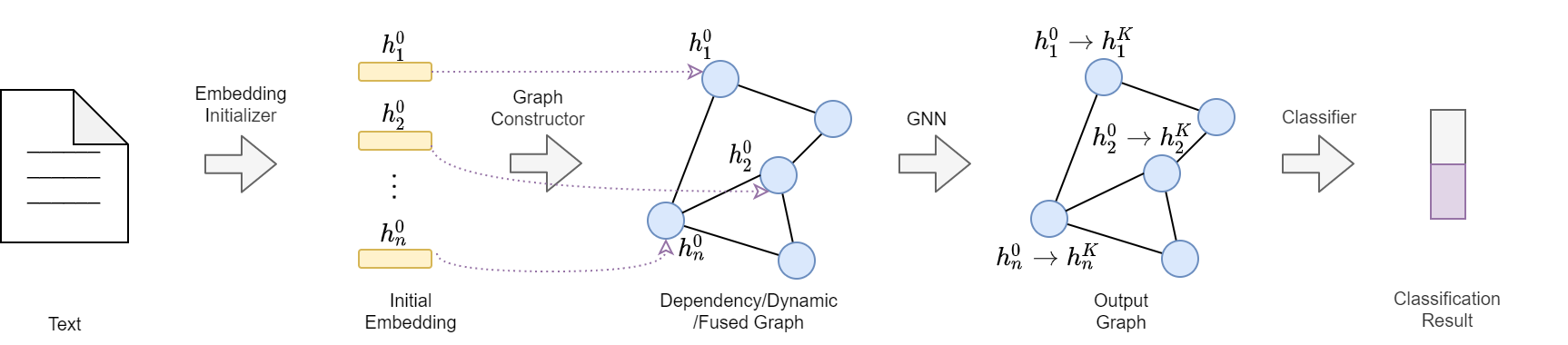
Alzheimer's disease (AD) is a common form of dementia that severely impacts patient health. As AD impairs the patient's language understanding and expression ability, the speech of AD patients can serve as an indicator of this disease. This study investigates various methods for detecting AD using patients' speech and transcripts data from the DementiaBank Pitt database. The proposed approach involves pre-trained language models and Graph Neural Network (GNN) that constructs a graph from the speech transcript, and extracts features using GNN for AD detection. Data augmentation techniques, including synonym replacement, GPT-based augmenter, and so on, were used to address the small dataset size. Audio data was also introduced, and WavLM model was used to extract audio features. These features were then fused with text features using various methods. Finally, a contrastive learning approach was attempted by converting speech transcripts back to audio and using it for contrastive learning with the original audio. We conducted intensive experiments and analysis on the above methods. Our findings shed light on the challenges and potential solutions in AD detection using speech and audio data.
Motivation & Objective
- To develop a low-cost, non-invasive diagnostic method for early Alzheimer’s disease (AD) detection using patient speech and transcripts.
- To address the challenge of small dataset size in AD research through effective data augmentation techniques.
- To explore multimodal fusion of textual and audio features for improved AD classification performance.
- To investigate whether contrastive learning using TTS-generated audio can enhance model understanding of speech patterns in AD patients.
- To provide a foundation for future multimodal AD detection systems using diverse patient data.
Proposed method
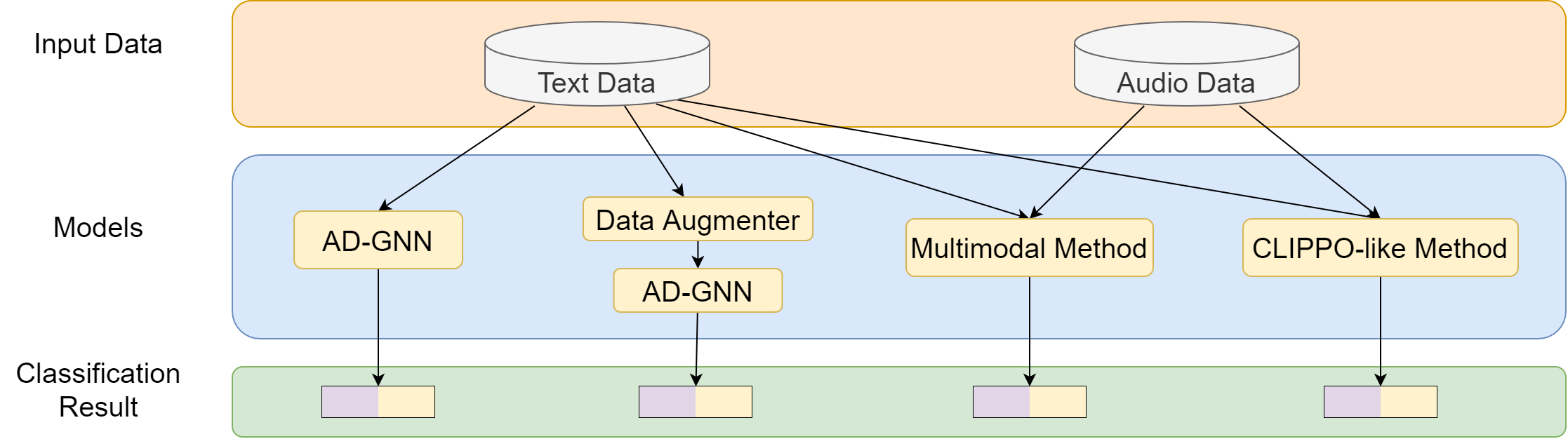
- A GNN-based method (AD-GNN) was developed to extract structural linguistic features from transcribed speech using BERT embeddings and graph convolutional networks.
- Data augmentation techniques, including synonym replacement, sentence deletion, and GPT-3.5-based generation, were applied to increase training data diversity and mitigate class imbalance.
- Audio features were extracted using the WavLM model, a self-supervised pre-trained speech representation model.
- Multimodal fusion was performed via direct concatenation, cross-network attention, and a CLIPPO-like contrastive learning framework that aligns raw audio with TTS-generated audio.
- The CLIPPO-like method enables joint embedding learning between raw and synthetic speech, improving semantic alignment without relying on pre-trained language models.
- Extensive experiments were conducted on the DementiaBank Pitt dataset, comparing unimodal (text, audio) and multimodal approaches with varying fusion strategies.
Experimental results
Research questions
- RQ1Can graph-structured linguistic features from transcribed speech improve AD detection accuracy compared to standard NLP models?
- RQ2How effective are various data augmentation techniques in improving model generalization on small AD datasets?
- RQ3Does multimodal fusion of text and audio features significantly enhance AD detection performance?
- RQ4Can contrastive learning between raw audio and TTS-generated audio improve representation learning for AD detection?
- RQ5Is the performance gain from multimodal fusion primarily driven by the stronger modality (text), or does audio contribute meaningfully?
Key findings
- The text-only model achieved the highest accuracy of 84.60%, significantly outperforming the audio-only model (77.14%), indicating that linguistic features are more discriminative for AD detection.
- The CLIPPO-like contrastive learning method achieved the best overall accuracy of 84.84%, demonstrating that aligning TTS audio with raw audio enhances model performance without requiring pre-trained language models.
- Multimodal fusion via direct concatenation (84.75%) and cross-network attention (84.18%) yielded results nearly identical to the text-only baseline, suggesting that the model over-relied on the stronger text modality.
- Data augmentation methods, including GPT-3.5 and RoBERTa-based augmenters, showed limited improvement, likely due to poor semantic preservation and mismatched speaking styles of AD patients.
- The WavLM model’s performance on audio was suboptimal, possibly due to lack of pre-training on AD patient speech, highlighting the need for domain-specific audio representation learning.
- The study confirms that while audio data contains useful information, its high dimensionality and background noise limit performance, and effective fusion requires careful architectural design.
Read this paper
Open the full text in the Nubint reader and ask about any passage as you read.
Read this paper on NubintThis review was generated by AI from the original paper. Please check the paper before citing it.