
[Paper Review] Exploring the Feasibility of ChatGPT for Event Extraction
The paper evaluates zero-shot ChatGPT for event extraction on ACE05, comparing it to task-specific models (Text2Event, EEQA) and finds limited competitiveness and notable prompt sensitivity, especially in long-tail and complex cases.
Event extraction is a fundamental task in natural language processing that involves identifying and extracting information about events mentioned in text. However, it is a challenging task due to the lack of annotated data, which is expensive and time-consuming to obtain. The emergence of large language models (LLMs) such as ChatGPT provides an opportunity to solve language tasks with simple prompts without the need for task-specific datasets and fine-tuning. While ChatGPT has demonstrated impressive results in tasks like machine translation, text summarization, and question answering, it presents challenges when used for complex tasks like event extraction. Unlike other tasks, event extraction requires the model to be provided with a complex set of instructions defining all event types and their schemas. To explore the feasibility of ChatGPT for event extraction and the challenges it poses, we conducted a series of experiments. Our results show that ChatGPT has, on average, only 51.04% of the performance of a task-specific model such as EEQA in long-tail and complex scenarios. Our usability testing experiments indicate that ChatGPT is not robust enough, and continuous refinement of the prompt does not lead to stable performance improvements, which can result in a poor user experience. Besides, ChatGPT is highly sensitive to different prompt styles.
Motivation & Objective
- Motivate event extraction as a challenging NLP task due to scarce annotated data.
- Assess whether ChatGPT can perform zero-shot event detection without fine-tuning.
- Compare ChatGPT to task-specific models in long-tail and multi-event texts.
- Investigate how prompt design affects ChatGPT’s event extraction performance.
- Evaluate usability and robustness of ChatGPT for practical event extraction workflows.
Proposed method
- Frame event extraction as a multi-turn question answering task using natural language instructions and a JSON-serialized output.
- Use ACE 2005 as the dataset with the same split and preprocessing as prior work.
- Evaluate ChatGPT against Text2Event (T5-base and T5-large) and EEQA (BERT-base) on 20 randomly sampled ACE05 test instances.
- Conduct ablation studies by removing prompt elements (event definitions, positive/negative examples) to assess impact on F1.
- Perform long-tail and complex-scenario analyses by partitioning the test set by event frequency and number of events per text.
- Carry out a usability study with four annotators to observe prompt sensitivity and robustness across attempts.
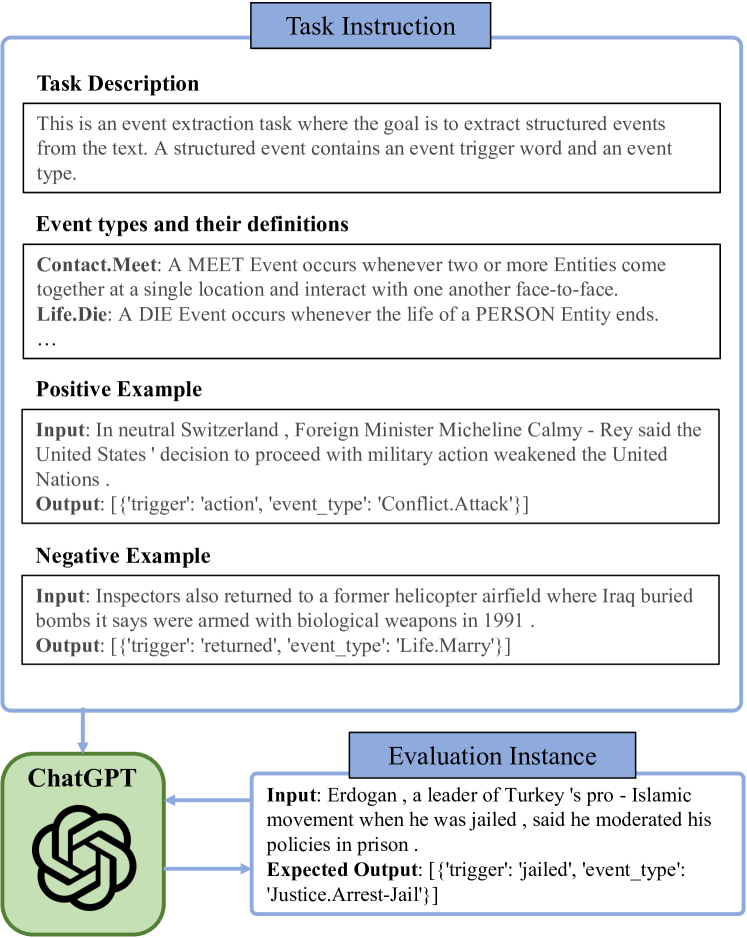
Experimental results
Research questions
- RQ1Can ChatGPT identify event triggers and classify event types in a zero-shot setting?
- RQ2How does ChatGPT’s performance compare to task-specific models (Text2Event and EEQA) on ACE05, especially in long-tail and complex scenarios?
- RQ3How do prompt elements (definitions, demonstrations, positive/negative examples) affect ChatGPT’s event extraction performance?
- RQ4Is ChatGPT robust and usable for practical event extraction across different prompt styles and user attempts?
Key findings
- ChatGPT achieves an F1 of 64.00 on event detection, lower than Text2Event (T5-base 75.76, T5-large 77.42) and EEQA (81.82).
- On average, ChatGPT attains only 51.04% of the performance of EEQA in long-tail and complex scenarios.
- In long-tail analysis, ChatGPT reaches 49.2% of EEQA on low-frequency events and 56.7% on high-frequency events.
- In complex scenarios, ChatGPT underperforms compared to EEQA and Text2Event across simple and complex samples.
- Prompt ablations show removing the positive example drops F1 by 6.17 points, removing event type definitions drops F1 by 11.95 points, and results vary with prompt style; one removal unexpectedly improved performance.
- Usability testing indicates ChatGPT is not robust across attempts and highly sensitive to prompt styles, with annotators achieving varying results (e.g., highest F1 66.67 vs. lowest 26.92).

Read this paper
Open the full text in the Nubint reader and ask about any passage as you read.
Read this paper on NubintThis review was generated by AI from the original paper. Please check the paper before citing it.