
[Paper Review] Fair coins tend to land on the same side they started: Evidence from 350,757 flips
This large-scale study of 350,757 coin flips provides strong empirical support for the physics-based model by Diaconis, Holmes, and Montgomery (2007), which predicts that fair coins tend to land on the same side they started due to subtle precession in human flipping. The data show a statistically significant same-side bias of 50.8% (95% CI [0.506, 0.509]), with substantial individual variation, confirming that human flipping introduces a predictable physical bias despite the coin's fairness.
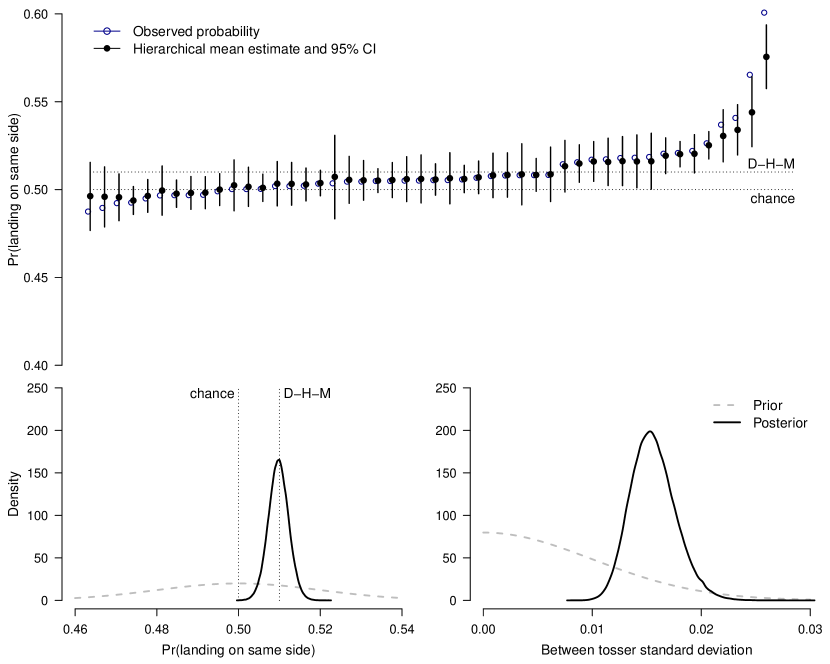
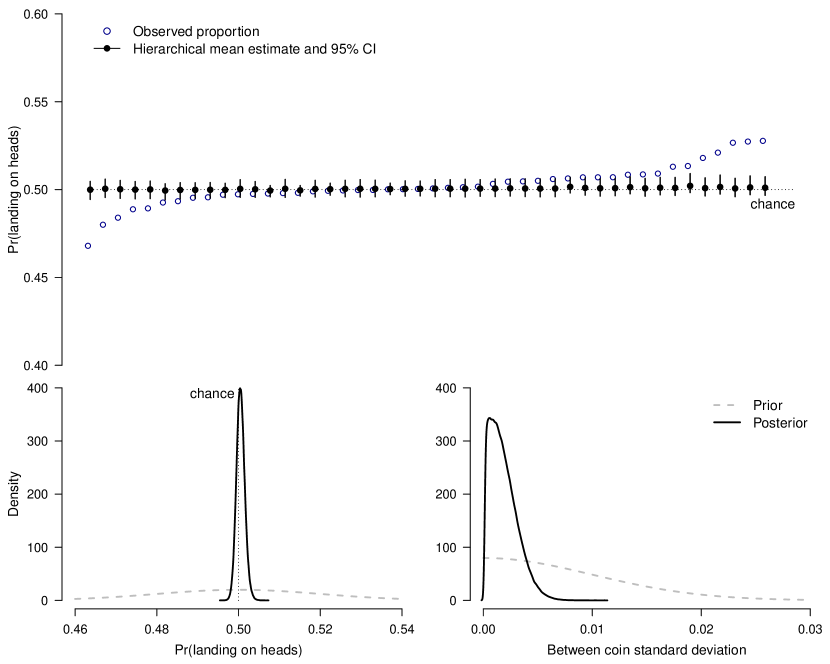
Many people have flipped coins but few have stopped to ponder the statistical and physical intricacies of the process. We collected $350{,}757$ coin flips to test the counterintuitive prediction from a physics model of human coin tossing developed by Diaconis, Holmes, and Montgomery (DHM; 2007). The model asserts that when people flip an ordinary coin, it tends to land on the same side it started -- DHM estimated the probability of a same-side outcome to be about 51\%. Our data lend strong support to this precise prediction: the coins landed on the same side more often than not, $ ext{Pr}( ext{same side}) = 0.508$, 95\% credible interval (CI) [$0.506$, $0.509$], $ ext{BF}_{ ext{same-side bias}} = 2359$. Furthermore, the data revealed considerable between-people variation in the degree of this same-side bias. Our data also confirmed the generic prediction that when people flip an ordinary coin -- with the initial side-up randomly determined -- it is equally likely to land heads or tails: $ ext{Pr}( ext{heads}) = 0.500$, 95\% CI [$0.498$, $0.502$], $ ext{BF}_{ ext{heads-tails bias}} = 0.182$. Furthermore, this lack of heads-tails bias does not appear to vary across coins. Additional analyses revealed that the within-people same-side bias decreased as more coins were flipped, an effect that is consistent with the possibility that practice makes people flip coins in a less wobbly fashion. Our data therefore provide strong evidence that when some (but not all) people flip a fair coin, it tends to land on the same side it started.
Motivation & Objective
- To test the counterintuitive prediction from the D-H-M physics model that human-flipped fair coins tend to land on the same side they started.
- To investigate whether this same-side bias is consistent across individuals and whether it varies between people.
- To examine whether the overall probability of heads or tails remains 50% when the starting side is randomized, confirming the absence of a heads-tails bias.
- To assess the practical implications of the same-side bias in real-world decision-making contexts.
- To validate the D-H-M model using a large, preregistered dataset collected from diverse participants.
Proposed method
- A preregistered, large-scale data collection effort involving 350,757 individual coin flips from a diverse group of participants.
- Participants flipped standard U.S. and Dutch coins using their preferred method, with the starting side (heads or tails up) randomly assigned.
- Each flip was recorded via video and audited to ensure data quality and prevent manipulation.
- Statistical analysis used Bayesian inference to estimate the probability of same-side outcomes and heads-tails bias, with Bayes factors for model comparison.
- The analysis included within-subjects variation to assess individual differences in same-side bias.
- Data and materials were made publicly available via the Open Science Framework (OSF) for transparency and replication.
Experimental results
Research questions
- RQ1Does the probability of a coin landing on the same side it started exceed 50%, as predicted by the D-H-M physics model?
- RQ2Is there significant individual variation in the degree of same-side bias among different coin flippers?
- RQ3Is the overall probability of landing heads equal to 50% when the starting side is randomized, indicating no heads-tails bias?
- RQ4To what extent does the observed same-side bias have practical implications in real-world decision-making scenarios?
- RQ5Can the D-H-M model’s prediction of a 51% same-side bias be empirically confirmed with a large, high-quality dataset?
Key findings
- The probability of a coin landing on the same side it started was 50.8%, with a 95% credible interval of [0.506, 0.509], providing strong evidence for the same-side bias.
- The Bayes factor for the same-side bias was 2364, indicating very strong support for the D-H-M model’s prediction.
- There was substantial between-person variability in the degree of same-side bias, suggesting individual differences in flipping mechanics.
- The overall probability of landing heads was 50.0%, with a 95% credible interval of [0.498, 0.502], and a Bayes factor of 0.183, indicating strong evidence against any heads-tails bias.
- The same-side bias was consistent across different types of coins, indicating it is not dependent on coin-specific properties.
- A simulation showed that knowing the starting side could yield a $19 profit over 1,000 bets, suggesting a strategic advantage in repeated betting scenarios.
Read this paper
Open the full text in the Nubint reader and ask about any passage as you read.
Read this paper on NubintThis review was generated by AI from the original paper. Please check the paper before citing it.