
[Paper Review] Fast UAV Trajectory Optimization using Bilevel Optimization with Analytical Gradients
This paper proposes a bilevel optimization framework that decouples UAV trajectory planning into spatial (state) and temporal (timing) variables, enabling efficient, globally optimal trajectory generation. By using analytical gradients derived from QP duality, it accelerates convergence and improves accuracy over finite-difference methods, achieving real-time performance in reactive target tracking tasks with significant speed and reliability gains.
We present an efficient optimization framework that solves trajectory optimization problems by decoupling state variables from timing variables, thereby decomposing a challenging nonlinear programming (NLP) problem into two easier subproblems. With timing fixed, the state variables can be optimized efficiently using convex optimization, and the timing variables can be optimized in a separate NLP, which forms a bilevel optimization problem. The challenge of obtaining the gradient of the timing variables is solved by sensitivity analysis of parametric NLPs. The exact analytic gradient is computed from the dual solution as a by-product, whereas existing finite-difference techniques require additional optimization. The bilevel optimization framework efficiently optimizes both timing and state variables which is demonstrated on generating trajectories for an unmanned aerial vehicle. Numerical experiments demonstrate that bilevel optimization converges significantly more reliably than a standard NLP solver, and analytical gradients outperform finite differences in terms of computation speed and accuracy. Physical experiments demonstrate its real-time applicability for reactive target tracking tasks.
Motivation & Objective
- To address the challenge of inefficient and unreliable time parametrization in UAV trajectory optimization, which often leads to high jerk and energy consumption.
- To develop a scalable and real-time trajectory optimization framework that jointly optimizes spatial paths and timing variables.
- To overcome the computational and accuracy limitations of finite-difference gradient estimation in bilevel trajectory optimization.
- To enable real-time applicability for reactive UAV tasks such as target tracking through efficient gradient computation.
- To ensure convergence and feasibility at all stages of optimization, even under non-smooth conditions.
Proposed method
- Decomposes the trajectory optimization problem into two levels: lower-level convex QP for spatial variables (position, velocity, acceleration) with fixed timing, and upper-level NLP for timing variables.
- Uses sensitivity analysis of parametric QP to compute exact analytical gradients of the cost w.r.t. timing variables from the dual solution (Lagrange multipliers).
- Employs gradient descent with line search and projection on the upper-level problem, with subgradient handling for non-smooth regions.
- Leverages the null space structure of polynomial splines to ensure feasibility and full-rank constraint matrices, guaranteeing strong second-order sufficient conditions (SSOSC).
- Implements a direct collocation benchmark using Hermite-Simpson discretization to compare performance against standard NLP solvers.
- Uses a cost function that balances total jerk and time, with a weighted sum objective to promote smooth, fast trajectories.
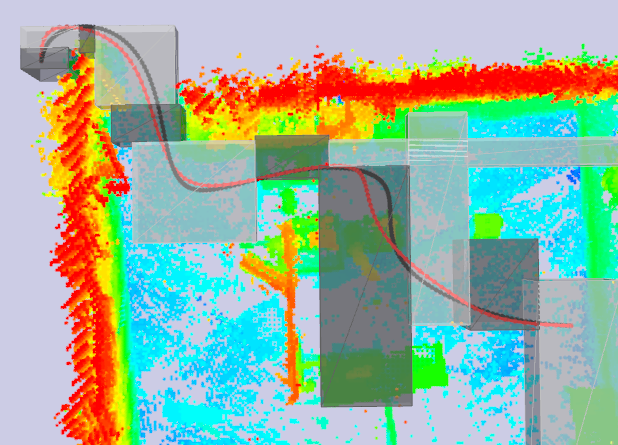
Experimental results
Research questions
- RQ1Can bilevel optimization with analytical gradients outperform standard NLP solvers in convergence speed and reliability for UAV trajectory planning?
- RQ2Does the use of analytical gradients from QP duality improve accuracy and reduce computation time compared to finite-difference approximations?
- RQ3Can the bilevel framework achieve real-time performance in reactive UAV tasks such as target tracking?
- RQ4How does the method handle non-smoothness in the upper-level cost function due to constraint qualifications not being satisfied?
- RQ5What is the impact of decoupling spatial and temporal optimization on trajectory quality, especially in terms of jerk and energy efficiency?
Key findings
- The bilevel optimization framework converges significantly more reliably than standard NLP solvers, even in high-dimensional, non-convex trajectory problems.
- Analytical gradients computed from the dual solution reduce computation time and improve accuracy compared to finite-difference methods, which require multiple QP solves per gradient step.
- The method achieves real-time performance in physical experiments, successfully enabling reactive target tracking with low-jerk, energy-efficient trajectories.
- The framework guarantees feasibility at all optimization steps, allowing arbitrary termination without compromising solution quality.
- Numerical experiments show that the proposed method reduces trajectory jerk and time cost more effectively than heuristic time parametrization methods.
- Theoretical analysis confirms that the method maintains strong second-order sufficient conditions (SSOSC) under standard UAV constraints, ensuring local optimality and convergence.
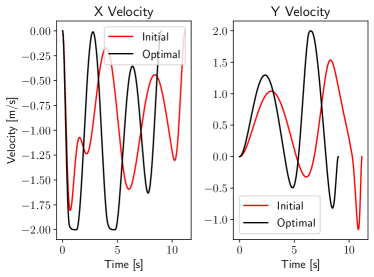
Read this paper
Open the full text in the Nubint reader and ask about any passage as you read.
Read this paper on NubintThis review was generated by AI from the original paper. Please check the paper before citing it.