
[Paper Review] Fault-tolerant quantum algorithm for symmetry-adapted perturbation theory
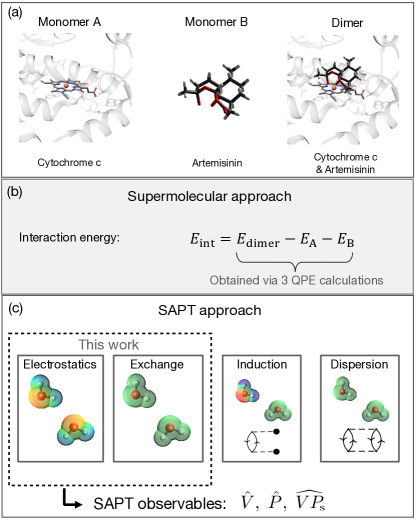
This paper presents a fault-tolerant quantum algorithm for computing first-order symmetry-adapted perturbation theory (SAPT) interaction energy components—electrostatic, exchange, and electrostatic-exchange—using a Heisenberg-limited estimation method. By leveraging high-order tensor factorization and block encoding, the algorithm achieves optimal uncertainty scaling and provides detailed resource estimates for benchmark molecules and a heme–artemisinin complex, identifying key cost drivers for large-scale quantum chemistry applications.
The efficient computation of observables beyond the total energy is a key challenge and opportunity for fault-tolerant quantum computing approaches in quantum chemistry. Here we consider the symmetry-adapted perturbation theory (SAPT) components of the interaction energy as a prototypical example of such an observable. We provide a guide for calculating this observable on a fault-tolerant quantum computer while optimizing the required computational resources. Specifically, we present a quantum algorithm that estimates interaction energies at the first-order SAPT level with a Heisenberg-limited scaling. To this end, we exploit a high-order tensor factorization and block encoding technique that efficiently represents each SAPT observable. To quantify the computational cost of our methodology, we provide resource estimates in terms of the required number of logical qubits and Toffoli gates to execute our algorithm for a range of benchmark molecules, also taking into account the cost of the eigenstate preparation and the cost of block encoding the SAPT observables. Finally, we perform the resource estimation for a heme and artemisinin complex as a representative large-scale system encountered in drug design, highlighting our algorithm's performance in this new benchmark study and discussing possible bottlenecks that may be improved in future work.
Motivation & Objective
- To develop a fault-tolerant quantum algorithm for computing physically interpretable SAPT interaction energy components beyond the total energy.
- To achieve Heisenberg-limited scaling in uncertainty for expectation value estimation of SAPT observables on a fault-tolerant quantum computer.
- To provide detailed resource estimates in terms of logical qubits and Toffoli gates for a range of molecules, including large-scale systems relevant to drug design.
- To identify computational bottlenecks in the algorithm, particularly in eigenstate preparation and block encoding, for future optimization.
Proposed method
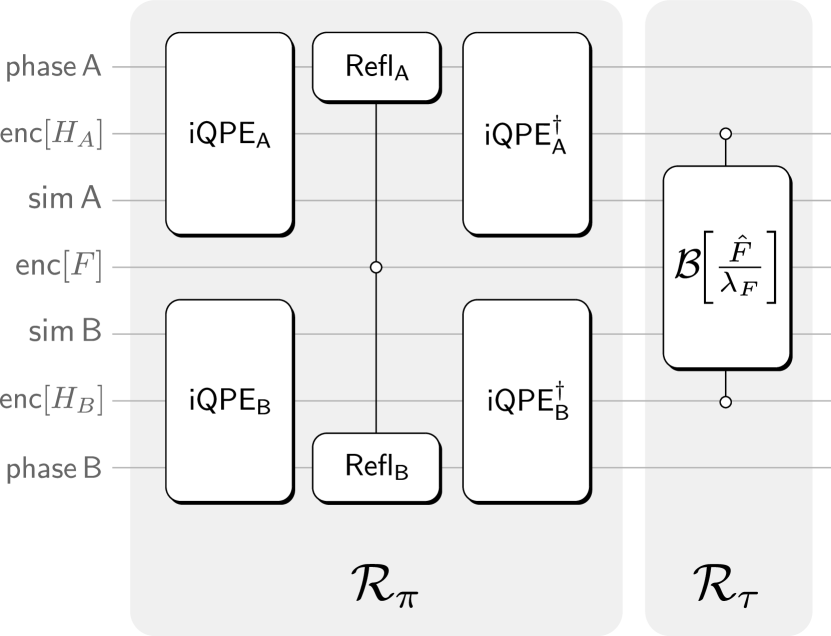
- The algorithm uses the QSP-EVE method for Heisenberg-limited expectation value estimation of SAPT operators.
- It employs block encoding to efficiently represent the SAPT Hamiltonians, enabling low-depth implementation of the observable evaluation.
- High-order tensor factorization is applied to decompose the SAPT operators into sparse, low-rank components, reducing resource overhead.
- The method is tailored to compute expectation values of the form ⟨ΨAΨB|F̂|ΨAΨB⟩, where F̂ is the first-order SAPT operator.
- Resource estimates are derived using surface code-based fault-tolerant quantum computing models, including logical qubit counts and Toffoli gate counts.
- The framework is applied to benchmark molecules and a heme–artemisinin complex, with basis set dependence analyzed across cc-pVDZ and larger basis sets.
Experimental results
Research questions
- RQ1Can a fault-tolerant quantum algorithm achieve Heisenberg-limited scaling for estimating SAPT interaction energy components?
- RQ2What are the leading resource costs—logical qubits and Toffoli gates—for computing first-order SAPT observables across different molecular systems?
- RQ3How do eigenstate preparation and block encoding of SAPT operators contribute to the overall computational cost?
- RQ4What are the dominant bottlenecks in the algorithm for large-scale molecular systems such as drug-like complexes?
- RQ5How do basis set size and system complexity scale the required quantum resources for SAPT on fault-tolerant hardware?
Key findings
- The algorithm achieves Heisenberg-limited scaling for uncertainty in expectation value estimation, enabling optimal precision scaling with runtime.
- For the heme–artemisinin complex with a cc-pVDZ[46] basis set, the method requires approximately 3.39×10¹¹ Toffoli gates and 1.43×10⁴ logical qubits for the exchange term.
- The dominant resource cost comes from the block encoding of the SAPT operators, particularly for larger basis sets, with Toffoli counts scaling with the square of the number of basis functions.
- Eigenstate preparation contributes significantly to the total cost, especially for larger molecules, and is a major bottleneck in the current implementation.
- The resource estimates show that basis set size has a strong impact: for cc-pVDZ[90], the Toffoli count for the exchange term reaches 3.44×10⁴, and logical qubit count exceeds 5×10⁵.
- The study identifies that optimizing block encoding and eigenstate preparation could yield the largest improvements in overall algorithmic efficiency.
Read this paper
Open the full text in the Nubint reader and ask about any passage as you read.
Read this paper on NubintThis review was generated by AI from the original paper. Please check the paper before citing it.