
[Paper Review] Feedback-Free Starbursts at Cosmic Dawn: Observable Predictions for JWST
The paper extends an analytic feedback-free starburst (FFB) model within standard cosmology to predict observable high-z galaxy properties for JWST, including elevated star-formation efficiency, stellar mass and UV luminosity functions, and bursty star-formation histories.
We extend the analysis of a physical model within the standard cosmology that robustly predicts a high star-formation efficiency (SFE) in massive galaxies at cosmic dawn due to feedback-free starbursts (FFBs). It implies an excess of bright galaxies at z>~10 compared to the standard models based on the low SFE at later epochs, an excess indicated by JWST observations. Here we provide observable predictions based on the analytic FFB scenario. These can be compared with simulations and JWST observations. We approximate the SFE as a function of redshift and mass, assuming a maximum SFE of 0.2~1 in the FFB regime. From this, we derive the evolution of the galaxy mass and luminosity functions as well as the evolution of stellar and star-formation densities. We then predict the star-formation history (SFH), galaxy sizes, outflows, gas fractions, metallicities, and dust attenuation, all as functions of mass and redshift in the FFB regime. The major distinguishing feature is the occurrence of FFBs above a mass threshold that declines with redshift. The luminosities and star formation rates in bright galaxies are predicted to be in excess of extrapolations of standard empirical models and cosmological simulations, an excess that grows from z~9 to higher redshifts. The FFB phase of ~100 Myr is predicted to show a characteristic SFH that fluctuates on a timescale of ~10 Myr. The stellar systems are compact (Re~0.3 kpc at z~10 and declining with z). The galactic gas consists of a steady wind driven by supernovae from earlier generations, with high outflow velocities (FWHM~1400-6700km/s), low gas fractions (<0.1), low metallicities (<~0.1 solar), and low dust attenuation ($A_{UV}$~0.5 at z~10 and declining with z). We make tentative comparisons with current JWST observations for initial insights, anticipating more complete and reliable datasets for detailed quantitative comparisons in the future.
Motivation & Objective
- Motivate that high star-formation efficiency is expected in massive galaxies at cosmic dawn due to feedback-free starbursts (FFB).
- Derive an analytic SFE as a function of redshift and halo mass within the FFB framework.
- Predict observable galaxy properties (mass and luminosity functions, densities, sizes, gas fractions, metallicities, dust) under the FFB regime.
- Compare FFB predictions to extrapolated high-z UM models and standard SAMs, and discuss preliminary JWST impressions.
- Provide digital tables and code to reproduce FFB predictions for community use.
Proposed method
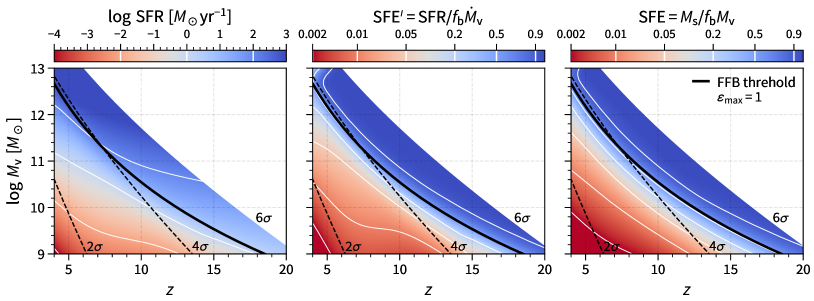
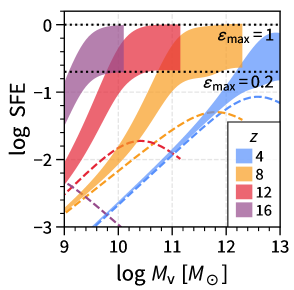
- Represent the FFB scenario with an SFE that transitions from a low UM-like value to a maximum SFE epsilon_max in the FFB regime (epsilon_max in 0.2–1).
- Model the SFR as <SFR_ffb> = epsilon_max f_b dot{M}_v above an FFB threshold M_v,ffb(z) with a smooth transition across the threshold (sigmoid function).
- Compute median stellar mass M_s(M_v,z) by adding the time-integrated difference between SFR_um+ffb and SFR_um to the UM baseline (Eq. 7).
- Derive the stellar mass function Phi(log M_s) by convolving the conditional M_s|M_v with the halo mass function n(M_v) (Eq. 10).
- Derive the UV luminosity function Phi(M_UV) from M_v via a Gaussian distribution of M_UV at fixed M_v and a median relation to M_s (Eq. 11, Eq. 12).
- Estimate cosmic densities rho_s(z), rho_UV(z), and rho_SFR(z) from the predicted mass and luminosity functions (Eqs. 13–15).
Experimental results
Research questions
- RQ1What redshift and halo mass regime allow feedback-free starbursts (FFB) to dominate star formation?
- RQ2How does FFB modify the stellar mass function and UV luminosity function at z ≳ 6–15 compared to standard models?
- RQ3What are the predicted cosmic densities (stellar, UV, SFR) in the FFB regime and how do they evolve?
- RQ4What are the characteristic star-formation histories and observable burst signatures in FFB galaxies?
- RQ5How do FFB predictions compare with UniverseMachine/projected UM extrapolations and JWST data?
Key findings
- FFB establishes a mass-redshift threshold line M_v,ffb(z); above this threshold, galaxies enter the FFB regime with epsilon_max up to 1 (0.2–1 range explored).
- FFB predicts brighter UV luminosity functions and larger stellar masses than standard UM/SAM models at z ≥ 6, with the excess growing at higher z.
- For epsilon_max = 0.2–1, the stellar mass function shows more abundant massive galaxies (M_s ≳ 10^9–10^10 M_sun) by z ∼ 10 and beyond.
- The UVLFs in the FFB scenario are significantly elevated relative to UM/SAM, particularly at z ∼ 9–12, even after dust corrections, with potential alignment to early JWST data for epsilon_max ∼ 0.2–0.5 at z ∼ 12.
- The FFB phase lasts ~100 Myr and features a bursty SFH with ~10 Myr fluctuations; galaxy sizes are compact (R_e ≈ 0.3 kpc at z ∼ 10), with winds: FWHM ≈ 1400–6700 km/s, gas fractions < 0.1, metallicities ≲ 0.1 Z_sun, and UV attenuation A_UV ≈ 0.5 at z ∼ 10 decreasing with z.
- Caveated comparisons with JWST data suggest rough consistency for epsilon_max ∼ 0.2–0.5, though results are preliminary and contingent on complete data.
- Digital tables and code for reproducing predictions are provided by the authors.
Read this paper
Open the full text in the Nubint reader and ask about any passage as you read.
Read this paper on NubintThis review was generated by AI from the original paper. Please check the paper before citing it.