
[Paper Review] Fiber-optic detection of snow avalanches using telecommunication infrastructure
This study demonstrates that existing telecommunication fiber-optic cables can detect snow avalanches via Distributed Acoustic Sensing (DAS), even when avalanches do not directly impact the cable. Using a 10 km fiber along the Flüelapass in the Swiss Alps, DAS recorded avalanche-induced seismic waves with apparent velocities >1500 m/s and strain fluctuations up to 3 μm/m/s, verified by drone and camera imagery, enabling cost-effective, near-real-time avalanche monitoring over long distances.
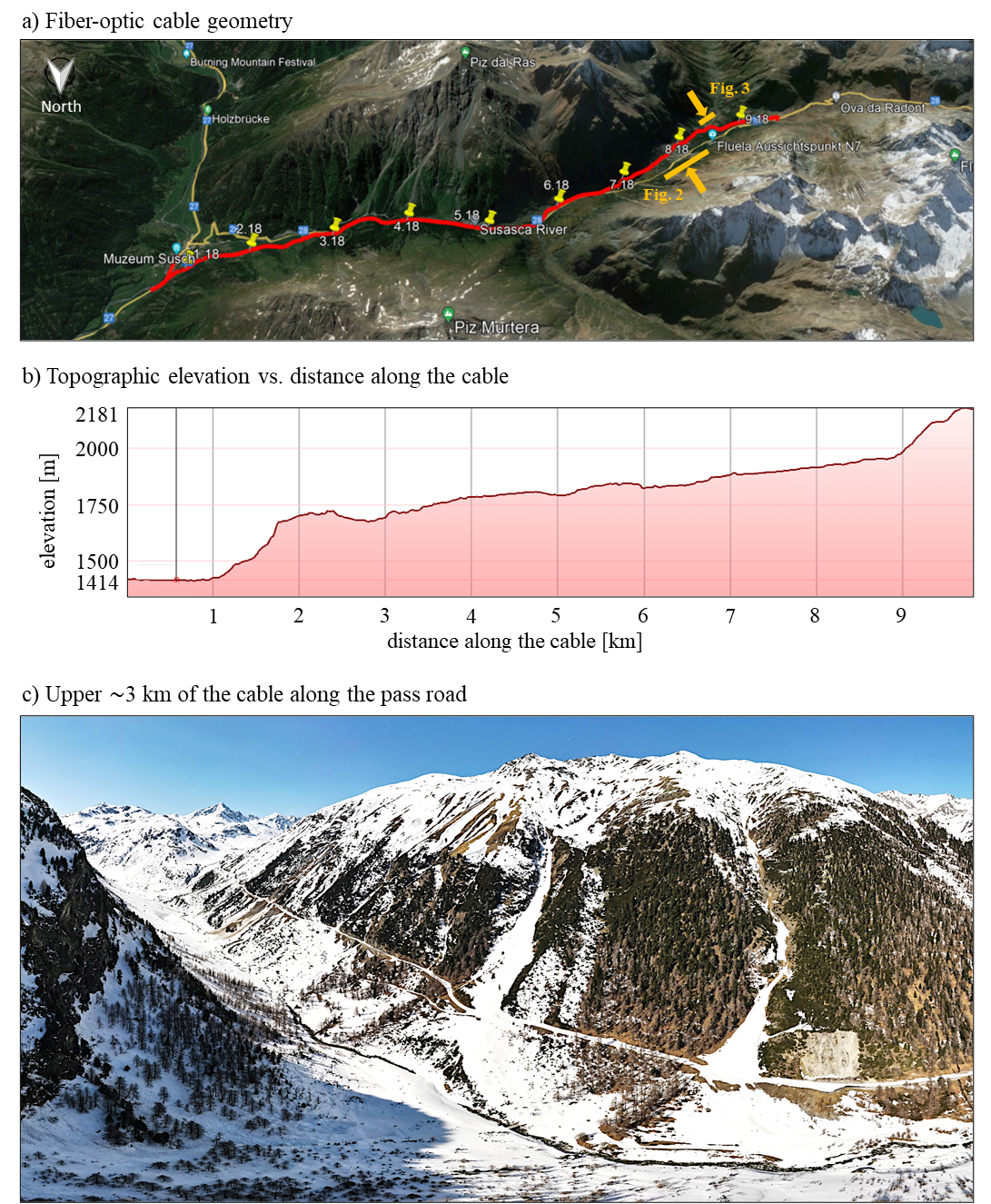
We demonstrate the detectability of snow avalanches using Distributed Acoustic Sensing (DAS) with existing fiber-optic telecommunication cables. For this, during winter 2021/2022, we interrogated a 10 km long cable closely following the avalanche prone Fluelapass road in the Swiss Alps. In addition to other signals like traffic and earthquakes, the DAS data contain clear recordings of numerous snow avalanches, even though most of them do not reach the cable. Here we present two examples of snow avalanche recordings that could be verified photographically. Our results open new perspectives for cost-effective, near-real-time avalanche monitoring over long distances using pre-installed fiber-optic infrastructure.
Motivation & Objective
- To evaluate the feasibility of using existing telecommunication fiber-optic cables for detecting snow avalanches via Distributed Acoustic Sensing (DAS).
- To assess whether DAS can detect avalanche signals even when the avalanche does not directly reach the cable, based on seismic wave propagation.
- To validate DAS recordings with photographic and field evidence for real-world avalanche events.
- To explore the potential of DAS as a cost-effective, large-scale solution for near-real-time avalanche and mass movement monitoring.
- To investigate the discrimination of avalanche signals from other ambient noise sources such as traffic and earthquakes.
Proposed method
- Interrogation of a ~10 km long existing telecommunication fiber-optic cable along the Flüelapass in the Swiss Alps using a Silixa iDAS TM 2.0 interrogator.
- Recording of raw DAS data at 100 Hz sampling frequency and 2 m spatial channel spacing, resulting in ~5000 measurement points along the cable.
- Use of tap tests to estimate cable position accuracy within ~20 m for channel mapping.
- Field visits and drone surveys to collect photographic evidence of avalanche events near the cable.
- Installation of a fixed camera at the cable end to capture time-lapse images of the valley for event validation.
- Comparison of DAS signals with visual records to confirm avalanche occurrence and characteristics.
Experimental results
Research questions
- RQ1Can DAS signals from existing telecommunication fibers detect snow avalanches that do not directly impact the cable?
- RQ2How do the DAS signal characteristics (e.g., apparent velocity, strain fluctuation) of avalanche events compare to those of traffic and seismic noise?
- RQ3To what extent can photographic and time-lapse image evidence confirm DAS-identified avalanche events?
- RQ4Can DAS data distinguish avalanche signals from other ambient signals such as vehicle traffic or earthquakes?
- RQ5What is the spatial extent of detectable avalanche signals along a fiber-optic cable, even when the physical avalanche is localized?
Key findings
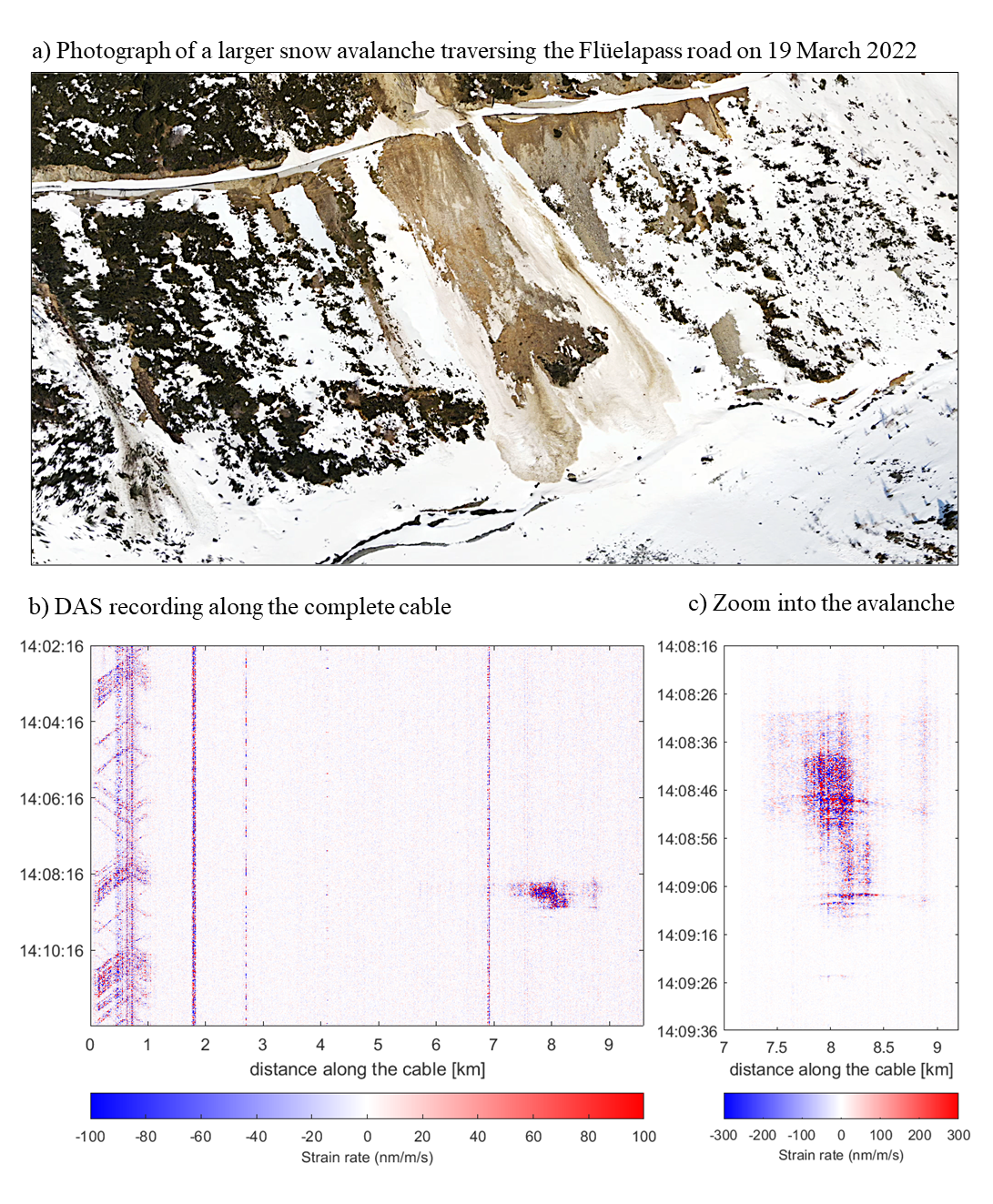
- DAS detected a large avalanche on 19 March 2022 along ~1.5 km of the fiber, despite the avalanche stopping ~350 m from the cable on the opposite side of the river.
- The avalanche produced a complex DAS signal with apparent velocities exceeding 1500 m/s and strain fluctuations reaching up to 3 μm/m/s, even though the physical avalanche was less than 200 m wide.
- A smaller avalanche on 15 April 2022, located on the south side of the river, was detected over several hundred meters of DAS data, with strain fluctuations of ~3 μm/m/s, confirmed by image differencing from a fixed camera.
- The DAS signal from the larger avalanche was spatially coherent over ~1.5 km of fiber, indicating strong seismic wave coupling to the ground and fiber.
- Traffic noise was distinguishable from avalanche signals due to its slower apparent velocity (<40 km/h) and consistent spatial pattern along the first 1.2 km of the cable.
- The study confirms that DAS can detect avalanche signals at distances up to several kilometers from the event, even without direct cable impact, due to seismic wave propagation through the ground.
Read this paper
Open the full text in the Nubint reader and ask about any passage as you read.
Read this paper on NubintThis review was generated by AI from the original paper. Please check the paper before citing it.