
[Paper Review] FigGen: Text to Scientific Figure Generation
This paper introduces FigGen, a latent diffusion model for text-to-scientific-figure generation, trained on the Paper2Fig100k dataset to synthesize figures from natural language descriptions. It achieves improved alignment between text prompts and generated figures using classifier-free guidance and a custom text encoder fine-tuned on technical scientific language, though generated figures remain insufficiently detailed for direct research use.
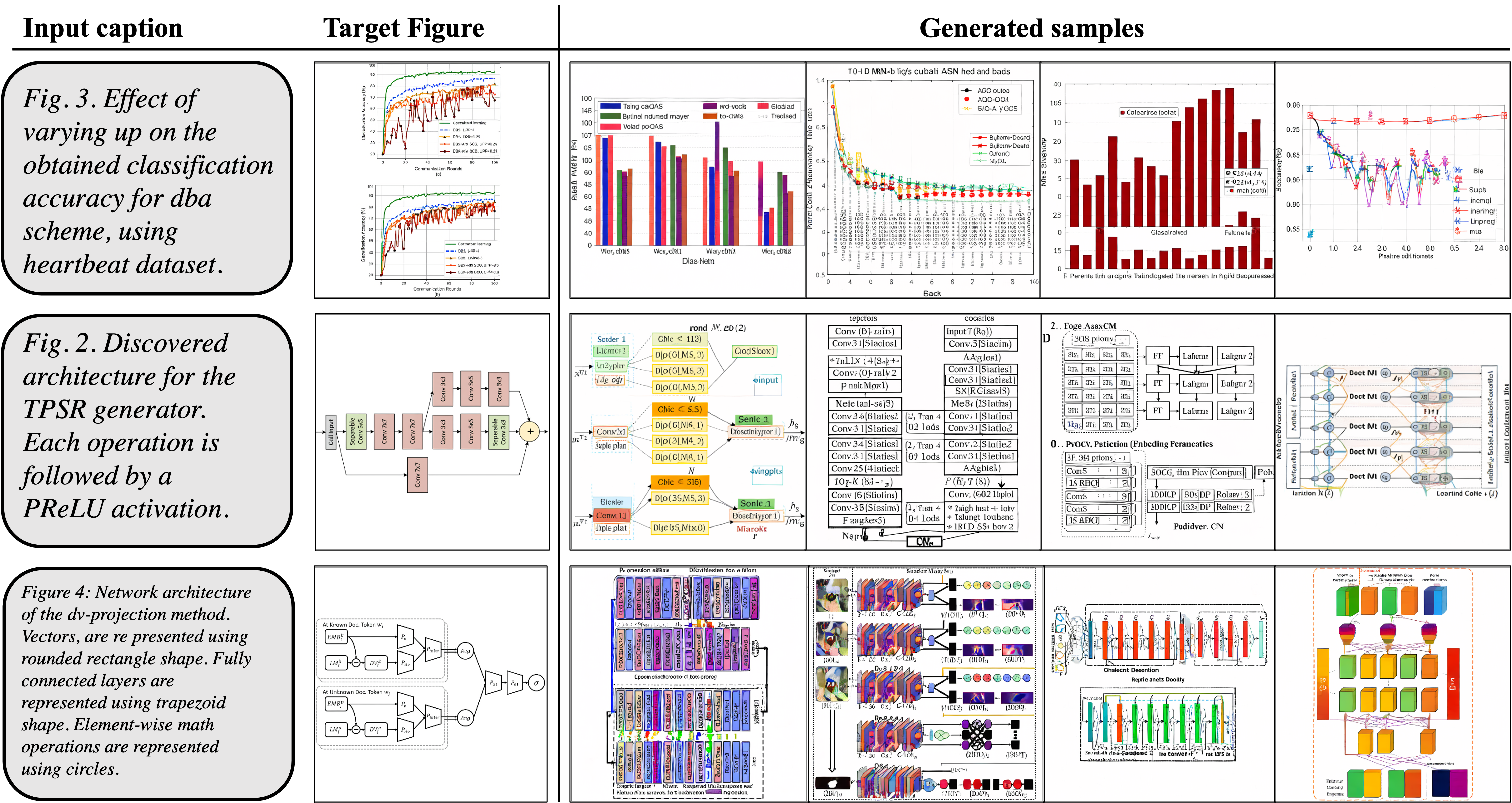
The generative modeling landscape has experienced tremendous growth in recent years, particularly in generating natural images and art. Recent techniques have shown impressive potential in creating complex visual compositions while delivering impressive realism and quality. However, state-of-the-art methods have been focusing on the narrow domain of natural images, while other distributions remain unexplored. In this paper, we introduce the problem of text-to-figure generation, that is creating scientific figures of papers from text descriptions. We present FigGen, a diffusion-based approach for text-to-figure as well as the main challenges of the proposed task. Code and models are available at https://github.com/joanrod/figure-diffusion
Motivation & Objective
- To address the lack of generative models for scientific figure creation, which are essential for efficient research communication.
- To explore the feasibility of text-to-figure generation using diffusion models, a domain underexplored compared to natural image generation.
- To overcome challenges in aligning highly technical, variable-length text descriptions with complex, discrete graphical elements like arrows, boxes, and text rendering.
- To develop a model capable of learning relationships between technical captions and corresponding figure structures, such as neural network architectures or plots.
- To establish a foundation for future work on metrics and loss functions tailored to discrete graphical generation.
Proposed method
- A latent diffusion model is trained from scratch using a VQ-based image autoencoder that compresses images to a 64×64×4 latent space, preserving text rendering quality.
- The image autoencoder is trained with a combination of KL loss, VGG perceptual loss, and a novel OCR perceptual loss to maintain textual fidelity in reconstructed figures.
- A BERT-based transformer encoder is trained end-to-end with the diffusion model, using 8, 32, or 128 layers, to better capture technical language from research papers.
- The diffusion model uses a time- and text-conditioned U-Net in the latent space with 1000 noise scheduling steps and a linear noise schedule.
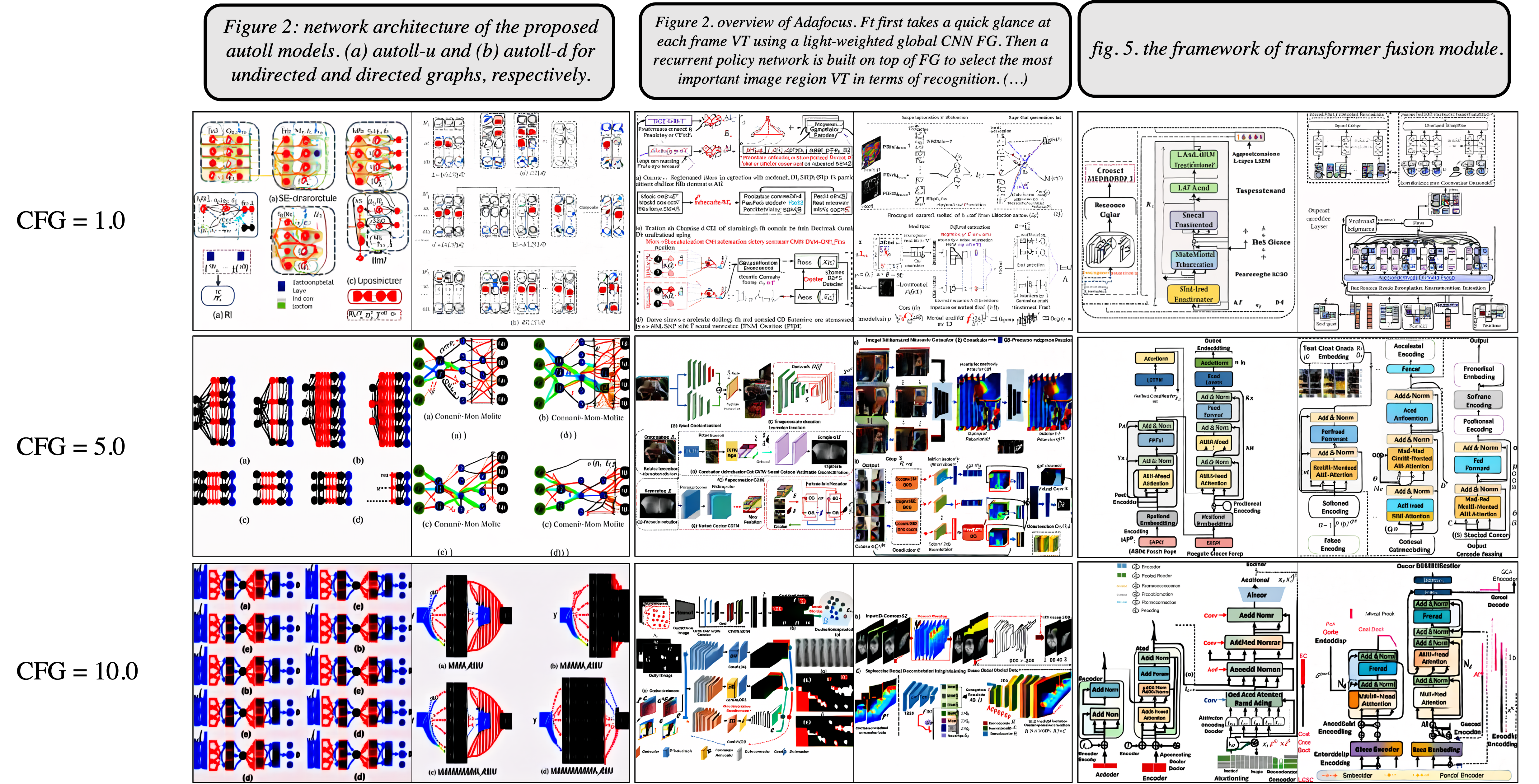
- Classifier-free guidance (CFG) is applied during inference to improve alignment between text prompts and generated figures.
- Training is performed on a filtered subset of Paper2Fig100k with aspect ratios between 0.5 and 2.0, using white padding instead of cropping to preserve information.
Experimental results
Research questions
- RQ1Can a diffusion model effectively generate scientific figures from natural language descriptions of technical content?
- RQ2How does the choice of text encoder (e.g., BERT vs. CLIP) affect the quality and alignment of generated figures?
- RQ3To what extent can classifier-free guidance improve the fidelity and prompt adherence of generated figures?
- RQ4What are the key challenges in aligning highly variable, technical text descriptions with discrete graphical components in scientific figures?
- RQ5How do different loss functions, including OCR perceptual loss, impact the generation of readable and semantically accurate figures?
Key findings
- The large BERT text encoder (128 layers) achieved the best FID (281.25) and IS (1.09) scores at a CFG scale of 5.0, outperforming smaller encoders.
- Increasing the classifier-free guidance (CFG) scale from 1.0 to 5.0 reduced FID from 302.46 to 281.25 and increased IS from 1.04 to 1.09, indicating improved sample quality and prompt alignment.
- The model successfully learned to differentiate between figure types such as plots, neural network architectures, and algorithm diagrams, as shown in qualitative samples.
- OCR-SIM scores remained relatively stable (~5.7–5.9) across models, indicating consistent text rendering quality despite variations in model size and CFG.
- Despite improvements, generated figures still lack sufficient detail and clarity for direct use in research, indicating the task remains challenging.
- The use of a custom BERT encoder trained end-to-end outperformed general-purpose encoders like CLIP, highlighting the domain gap between natural language and technical scientific text.
Read this paper
Open the full text in the Nubint reader and ask about any passage as you read.
Read this paper on NubintThis review was generated by AI from the original paper. Please check the paper before citing it.