
[Paper Review] Formal Modelling and Analysis of a Self-Adaptive Robotic System
This paper presents a formal model of a self-adaptive autonomous underwater vehicle (AUV) for pipeline inspection using a two-layer architecture: a managed subsystem modeled as a feature-guarde probabilistic transition system and a managing subsystem modeled as a dynamic controller switching between valid feature configurations. Using ProFeat for family-based probabilistic model checking, the approach enables efficient verification of quantitative safety and reward properties across all system configurations, demonstrating feasibility for real-time adaptation in uncertain underwater environments.
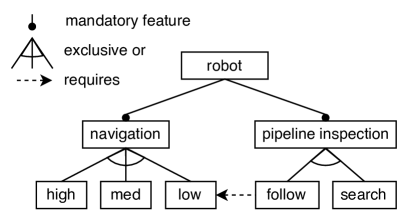
Self-adaptation is a crucial feature of autonomous systems that must cope with uncertainties in, e.g., their environment and their internal state. Self-adaptive systems are often modelled as two-layered systems with a managed subsystem handling the domain concerns and a managing subsystem implementing the adaptation logic. We consider a case study of a self-adaptive robotic system; more concretely, an autonomous underwater vehicle (AUV) used for pipeline inspection. In this paper, we model and analyse it with the feature-aware probabilistic model checker ProFeat. The functionalities of the AUV are modelled in a feature model, capturing the AUV's variability. This allows us to model the managed subsystem of the AUV as a family of systems, where each family member corresponds to a valid feature configuration of the AUV. The managing subsystem of the AUV is modelled as a control layer capable of dynamically switching between such valid feature configurations, depending both on environmental and internal conditions. We use this model to analyse probabilistic reward and safety properties for the AUV.
Motivation & Objective
- To address the challenge of designing autonomous robotic systems that can adapt to uncertain environmental and internal conditions during runtime.
- To enable efficient verification of safety and performance properties across all valid configurations of a robotic system with runtime variability.
- To demonstrate the feasibility of modeling and analyzing a self-adaptive robotic system as a family of systems using feature models and probabilistic model checking.
- To provide a scalable, formal methodology for verifying quantitative properties such as energy consumption and mission duration in autonomous underwater vehicles.
- To lay the foundation for future work on optimal adaptation strategies and control pattern discovery in self-adaptive cyber-physical systems.
Proposed method
- Model the AUV’s managed subsystem as a family of systems using a feature model that captures functional variability and dependencies.
- Represent the managed subsystem’s behavior as a probabilistic transition system with feature guards, ensuring transitions are only enabled under valid configurations.
- Model the managing subsystem as a control layer that dynamically switches between feature configurations based on environmental and internal state observations.
- Use ProFeat, a feature-aware probabilistic model checker, to perform family-based model checking across all valid configurations in a single analysis run.
- Integrate environmental uncertainty by assigning probabilities to events such as thruster failures and changes in water visibility.
- Define and verify quantitative properties such as expected mission duration, energy consumption, and safety under various operational scenarios.

Experimental results
Research questions
- RQ1How can a self-adaptive robotic system with dynamic variability be formally modeled to support automated verification?
- RQ2What is the impact of different feature configurations on the AUV’s energy consumption and mission duration under probabilistic environmental uncertainty?
- RQ3Can a single model checking run analyze all valid configurations of a robotic system family while preserving accuracy and efficiency?
- RQ4How does dynamic switching between feature configurations affect the safety and reliability of the AUV during pipeline inspection?
- RQ5What control strategies emerge from the analysis that could guide the design of more resilient adaptation logic in real-world AUVs?
Key findings
- The approach successfully models the AUV as a family of systems, where each configuration corresponds to a valid feature set, enabling holistic analysis of variability.
- Family-based model checking with ProFeat allowed efficient verification of probabilistic reward and safety properties across all configurations in a single execution.
- The analysis provided quantitative estimates of expected mission duration and energy consumption under different environmental conditions and feature configurations.
- Safety properties were verified, ensuring that the AUV maintains operational integrity even under thruster failures or low visibility conditions.
- The model demonstrated that operating at higher altitudes reduces thruster failure probability but requires sufficient water visibility to maintain perception, leading to dynamic altitude switching as a key adaptation strategy.
- The results suggest that optimal adaptation strategies can be discovered through such formal analysis, supporting future work on controller optimization.
Better researchstarts right now
From reading papers to final review, dramatically reduce your research time.
No credit card · Free plan available
This review was created by AI and reviewed by human editors.