
[Paper Review] Fourier Neural Operator for Plasma Modelling
The paper demonstrates Fourier Neural Operator (FNO) as a fast surrogate and digital twin for plasma evolution in MHD simulations and camera observations on MAST, outperforming Conv-LSTM and U-Net in speed and parameter efficiency while maintaining accuracy.
Predicting plasma evolution within a Tokamak is crucial to building a sustainable fusion reactor. Whether in the simulation space or within the experimental domain, the capability to forecast the spatio-temporal evolution of plasma field variables rapidly and accurately could improve active control methods on current tokamak devices and future fusion reactors. In this work, we demonstrate the utility of using Fourier Neural Operator (FNO) to model the plasma evolution in simulations and experiments. Our work shows that the FNO is capable of predicting magnetohydrodynamic models governing the plasma dynamics, 6 orders of magnitude faster than the traditional numerical solver, while maintaining considerable accuracy (NMSE $\sim 10^{-5})$. Our work also benchmarks the performance of the FNO against other standard surrogate models such as Conv-LSTM and U-Net and demonstrate that the FNO takes significantly less time to train, requires less parameters and outperforms other models. We extend the FNO approach to model the plasma evolution observed by the cameras positioned within the MAST spherical tokamak. We illustrate its capability in forecasting the formation of filaments within the plasma as well as the heat deposits. The FNO deployed to model the camera is capable of forecasting the full length of the plasma shot within half the time of the shot duration.
Motivation & Objective
- Motivate rapid plasma evolution prediction to enable real-time control in tokamaks and reduce reliance on computationally intensive codes.
- Demonstrate that Fourier Neural Operators can learn MHD solution mappings in a mesh-invariant manner.
- Benchmark FNO against standard surrogates (Conv-LSTM, U-Net) for both simulation data and experimental camera data.
- Explore FNO as a digital twin for camera-based plasma state forecasting on the MAST tokamak.
Proposed method
- Adopt 2D Fourier Neural Operator (FNO-2d) in an auto-regressive framework to map 20 input time steps to the next 5 time steps, iteratively forecasting up to T_out=70.
- Train separate FNOs for density, potential, and vorticity fields, with inputs on a 100x100 grid and 32-wide features, up to 16 Fourier modes per layer.
- Compare FNO against ConvLSTM and U-Net architectures under identical training conditions (Adam optimizer, 500 epochs, batch size 5).
- Extend the FNO approach to experimental fast-camera data from MAST to forecast plasma evolution seen by central solenoid and divertor cameras, using calibrated uniform grids.
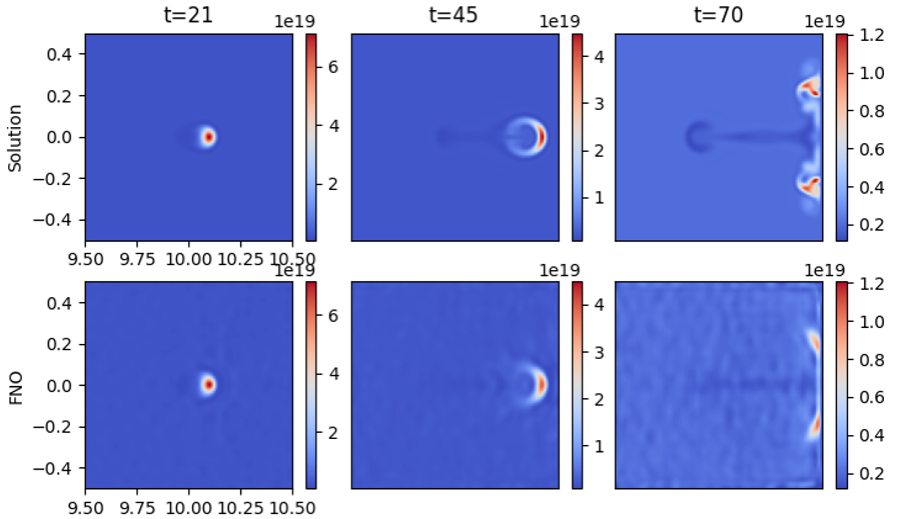
Experimental results
Research questions
- RQ1Can FNO learn the MHD solution operator for reduced MHD equations in toroidal geometry efficiently and accurately?
- RQ2How does FNO compare to Conv-LSTM and U-Net in training time, parameter count, and NMSE for plasma field evolution?
- RQ3Can FNO model experimental camera data to act as a real-time digital twin for tokamak plasmas, including filament formation and heat deposition patterns?
- RQ4What is the predictive capability of FNO for camera-based diagnostics in forecasting events like ELMs or L-H transitions?
Key findings
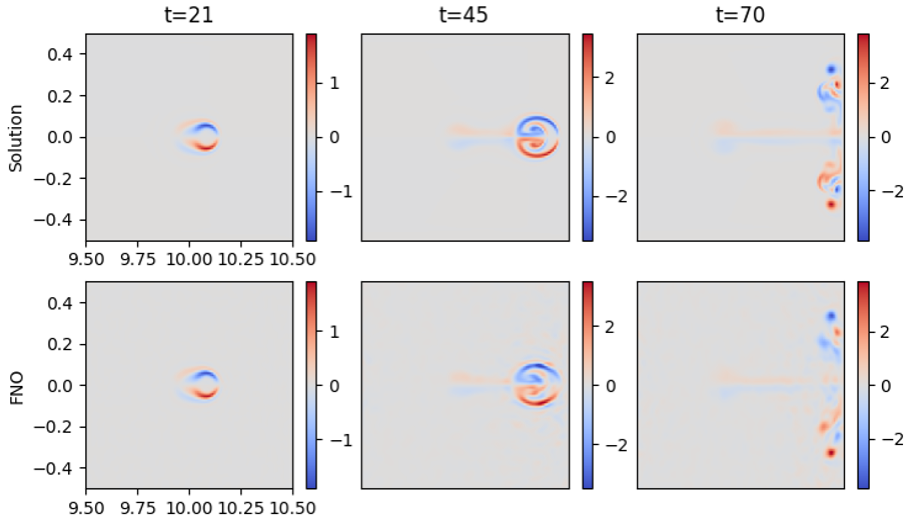
- FNO predicts reduced MHD evolution with NMSE ≈ 4–5×10^-5 across electric potential, density, and vorticity.
- FNO inference time is 0.025 s per run, vastly faster than traditional solvers and compared surrogates.
- FNO uses far fewer parameters and shorter training times than ConvLSTM and U-Net while delivering superior or comparable accuracy.
- For camera data on MAST, FNO achieved NMSE ~0.04 (central solenoid camera) and ~0.014 (divertor camera), forecasting up to the full remaining shot duration.
- FNO captures global plasma features and heat flux regions effectively, though local pixel-level accuracy can be limited.
- The framework demonstrates potential for real-time planning and control in fusion devices and as a digital twin for diagnostics.
Read this paper
Open the full text in the Nubint reader and ask about any passage as you read.
Read this paper on NubintThis review was generated by AI from the original paper. Please check the paper before citing it.