
[Paper Review] Fourier Neural Operators for Arbitrary Resolution Climate Data Downscaling
This paper proposes a Fourier Neural Operator (FNO)-based downscaling method that trains on low-resolution climate data and generalizes zero-shot to arbitrary high resolutions, significantly outperforming state-of-the-art convolutional and GAN-based models in both standard and zero-shot downscaling across ERA5 reanalysis and Navier-Stokes solution data.
Climate simulations are essential in guiding our understanding of climate change and responding to its effects. However, it is computationally expensive to resolve complex climate processes at high spatial resolution. As one way to speed up climate simulations, neural networks have been used to downscale climate variables from fast-running low-resolution simulations, but high-resolution training data are often unobtainable or scarce, greatly limiting accuracy. In this work, we propose a downscaling method based on the Fourier neural operator. It trains with data of a small upsampling factor and then can zero-shot downscale its input to arbitrary unseen high resolution. Evaluated both on ERA5 climate model data and on the Navier-Stokes equation solution data, our downscaling model significantly outperforms state-of-the-art convolutional and generative adversarial downscaling models, both in standard single-resolution downscaling and in zero-shot generalization to higher upsampling factors. Furthermore, we show that our method also outperforms state-of-the-art data-driven partial differential equation solvers on Navier-Stokes equations. Overall, our work bridges the gap between simulation of a physical process and interpolation of low-resolution output, showing that it is possible to combine both approaches and significantly improve upon each other.
Motivation & Objective
- Address the challenge of high computational cost in high-resolution climate simulations by enabling fast, differentiable downscaling using deep learning.
- Overcome the limitation of fixed-input-size deep learning models that cannot generalize to unseen resolution factors.
- Develop a single FNO-based model capable of zero-shot downscaling to arbitrary, previously unseen high resolutions after training on low-resolution data.
- Improve physical consistency and accuracy in climate downscaling by integrating conservation law constraints via a softmax layer.
- Demonstrate the method's effectiveness on both synthetic PDE solutions (Navier-Stokes) and real-world observational climate data (ERA5 water content).
Proposed method
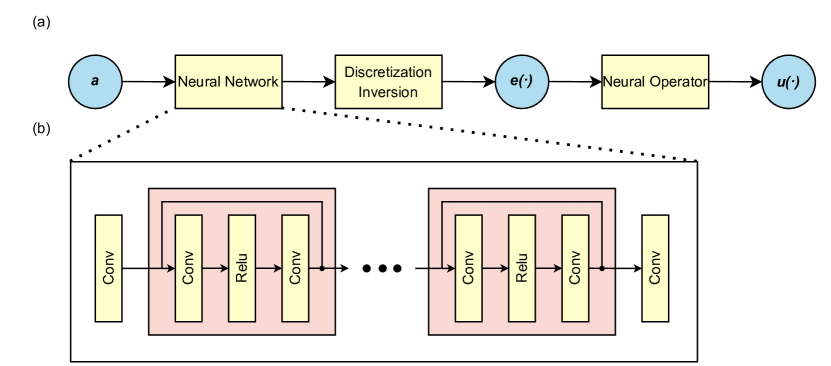
- Utilize Fourier Neural Operators (FNOs) to learn the mapping between low- and high-resolution climate fields by operating in the Fourier spectral domain.
- Train the FNO model exclusively on low-upsampling-factor data (e.g., 2×) to enable zero-shot inference at higher resolutions (e.g., 4×, 8×) without retraining.
- Apply a softmax constraint layer at the output to enforce physical conservation laws, improving fidelity in the downsampled outputs.
- Leverage the spectral inductive bias of FNOs, which exploit the smoothness and low-rank structure of climate and fluid dynamics data in the Fourier domain.
- Use a truncated Fourier series representation to efficiently model the operator, enabling generalization across resolution scales.
- Perform post-processing via average pooling or model recursion to evaluate models trained on specific upsampling factors on different resolution targets.
Experimental results
Research questions
- RQ1Can an FNO-based model trained on low-resolution data generalize zero-shot to arbitrary high-resolution climate downscaling tasks?
- RQ2How does the FNO downscaling model compare to state-of-the-art convolutional and GAN-based models in terms of accuracy and generalization across resolution factors?
- RQ3To what extent can the FNO model preserve physical consistency in climate downscaling when constrained by conservation laws?
- RQ4Does the FNO-based approach outperform data-driven PDE solvers like the original FNO in Navier-Stokes equation integration and solution refinement?
- RQ5How well does the model generalize to noisy, observational climate data such as total column water content from ERA5?
Key findings
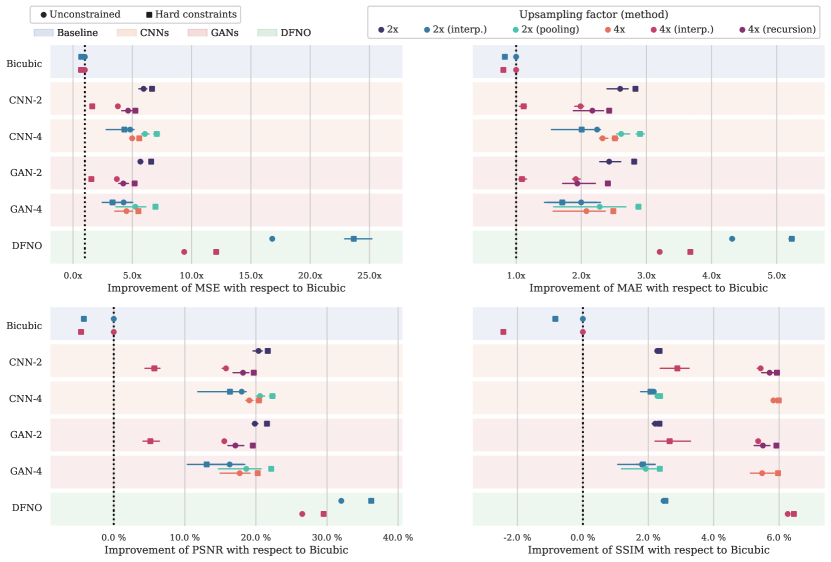
- The proposed FNO downscaling model achieves state-of-the-art performance on both Navier-Stokes solution downscaling and ERA5 water content downscaling, with lower MSE and higher PSNR than prior models.
- On the Navier-Stokes dataset, the FNO model achieved a PSNR of 48.95 at 2× and 47.17 at 4× resolution when using the softmax constraint, outperforming the original FNO solver.
- On the ERA5 water content dataset, the FNO model achieved a PSNR of 48.95 at 2× and 47.17 at 4× with the softmax layer, significantly outperforming CNN and GAN baselines.
- The model demonstrated strong zero-shot generalization: when trained on 2× data, it achieved lower MSE and higher PSNR at 4× resolution than models explicitly trained on 4× data.
- The addition of the softmax constraint layer improved physical consistency, reducing MAE and MSE across all resolution factors and boosting SSIM scores.
- The FNO model achieved a PSNR of 164.18 on 1× resolution (when trained on 2×) with the softmax layer, indicating near-perfect reconstruction on the lowest resolution, and maintained high performance across all scales.
Read this paper
Open the full text in the Nubint reader and ask about any passage as you read.
Read this paper on NubintThis review was generated by AI from the original paper. Please check the paper before citing it.