
[Paper Review] Fractional spin excitations in the infinite-layer cuprate CaCuO$_2$
This study provides experimental evidence of fractional spin excitations—spinon pairs—in the infinite-layer cuprate CaCuO₂ using resonant inelastic x-ray scattering (RIXS). The results show a broad continuum of spin-1/2 excitations near the (1/2, 0) point with ~80% of the magnetic spectral weight, strongly dominated by ΔS = 1 character and linked to a large ring exchange coupling Jc ≈ J₁, indicating enhanced quantum magnetism due to strong multi-site interactions.
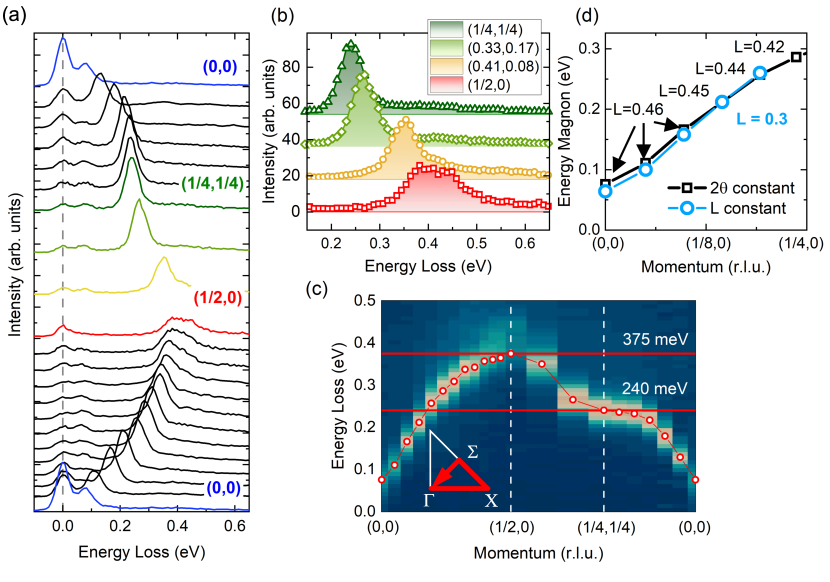
We use resonant inelastic x-ray scattering (RIXS) to investigate the magnetic dynamics of the infinite-layer cuprate CaCuO2. We find that close to the (1/2,0) point the single magnon decays into a broad continuum of excitations accounting for 80% of the total magnetic spectral weight. Polarization resolved RIXS spectra reveal the overwhelming dominance of spin-flip ($ΔS = 1$) characterof this continuum with respect to the $ΔS= 0$ multimagnon contributions. Moreover, its incident energy dependence is identical to that of the magnon, supporting a common physical origin. We propose that the continuum originates from the decay of the magnon into spinon pairs, and we relate it to the exceptionally high ring exchange $J_\mathrm{c} \sim J_1$ of CaCuO2. In the infinite layer cuprates long-range and multi-site hopping integrals are pivotal and amplify the 2D quantum magnetism effects in spite the 3D antiferromagnetic Néel order.
Motivation & Objective
- To investigate the magnetic excitation spectrum of the infinite-layer cuprate CaCuO₂ beyond conventional spin-wave theory.
- To determine whether the anomalous spectral weight at the (1/2, 0) point arises from fractionalized spin excitations or multimagnon processes.
- To clarify the role of ring exchange and multi-site superexchange in enhancing quantum fluctuations in 2D square-lattice antiferromagnets.
- To establish a direct link between the observed continuum and spinon pair excitations in a layered cuprate with strong quantum magnetic effects.
Proposed method
- Resonant inelastic x-ray scattering (RIXS) was performed at beamline ID32 of the ESRF using the ERIXS spectrometer.
- Polarization-resolved RIXS measurements were used to distinguish between ΔS = 1 (spin-flip) and ΔS = 0 (multimagnon) excitations.
- Incident-energy-dependent RIXS spectra were analyzed to confirm a common origin between the magnon and the continuum.
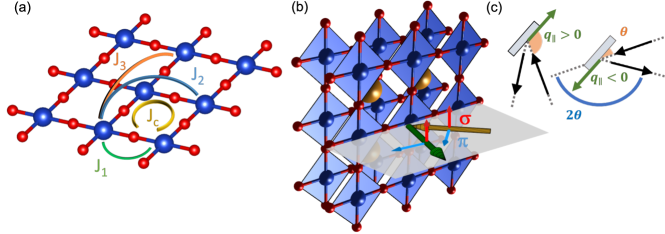
- Momentum-resolved RIXS data were collected in grazing-in and grazing-out geometries to map the full magnetic excitation spectrum.
- Theoretical modeling based on the extended Hubbard model with ring exchange (Jc) was used to interpret the spectral features.
- A quantitative analysis of the magnon energy at (1/2, 0) and (1/4, 1/4) was used to extract Jc/J₁ ≈ 1 from the spectral dispersion.
Experimental results
Research questions
- RQ1Does the anomalous spectral weight at the (1/2, 0) point in CaCuO₂ arise from fractionalized spinon pairs or multimagnon processes?
- RQ2What is the role of ring exchange coupling Jc in enhancing the continuum of excitations in the infinite-layer cuprate?
- RQ3How does the polarization dependence of the RIXS spectra distinguish between spin-flip (ΔS = 1) and non-spin-flip (ΔS = 0) excitations?
- RQ4Is the incident-energy dependence of the continuum identical to that of the magnon, indicating a common physical origin?
- RQ5To what extent does the large Jc/J₁ ratio in CaCuO₂ explain the enhanced fractionalization compared to other cuprates?
Key findings
- Close to the (1/2, 0) point, ~80% of the total magnetic spectral weight is distributed in a broad continuum, indicating a strong deviation from single-magnon behavior.
- Polarization-resolved RIXS shows that the continuum is overwhelmingly dominated by ΔS = 1 (spin-flip) character, ruling out local bimagnon contributions.
- The incident-energy dependence of the continuum matches that of the magnon, supporting a common origin and direct RIXS process.
- The ring exchange coupling Jc is found to be approximately equal to the nearest-neighbor exchange J₁ (Jc ≈ J₁), the largest among known cuprates.
- The enhanced continuum and suppressed multimagnon features are attributed to strong multi-spin couplings, particularly the large Jc, which promotes partial spinon deconfinement.
- The results provide the first direct experimental evidence of fractional spin excitations in a layered 2D cuprate, supporting theoretical predictions of spinon pair formation in quantum magnets.
Read this paper
Open the full text in the Nubint reader and ask about any passage as you read.
Read this paper on NubintThis review was generated by AI from the original paper. Please check the paper before citing it.