
[Paper Review] From LLMs to LLM-based Agents for Software Engineering: A Survey of Current, Challenges and Future
A survey distinguishing LLMs from LLM-based agents in software engineering, covering six SE domains, benchmarks, and future directions.
With the rise of large language models (LLMs), researchers are increasingly exploring their applications in var ious vertical domains, such as software engineering. LLMs have achieved remarkable success in areas including code generation and vulnerability detection. However, they also exhibit numerous limitations and shortcomings. LLM-based agents, a novel tech nology with the potential for Artificial General Intelligence (AGI), combine LLMs as the core for decision-making and action-taking, addressing some of the inherent limitations of LLMs such as lack of autonomy and self-improvement. Despite numerous studies and surveys exploring the possibility of using LLMs in software engineering, it lacks a clear distinction between LLMs and LLM based agents. It is still in its early stage for a unified standard and benchmarking to qualify an LLM solution as an LLM-based agent in its domain. In this survey, we broadly investigate the current practice and solutions for LLMs and LLM-based agents for software engineering. In particular we summarise six key topics: requirement engineering, code generation, autonomous decision-making, software design, test generation, and software maintenance. We review and differentiate the work of LLMs and LLM-based agents from these six topics, examining their differences and similarities in tasks, benchmarks, and evaluation metrics. Finally, we discuss the models and benchmarks used, providing a comprehensive analysis of their applications and effectiveness in software engineering. We anticipate this work will shed some lights on pushing the boundaries of LLM-based agents in software engineering for future research.
Motivation & Objective
- Explain the distinctions between LLMs and LLM-based agents in software engineering.
- Survey six SE domains to map tasks, benchmarks, and evaluation metrics.
- Identify state-of-the-art techniques, datasets, and experimental methodologies.
- Highlight challenges such as context length, hallucinations, and tool integration.
- Offer guidance for future research and benchmarking in SE with LLM-based agents.
Proposed method
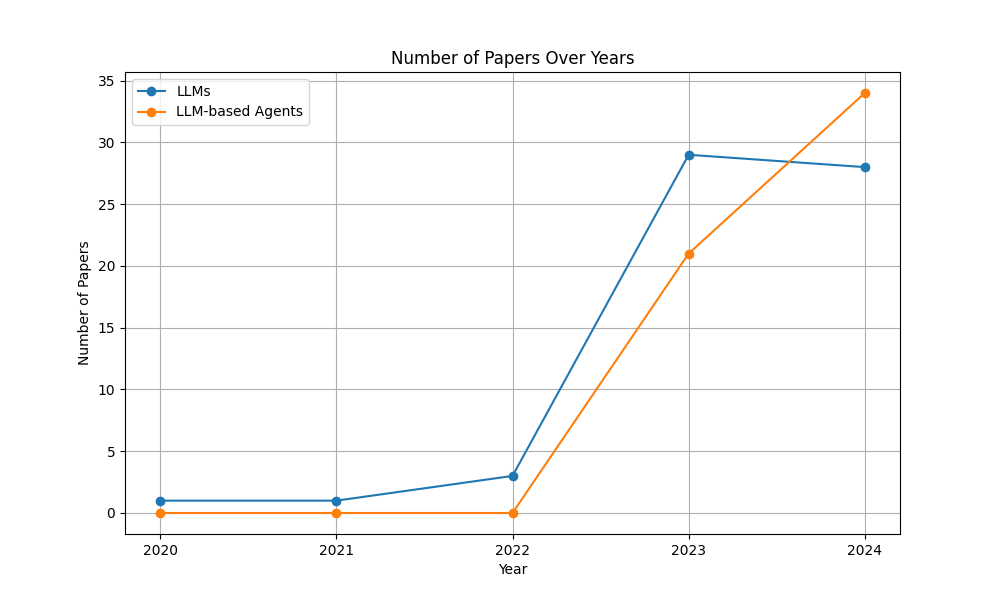
- Literature collection from DBLP and arXiv focusing on late 2023 to May 2024.
- Manual screening to remove non-LLM papers and low-quality submissions.
- Snowballing search to capture influential works missed initially.
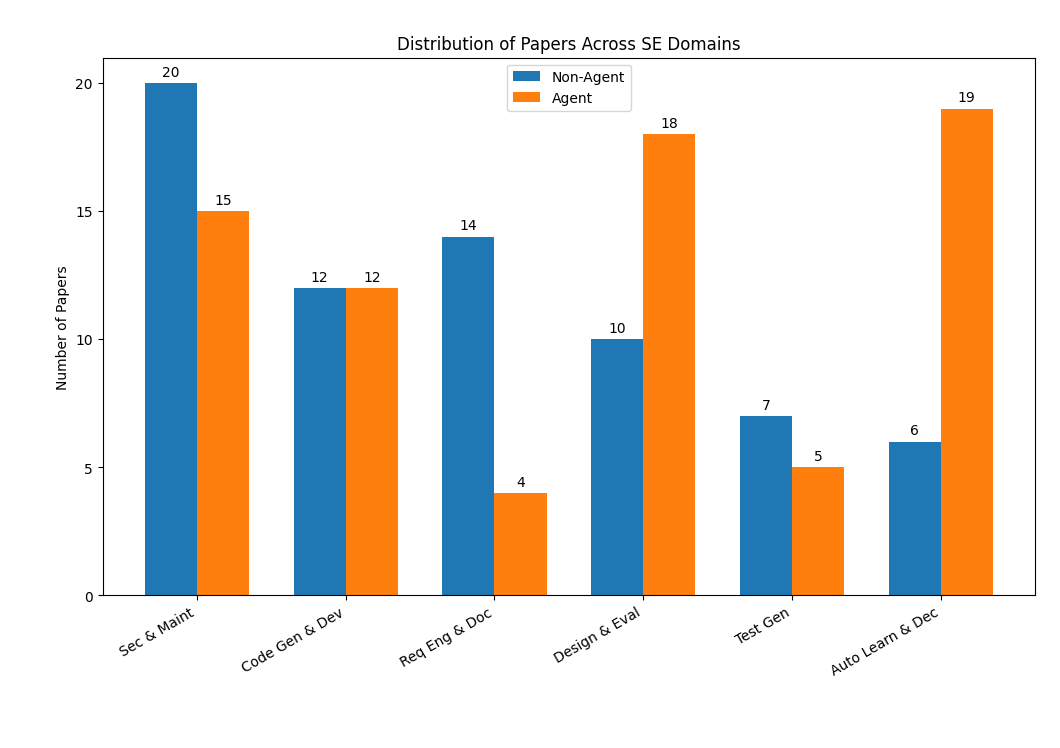
- Categorical analysis distinguishing LLMs and LLM-based agents across six SE domains.
- Comparison of tasks, benchmarks, and evaluation metrics between LLMs and agents.
Experimental results
Research questions
- RQ1RQ1: What are the state-of-the-art techniques and practices in LLMs and LLM-based agents for SE?
- RQ2RQ2: What are the key differences in task performance between LLMs and LLM-based agents in SE applications?
- RQ3RQ3: Which benchmark datasets and evaluation metrics are most commonly used for assessing performance of LLMs and LLM-based agents in SE tasks?
- RQ4RQ4: What are the predominant experimental models and methodologies when utilizing LLMs in SE?
Key findings
- The survey distinguishes LLMs from LLM-based agents and maps them to six SE domains.
- It analyzes benchmarks and metrics used for evaluating LLMs and agents in SE.
- It notes the lack of unified standards and benchmarks for LLM-based agents in SE.
- It summarizes architectures, RAG, and tool usage as key enabling technologies.
- It discusses single vs. multi-agent systems and their impact on context management and robustness.
- It compiles a comprehensive view of current applications and future research directions.
Read this paper
Open the full text in the Nubint reader and ask about any passage as you read.
Read this paper on NubintThis review was generated by AI from the original paper. Please check the paper before citing it.