
[Paper Review] From Persona to Personalization: A Survey on Role-Playing Language Agents
A comprehensive survey of Role-Playing Language Agents (RPLAs) powered by LLMs, categorizing personas into demographic, character, and individualized types, and outlining construction, evaluation, risks, and applications.
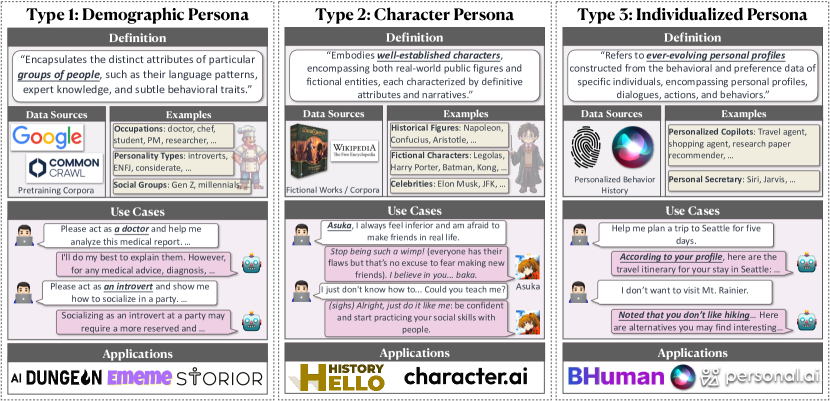
Recent advancements in large language models (LLMs) have significantly boosted the rise of Role-Playing Language Agents (RPLAs), i.e., specialized AI systems designed to simulate assigned personas. By harnessing multiple advanced abilities of LLMs, including in-context learning, instruction following, and social intelligence, RPLAs achieve a remarkable sense of human likeness and vivid role-playing performance. RPLAs can mimic a wide range of personas, ranging from historical figures and fictional characters to real-life individuals. Consequently, they have catalyzed numerous AI applications, such as emotional companions, interactive video games, personalized assistants and copilots, and digital clones. In this paper, we conduct a comprehensive survey of this field, illustrating the evolution and recent progress in RPLAs integrating with cutting-edge LLM technologies. We categorize personas into three types: 1) Demographic Persona, which leverages statistical stereotypes; 2) Character Persona, focused on well-established figures; and 3) Individualized Persona, customized through ongoing user interactions for personalized services. We begin by presenting a comprehensive overview of current methodologies for RPLAs, followed by the details for each persona type, covering corresponding data sourcing, agent construction, and evaluation. Afterward, we discuss the fundamental risks, existing limitations, and future prospects of RPLAs. Additionally, we provide a brief review of RPLAs in AI applications, which reflects practical user demands that shape and drive RPLA research. Through this work, we aim to establish a clear taxonomy of RPLA research and applications, and facilitate future research in this critical and ever-evolving field, and pave the way for a future where humans and RPLAs coexist in harmony.
Motivation & Objective
- Define a taxonomy of RPLA personas (demographic, character, individualized) and motivate personalization in RPLAs.
- Survey data sources, construction methods, and evaluation criteria for each persona type.
- Discuss risks, limitations, and future directions to guide safe, effective RPLA research and applications.
Proposed method
- Survey existing methodologies for building RPLAs, including parametric training and nonparametric prompting.
- Describe memory, tool-usage, and planning modules used to enable anthropomorphic behavior in RPLAs.
- Summarize data sources and construction approaches for each persona type (demographic, character, individualized).
- Outline evaluation criteria for role-playing capability and persona fidelity.
- Provide taxonomy and framework through which RPLA research and applications can be analyzed.
Experimental results
Research questions
- RQ1How are RPLAs categorized into demographic, character, and individualized personas and what data sources support each type?
- RQ2What are the common construction techniques and modules (memory, tools, planning) enabling RPLAs to simulate personas?
- RQ3How are RPLAs evaluated in terms of role-playing ability and fidelity to assigned personas?
- RQ4What are the practical applications and risks associated with each persona category?
- RQ5What future directions and gaps exist for safe and effective RPLA research and deployment?
Key findings
- RPLAs are effectively organized into three progressive persona types: demographic, character, and individualized.
- Memory, tool-usage, and planning modules are central to enabling dynamic, context-aware role-playing in RPLAs.
- Parametric training suits demographic and character personas, while prompting methods are common for individualized personalization.
- Evaluation distinguishes role-playing capabilities from persona fidelity to specific individuals or demographics.
- RPLAs offer broad applications from digital clones and companions to interactive games, but raise risks such as toxicity, bias, hallucinations, and privacy concerns.
Read this paper
Open the full text in the Nubint reader and ask about any passage as you read.
Read this paper on NubintThis review was generated by AI from the original paper. Please check the paper before citing it.