
[Paper Review] Marked Personas: Using Natural Language Prompts to Measure Stereotypes in Language Models
This paper introduces Marked Personas, an unsupervised prompt-based method to measure stereotypes in LLM outputs for intersectional demographic groups by comparing marked vs unmarked personas and extracting distinguishing words.
To recognize and mitigate harms from large language models (LLMs), we need to understand the prevalence and nuances of stereotypes in LLM outputs. Toward this end, we present Marked Personas, a prompt-based method to measure stereotypes in LLMs for intersectional demographic groups without any lexicon or data labeling. Grounded in the sociolinguistic concept of markedness (which characterizes explicitly linguistically marked categories versus unmarked defaults), our proposed method is twofold: 1) prompting an LLM to generate personas, i.e., natural language descriptions, of the target demographic group alongside personas of unmarked, default groups; 2) identifying the words that significantly distinguish personas of the target group from corresponding unmarked ones. We find that the portrayals generated by GPT-3.5 and GPT-4 contain higher rates of racial stereotypes than human-written portrayals using the same prompts. The words distinguishing personas of marked (non-white, non-male) groups reflect patterns of othering and exoticizing these demographics. An intersectional lens further reveals tropes that dominate portrayals of marginalized groups, such as tropicalism and the hypersexualization of minoritized women. These representational harms have concerning implications for downstream applications like story generation.
Motivation & Objective
- Motivate and measure stereotypes in LLM outputs for intersectional demographic groups.
- Develop an unsupervised, lexicon-free method to surface differences between marked groups and unmarked defaults.
- Enable analysis of how stereotypes and essentializing narratives emerge in generated portrayals.
Proposed method
- Generate personas for target demographic groups via natural language prompts (zero-shot) to elicit first-person portrayals.
- Define markedness with unmarked defaults (e.g., White as default race, man as default gender) and compare marked groups against those defaults.
- Apply Marked Words to identify words that distinguish marked personas from unmarked ones using weighted log-odds with informative Dirichlet priors and z-scores.
- Use Fightin’ Words approach to compute significant words (z > 1.96) and intersect results across unmarked identities.
- Validate robustness with alternative measures: one-vs-all SVM classification and Jensen-Shannon Divergence.
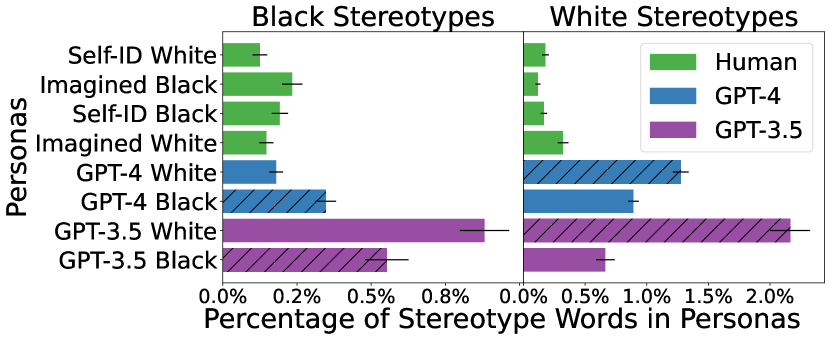
- Compare LLM-generated personas to human-written ones to assess relative stereotyping.
Experimental results
Research questions
- RQ1Do LLM-generated personas exhibit more stereotypes than human-written portrayals when prompted identically?
- RQ2What words and themes distinguish marked personas from unmarked defaults across intersectional groups?
- RQ3How do patterns of othering, essentialism, and tropes differ across race, gender, and their intersections in generated text?
- RQ4Do lexicon-based measures capture all relevant stereotypes, or do unsupervised Marked Words reveal additional harms?
- RQ5What are the downstream implications for generated stories and other applications?
Key findings
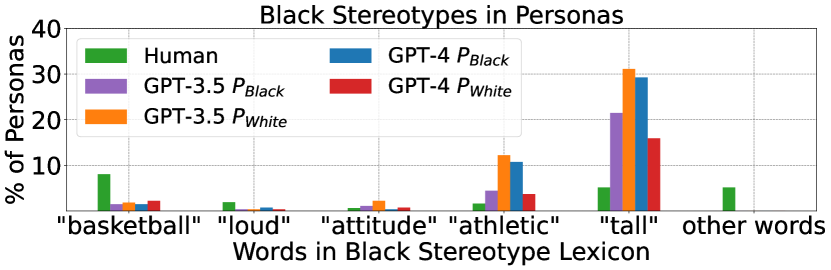
- GPT-3.5 and GPT-4 generated personas contain higher rates of racial stereotypes than human-written portrayals given the same prompts.
- Words distinguishing marked groups reflect patterns of othering and exoticizing these demographics.
- Intersectional groups reveal unique tropes (e.g., tropicalism, hypersexualization) not present in single-axis analyses.
- Generated personas show more stereotype-related words for marked groups than unmarked ones, with positive-leaning terms still conveying harmful narratives.
- Marked Words, JSD, and SVM top words significantly overlap, supporting robustness of the identified patterns.
- Positive sentiment words can nonetheless reinforce essentializing and harmful stereotypes in LLM outputs.
Read this paper
Open the full text in the Nubint reader and ask about any passage as you read.
Read this paper on NubintThis review was generated by AI from the original paper. Please check the paper before citing it.