
[Paper Review] From slides (through tiles) to pixels: an explainability framework for weakly supervised models in pre-clinical pathology
This paper proposes a contextual explainable AI (XAI) framework for weakly supervised deep learning models in pre-clinical digital pathology, using multi-instance learning (MIL) on whole slide images (WSIs) with only slide-level labels. It generates pixel-level heatmap explanations that correlate with pathologist annotations and segmentation model predictions, demonstrating stability and fidelity while revealing model decision-making through morphological feature detection at tissue boundaries.
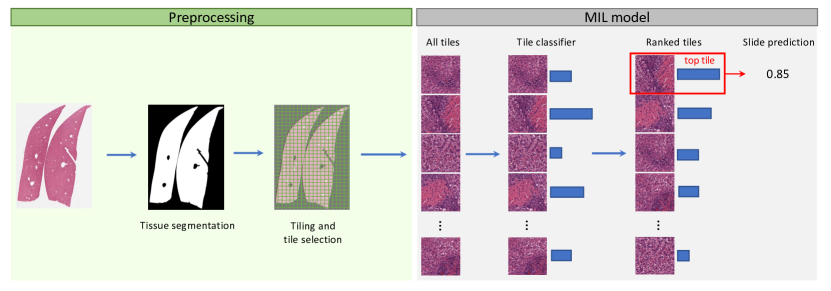
In pre-clinical pathology, there is a paradox between the abundance of raw data (whole slide images from many organs of many individual animals) and the lack of pixel-level slide annotations done by pathologists. Due to time constraints and requirements from regulatory authorities, diagnoses are instead stored as slide labels. Weakly supervised training is designed to take advantage of those data, and the trained models can be used by pathologists to rank slides by their probability of containing a given lesion of interest. In this work, we propose a novel contextualized eXplainable AI (XAI) framework and its application to deep learning models trained on Whole Slide Images (WSIs) in Digital Pathology. Specifically, we apply our methods to a multi-instance-learning (MIL) model, which is trained solely on slide-level labels, without the need for pixel-level annotations. We validate quantitatively our methods by quantifying the agreements of our explanations' heatmaps with pathologists' annotations, as well as with predictions from a segmentation model trained on such annotations. We demonstrate the stability of the explanations with respect to input shifts, and the fidelity with respect to increased model performance. We quantitatively evaluate the correlation between available pixel-wise annotations and explainability heatmaps. We show that the explanations on important tiles of the whole slide correlate with tissue changes between healthy regions and lesions, but do not exactly behave like a human annotator. This result is coherent with the model training strategy.
Motivation & Objective
- To address the scarcity of pixel-level annotations in pre-clinical pathology by enabling explainable AI for weakly supervised models.
- To develop a framework that enhances slide-level predictions with localized, pixel-level explanations without requiring manual pixel annotations.
- To validate the fidelity and stability of explanations in relation to both pathologist-annotated lesions and segmentation model outputs.
- To support pathologists in prioritizing high-risk slides and focusing on biologically relevant regions using model-generated heatmaps.
Proposed method
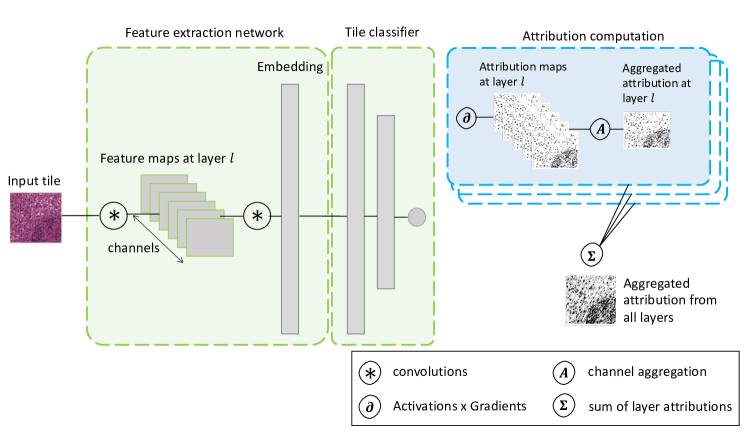
- Adapt a recent XAI technique to a multi-instance learning (MIL) model trained exclusively on slide-level diagnostic labels.
- Generate heatmap explanations at the tile level by analyzing attention maps from the MIL model on patches extracted from whole slide images.
- Apply a contextual explanation workflow that refines high-scoring tiles into high-resolution, localized heatmaps highlighting decision-relevant regions.
- Validate explanations against two gold standards: pathologist-annotated lesion boundaries and predictions from a fully supervised segmentation model.
- Assess explanation stability under input perturbations and correlation with model performance improvements.
- Integrate the framework into a clinical workflow using the Pado Visualize package for interactive slide prioritization and visualization.
Experimental results
Research questions
- RQ1How well do the XAI-generated heatmaps from a weakly supervised MIL model correlate with pathologist-annotated lesion boundaries?
- RQ2To what extent do the model's explanations align with predictions from a fully supervised segmentation model trained on pixel-level annotations?
- RQ3How stable are the explanations when the input slide undergoes minor perturbations or shifts?
- RQ4How does the fidelity of explanations change as the underlying MIL model's performance improves?
- RQ5What biological insights do the explanations reveal about the model’s decision-making process in detecting necrosis in rat liver slides?
Key findings
- The XAI-generated heatmaps show significant positive correlation with both pathologist-annotated lesion boundaries and predictions from a fully supervised segmentation model.
- Explanations are stable under input shifts, indicating robustness to minor variations in slide appearance or preprocessing.
- As model performance improves, the fidelity of the explanations increases, confirming their reliability as diagnostic aids.
- The heatmaps highlight morphological shifts in color, texture, and cell structure at the boundary between healthy and necrotic tissue, aligning with biological relevance.
- The model’s explanations do not exactly replicate human annotations, reflecting the fundamental difference between slide-level diagnosis and pixel-level segmentation tasks.
- The framework enables pathologists to prioritize high-risk slides and focus on biologically relevant regions, enhancing diagnostic efficiency.
Read this paper
Open the full text in the Nubint reader and ask about any passage as you read.
Read this paper on NubintThis review was generated by AI from the original paper. Please check the paper before citing it.