
[Paper Review] FrontierMath: A Benchmark for Evaluating Advanced Mathematical Reasoning in AI
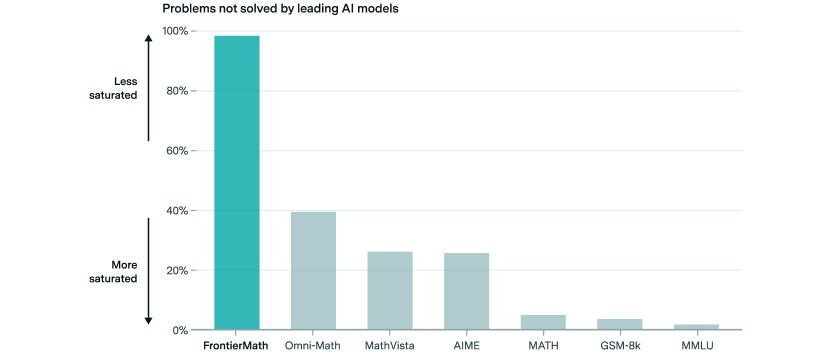
FrontierMath presents hundreds of original, unpublished advanced mathematics problems across modern MSC2020 topics, with automated verification, to rigorously evaluate AI's progress toward expert-level mathematical reasoning; current SOTA models solve under 2% of problems.
We introduce FrontierMath, a benchmark of hundreds of original, exceptionally challenging mathematics problems crafted and vetted by expert mathematicians. The questions cover most major branches of modern mathematics -- from computationally intensive problems in number theory and real analysis to abstract questions in algebraic geometry and category theory. Solving a typical problem requires multiple hours of effort from a researcher in the relevant branch of mathematics, and for the upper end questions, multiple days. FrontierMath uses new, unpublished problems and automated verification to reliably evaluate models while minimizing risk of data contamination. Current state-of-the-art AI models solve under 2% of problems, revealing a vast gap between AI capabilities and the prowess of the mathematical community. As AI systems advance toward expert-level mathematical abilities, FrontierMath offers a rigorous testbed that quantifies their progress.
Motivation & Objective
- Address saturation in existing math benchmarks that focus on high-school/undergraduate material.
- Mitigate data contamination by using exclusively new, unpublished problems.
- Provide automated, verifiable evaluation to enable scalable benchmarking of AI models.
- Cover a broad range of modern mathematics (MSC2020) with rigorous problem creation and validation.
Proposed method
- Collaboratively created hundreds of original problems by 60+ mathematicians across disciplines.
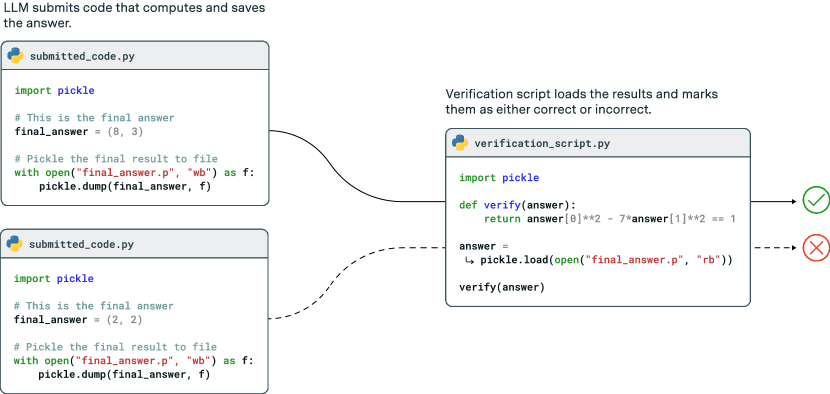
- Enforce automated verifiability by designing problems with unique integer or symbolic solutions verifiable via code or SymPy objects.
- Incorporate a guessproofness criterion to minimize chance-based success and ensure genuine reasoning.
- Require computationally tractable verification scripts that run within a minute on standard hardware.
- Implement an independent multi-stage validation process including blind peer review and originality checks to ensure quality and prevent contamination.
Experimental results
Research questions
- RQ1How difficult are advanced mathematical problems for current AI models across modern mathematics?
- RQ2Can a benchmark of unpublished, verifiable problems accurately discriminate between model capabilities at research-level mathematics?
- RQ3What is the rate of AI success on FrontierMath compared to existing benchmarks, and what does this imply about AI progress in mathematical reasoning?
- RQ4How reliable are difficulty ratings and metadata in predicting model performance across domains?
Key findings
- AI models solve under 2% of FrontierMath problems on the full benchmark.
- The benchmark maintains a >98% unsolved rate across problems, indicating high difficulty beyond existing benchmarks.
- Automated verification enables rapid, objective evaluation and minimizes data contamination.
- Six leading models showed low accuracy, with some variability on problems solved at least once across repeats.
- Transcripts and samples are publicly available to illustrate solver behavior on solved cases.
Read this paper
Open the full text in the Nubint reader and ask about any passage as you read.
Read this paper on NubintThis review was generated by AI from the original paper. Please check the paper before citing it.