
[Paper Review] Full-Atom Protein Pocket Design via Iterative Refinement
FAIR is a novel deep generative framework for full-atom protein pocket design that co-designs residue sequences and 3D structures via iterative, coarse-to-fine refinement. It achieves state-of-the-art performance with 15.5% average AAR and 13.5% RMSD improvement over prior methods by modeling side-chain atoms, ligand flexibility, and sequence-structure consistency through end-to-end, E(3)-equivariant optimization.
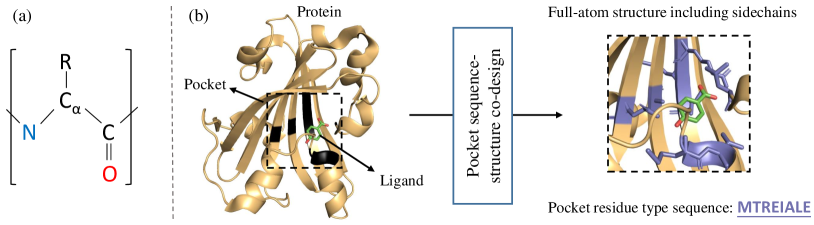
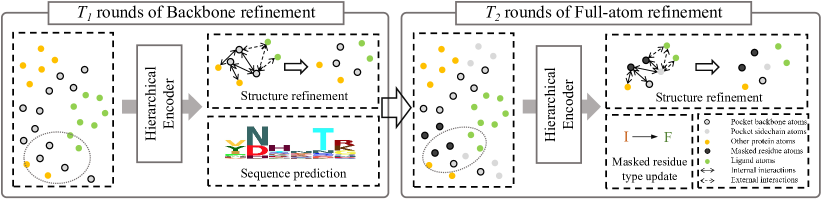
The design of \emph{de novo} functional proteins that bind specific ligand molecules is paramount in therapeutics and bio-engineering. A critical yet formidable task in this endeavor is the design of the protein pocket, which is the cavity region of the protein where the ligand binds. Current methods are plagued by inefficient generation, inadequate context modeling of the ligand molecule, and the inability to generate side-chain atoms. Here, we present the Full-Atom Iterative Refinement (FAIR) method, designed to address these challenges by facilitating the co-design of protein pocket sequences, specifically residue types, and their corresponding 3D structures. FAIR operates in two steps, proceeding in a coarse-to-fine manner (transitioning from protein backbone to atoms, including side chains) for a full-atom generation. In each iteration, all residue types and structures are simultaneously updated, a process termed full-shot refinement. In the initial stage, the residue types and backbone coordinates are refined using a hierarchical context encoder, complemented by two structure refinement modules that capture both inter-residue and pocket-ligand interactions. The subsequent stage delves deeper, modeling the side-chain atoms of the pockets and updating residue types to ensure sequence-structure congruence. Concurrently, the structure of the binding ligand is refined across iterations to accommodate its inherent flexibility. Comprehensive experiments show that FAIR surpasses existing methods in designing superior pocket sequences and structures, producing average improvement exceeding 10\% in AAR and RMSD metrics. FAIR is available at \url{https://github.com/zaixizhang/FAIR}.
Motivation & Objective
- Address the critical challenge of de novo design of functional protein pockets that bind specific ligands for therapeutic and bioengineering applications.
- Overcome limitations in existing methods, including inefficient generation, poor modeling of ligand flexibility, and omission of side-chain atoms.
- Co-design protein pocket sequences and 3D structures in an end-to-end, iterative framework that ensures sequence-structure consistency.
- Enable high-fidelity, full-atom generation of protein-ligand complexes with improved geometric complementarity and binding affinity.
Proposed method
- FAIR employs a two-stage, coarse-to-fine iterative refinement pipeline: first refining backbone coordinates and residue types, then incorporating side-chain atoms and refining full-atom structures.
- Uses a hierarchical context encoder with residue- and atom-level encoders to model multi-scale structural dependencies in protein-ligand complexes.
- Employs two structure refinement modules: one for inter-residue interactions and another for pocket-ligand interactions, updated iteratively.
- Applies full-shot refinement—simultaneous update of all residue types and coordinates in each iteration—enhancing efficiency and convergence.
- Introduces a masked residue type update mechanism that ensures sequence-structure consistency by predicting missing residues based on neighbors.
- Refines the ligand’s 3D structure iteratively to account for conformational flexibility, improving binding compatibility.
Experimental results
Research questions
- RQ1Can iterative, full-shot refinement of both sequence and structure improve the quality of de novo protein pocket design compared to autoregressive or one-shot methods?
- RQ2To what extent do side-chain atoms and ligand flexibility contribute to improved binding affinity and geometric complementarity in designed pockets?
- RQ3How effective is the integration of sequence-structure consistency modeling via masked residue type prediction in enhancing design accuracy?
- RQ4Does the hierarchical encoder and E(3)-equivariant design improve generalization and representation learning in protein-ligand complex generation?
- RQ5How does FAIR compare to physics-based, template-matching, and deep generative baselines in key metrics like AAR, RMSD, and Vina score?
Key findings
- FAIR achieves a 40.17% average Amino Acid Recovery (AAR) on the CrossDocked dataset and 43.75% on Binding MOAD, representing a 15.5% average improvement over baselines.
- FAIR reduces RMSD to 1.42 Å on CrossDocked and 1.35 Å on Binding MOAD, showing a 13.5% average improvement in structural accuracy.
- Ablation studies confirm that removing the hierarchical encoder causes the largest performance drop (AAR: 25.30% vs. 40.17%), highlighting its critical role in representation learning.
- The inclusion of full-atom refinement and ligand structure refinement contributes significantly to performance, with AAR dropping to 35.52% and 33.16% respectively when removed.
- Replacing full-shot refinement with autoregressive decoding reduces AAR to 31.04% on CrossDocked, demonstrating that iterative joint optimization is more efficient and accurate.
- FAIR generates high-quality pockets in less time than autoregressive methods, with an average generation time of 1.8 seconds per pocket, outperforming baseline methods in speed and accuracy.
Read this paper
Open the full text in the Nubint reader and ask about any passage as you read.
Read this paper on NubintThis review was generated by AI from the original paper. Please check the paper before citing it.