
[Paper Review] Game-theoretic LLM: Agent Workflow for Negotiation Games
This paper proposes game-theoretic agent workflows to enhance the rationality of large language models (LLMs) in strategic negotiation settings. By integrating classic game theory principles—such as dominant strategy search and backward induction—into LLM reasoning, the workflow significantly improves decision-making in complete- and incomplete-information games, achieving near-optimal outcomes and reducing exploitation in negotiations, especially in complex scenarios like Deal-or-No-Deal.
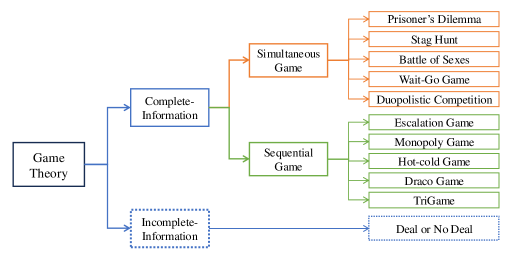
This paper investigates the rationality of large language models (LLMs) in strategic decision-making contexts, specifically within the framework of game theory. We evaluate several state-of-the-art LLMs across a spectrum of complete-information and incomplete-information games. Our findings reveal that LLMs frequently deviate from rational strategies, particularly as the complexity of the game increases with larger payoff matrices or deeper sequential trees. To address these limitations, we design multiple game-theoretic workflows that guide the reasoning and decision-making processes of LLMs. These workflows aim to enhance the models' ability to compute Nash Equilibria and make rational choices, even under conditions of uncertainty and incomplete information. Experimental results demonstrate that the adoption of these workflows significantly improves the rationality and robustness of LLMs in game-theoretic tasks. Specifically, with the workflow, LLMs exhibit marked improvements in identifying optimal strategies, achieving near-optimal allocations in negotiation scenarios, and reducing susceptibility to exploitation during negotiations. Furthermore, we explore the meta-strategic considerations of whether it is rational for agents to adopt such workflows, recognizing that the decision to use or forgo the workflow constitutes a game-theoretic issue in itself. Our research contributes to a deeper understanding of LLMs' decision-making capabilities in strategic contexts and provides insights into enhancing their rationality through structured workflows. The findings have implications for the development of more robust and strategically sound AI agents capable of navigating complex interactive environments. Code and data supporting this study are available at \url{https://github.com/Wenyueh/game_theory}.
Motivation & Objective
- To evaluate the rationality of state-of-the-art LLMs in strategic game-theoretic contexts, particularly under increasing game complexity.
- To address the observed deviations from rational behavior in LLMs during negotiation and game-playing tasks, especially in incomplete-information and sequential games.
- To design and validate game-theoretic workflows that guide LLM reasoning to compute Nash equilibria and make optimal decisions.
- To investigate whether adopting such workflows is itself a rational meta-strategic choice for agents in negotiation games.
- To explore how prompt design, negotiation order, and agent personality influence LLM rationality and outcome efficiency.
Proposed method
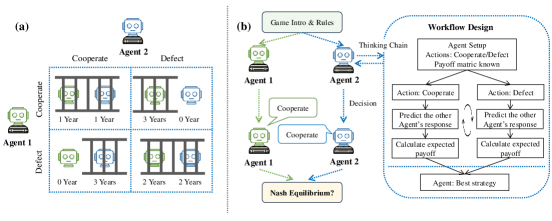
- Designing a game-theoretic workflow based on dominant strategy search to identify strategies that maximize payoff regardless of opponent actions.
- Implementing backward induction in sequential games by analyzing decision trees from terminal nodes back to the root to determine optimal paths.
- Creating a Bayesian update-based workflow for incomplete-information games (e.g., Deal-or-No-Deal) to enable Pareto-optimal and envy-free allocations.
- Integrating structured reasoning prompts that guide LLMs through step-by-step game-theoretic analysis, reducing reliance on heuristic or intuitive responses.
- Using self-consistent reasoning chains to evaluate and refine LLM decisions, ensuring alignment with game-theoretic equilibria.
- Evaluating workflow efficacy through controlled experiments across multiple game types, comparing LLM performance with and without the workflow.
Experimental results
Research questions
- RQ1To what extent do LLMs deviate from rational strategies in complete-information games as payoff matrix size and game depth increase?
- RQ2Can game-theoretic workflows significantly improve LLMs’ ability to identify Nash equilibria and achieve optimal outcomes in strategic games?
- RQ3How does the workflow affect LLM performance in incomplete-information negotiation games like Deal-or-No-Deal, particularly in achieving Pareto-efficient and envy-free allocations?
- RQ4Is it rational for an LLM agent to adopt a negotiation workflow, and how does this meta-strategic decision affect overall utility and outcome fairness?
- RQ5How do factors such as prompt wording, negotiation order, and agent personality influence the rationality and consistency of LLM decisions in negotiation tasks?
Key findings
- LLMs frequently deviate from rational strategies in complex games, especially with larger payoff matrices or deeper sequential trees, showing reduced robustness under uncertainty.
- The adoption of game-theoretic workflows significantly improves LLMs’ ability to identify optimal strategies, with marked gains in coordination and outcome efficiency in games like Stag Hunt and Battle of the Sexes.
- In the Deal-or-No-Deal negotiation game, the Bayesian-based workflow enabled near-Pareto-optimal and envy-free allocations, outperforming non-workflow strategies.
- When both agents use the workflow, collective payoffs increase substantially compared to non-cooperative or unstructured negotiation, indicating enhanced coordination and mutual benefit.
- The influence of negotiation on LLM rationality is mitigated by well-crafted prompts, though this effect weakens with more negotiation rounds, indicating a need for persistent reasoning structure.
- LLMs exhibit different irrationality patterns than humans, suggesting distinct cognitive biases rather than simple performance gaps, highlighting the need for tailored rationality enhancement techniques.
Read this paper
Open the full text in the Nubint reader and ask about any passage as you read.
Read this paper on NubintThis review was generated by AI from the original paper. Please check the paper before citing it.