
[Paper Review] GaMeS: Mesh-Based Adapting and Modification of Gaussian Splatting
GaMeS binds Gaussian Splatting to mesh faces to enable real-time editing and automatic adaptation of Gaussian components when the mesh changes, enabling editable, real-time rendering of 3D scenes.
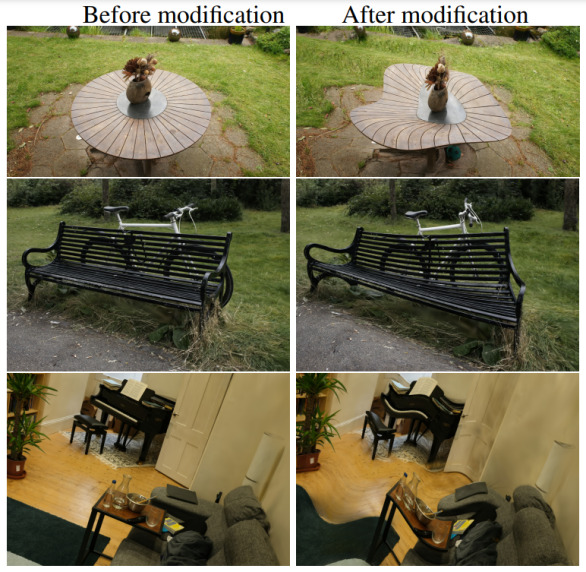
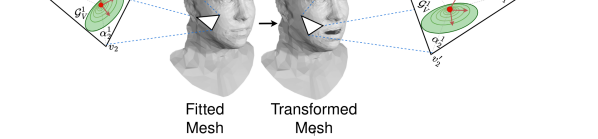
Gaussian Splatting (GS) is a novel, state-of-the-art technique for rendering points in a 3D scene by approximating their contribution to image pixels through Gaussian distributions, warranting fast training and real-time rendering. The main drawback of GS is the absence of a well-defined approach for its conditioning due to the necessity of conditioning several hundred thousand Gaussian components. To solve this, we introduce the Gaussian Mesh Splatting (GaMeS) model, which allows modification of Gaussian components in a similar way as meshes. We parameterize each Gaussian component by the vertices of the mesh face. Furthermore, our model needs mesh initialization on input or estimated mesh during training. We also define Gaussian splats solely based on their location on the mesh, allowing for automatic adjustments in position, scale, and rotation during animation. As a result, we obtain a real-time rendering of editable GS.
Motivation & Objective
- Motivate faster, editable 3D scene rendering compared to neural radiance fields (NeRFs).
- Introduce a mesh-based Gaussian Splatting (GaMeS) representation that enables real-time modification and animation of Gaussians via mesh changes.
- Show that GaMeS can operate with or without an explicit input mesh and can be initialized from pseudo-mesh or FLAME-based meshes.
- Demonstrate competitive rendering quality on multiple datasets while enabling efficient, one-stage training and editing.
Proposed method
- Parameterize each Gaussian by the vertices of a mesh face, placing Gaussians on mesh surfaces.
- Use a conductivity where the mean of a Gaussian is a convex combination of the face vertices, maintaining alignment with the face center.
- Represent Gaussian covariances with a factorized form Sigma = R^T S R, where R is a rotation aligned to the face and S is a diagonal scaling; fix the first scale component to a small epsilon to lie on the surface.
- Allow both mesh-based and pseudo-mesh-based GaMeS; when a mesh is absent, infer a pseudo-mesh by reparameterizing Gaussians per component onto estimated faces.
- Provide a single-stage training regime where mesh and Gaussian parameters are jointly optimized, enabling real-time adjustments when the mesh is edited.
- Optionally initialize a mesh using FLAME for human-face experiments and train GaMeS to achieve editable, animated results.
Experimental results
Research questions
- RQ1Can GaMeS achieve comparable rendering quality to state-of-the-art Gaussian Splatting (GS) methods while enabling editable, mesh-bound Gaussian components?
- RQ2Does binding Gaussians to mesh faces allow automatic propagation of mesh edits to Gaussian parameters (means and covariances) during training and inference?
- RQ3Is GaMeS effective with both pre-existing meshes and pseudo-meshes generated during training, and how does initialization (including FLAME) affect performance?
- RQ4What is the impact of per-face Gaussian quantity and mesh face subdivision on rendering quality and training time?
- RQ5How does GaMeS perform in animated or dynamically edited scenarios compared to static GS?
Key findings
- GaMeS yields competitive PSNR results compared to baselines on NeRF-Synthetic and Mip-NeRF360 datasets.
- GaMeS enables real-time editing where mesh modifications automatically propagate to Gaussian means and covariances, maintaining high rendering quality during transformations.
- GaMeS supports scenarios with an existing mesh, pseudo-mesh initialization, and FLAME-based human-face initialization, showing flexibility across objects and scenes.
- Using a pseudo-mesh (one face per Gaussian) allows editing Gaussians without expensive preprocessing, achieving results close to GS variants.
- Subdividing large mesh faces improves robustness and rendering quality when undergoing significant mesh deformations.
- Inference and editing can be performed at speeds comparable to static GS renderings, with a training time ranging from minutes to under an hour depending on scene complexity.
Read this paper
Open the full text in the Nubint reader and ask about any passage as you read.
Read this paper on NubintThis review was generated by AI from the original paper. Please check the paper before citing it.