
[Paper Review] Gate Tunable Josephson Diode in Proximitized InAs Supercurrent Interferometers
Demonstrates gate-tunable Josephson diode in a proximitized InAs SQUID with non-sinusoidal CPR, achieving up to ~30% diode efficiency at finite flux bias.
The Josephson diode (JD) is a non-reciprocal circuit element that supports a larger critical current in one direction compared to the other. This effect has gained a growing interest because of promising applications in superconducting electronic circuits with low power consumption. Some implementations of a JD rely on breaking the inversion symmetry in the material used to realize Josephson junctions (JJs), but two recent theoretical proposals have suggested that the effect can also be engineered by combining two JJs hosting highly transmitting Andreev bound states in a Superconducting Quantum Interference Device (SQUID) at a small, but finite flux bias [1, 2]. We have realized a SQUID with two JJs fabricated in a proximitized InAs two-dimensional electron gas (2DEG). We demonstrate gate control of the diode efficiency from zero up to around 30% at specific flux bias values which comes close to the maximum of approxiomately 40% predicated in Ref. [1]. The key ingredients to the JD effect in the SQUID arrangement is the presence of highly transmitting channels in the JJs, a flux bias and an asymmetry between the two SQUID arms.
Motivation & Objective
- Motivate the search for superconducting diodes as low-dissipation circuit elements for quantum technologies.
- Investigate whether a Josephson diode (SDE) can be engineered in a SQUID using two non-sinusoidal JJs.
- Show that diode behavior arises from interference of higher harmonics in CPRs of highly transmitting channels.
- Quantify gate control of diode efficiency and compare with theoretical predictions.
- Disentangle origins of SDE from loop inductances and other potential artefacts.
Proposed method
- Model each junction with a non-sinusoidal CPR approximated by I(phi)= (I_c/A_N) * sin(phi) / sqrt(1 - tau* sin^2(phi/2)) across channels.
- Use an effective transmission tau* to capture highly transmitting channels in multichannel InAs/Al JJs.
- Apply flux through the SQUID to relate branch phases via varphi_ext = 2πΦ_ext/Φ0 and sum currents I(phi1)+I(phi2).
- Introduce asymmetry parameters alpha and beta to quantify critical-current and transmission-channel differences between the two arms.
- Compare experimental I_c^+ and I_c^- as functions of Φ_ext with model predictions to identify SDE origins.
- Assess potential artefacts from loop inductances and hysteresis by simulations and cross-checks of switching/retrapping currents.

Experimental results
Research questions
- RQ1Can a Josephson diode effect be realized in a gate-tunable, proximitized InAs SQUID?
- RQ2What conditions (non-sinusoidal CPRs, asymmetry, and finite flux bias) are required to observe SDE in such devices?
- RQ3How well does a two-junction SQUID with highly transmitting channels reproduce the predicted SDE magnitudes?
- RQ4To what extent can gate tuning control the diode efficiency in this platform?
- RQ5Are loop inductances or hysteretic effects sufficient to explain observed SDEs?
Key findings
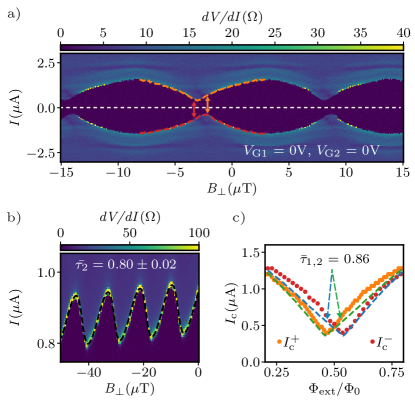
- A SDE is observed in a dc SQUID with two non-sinusoidal JJs in proximitized InAs, showing I_c^+ ≠ I_c^- at finite flux bias.
- The diode efficiency reaches approximately 30% under suitable gate configurations and flux values.
- Fitting the data with a model using tau* ≈ 0.86 for both junctions and measured I_c1, I_c2 reproduces the flux dependence of I_c^+ and I_c^- well.
- The large tau* indicates strongly non-sinusoidal CPRs due to highly transmitting channels in multichannel JJs.
- Numerical comparisons suggest loop inductances alone cannot explain the observed SDE, reinforcing the CPR-interference origin.
- Gate control of the diode efficiency follows a characteristic butterfly pattern, with maxima near asymmetric gate settings and Φ_ext ≈ 0.25–0.75 Φ0; maximum observed is ~0.3.
Read this paper
Open the full text in the Nubint reader and ask about any passage as you read.
Read this paper on NubintThis review was generated by AI from the original paper. Please check the paper before citing it.