
[Paper Review] General Purpose Verification for Chain of Thought Prompting
This paper proposes a general-purpose verification framework for Chain-of-Thought (CoT) prompting that improves LLM reasoning by applying three core principles—Relevance, Mathematical Accuracy, and Logical Consistency—via LLM-based verifiers operating at the step level. It outperforms both vanilla generation and best-of-N sampling on 6 out of 9 datasets, demonstrating that self-verification enhances reasoning quality beyond perplexity alone.
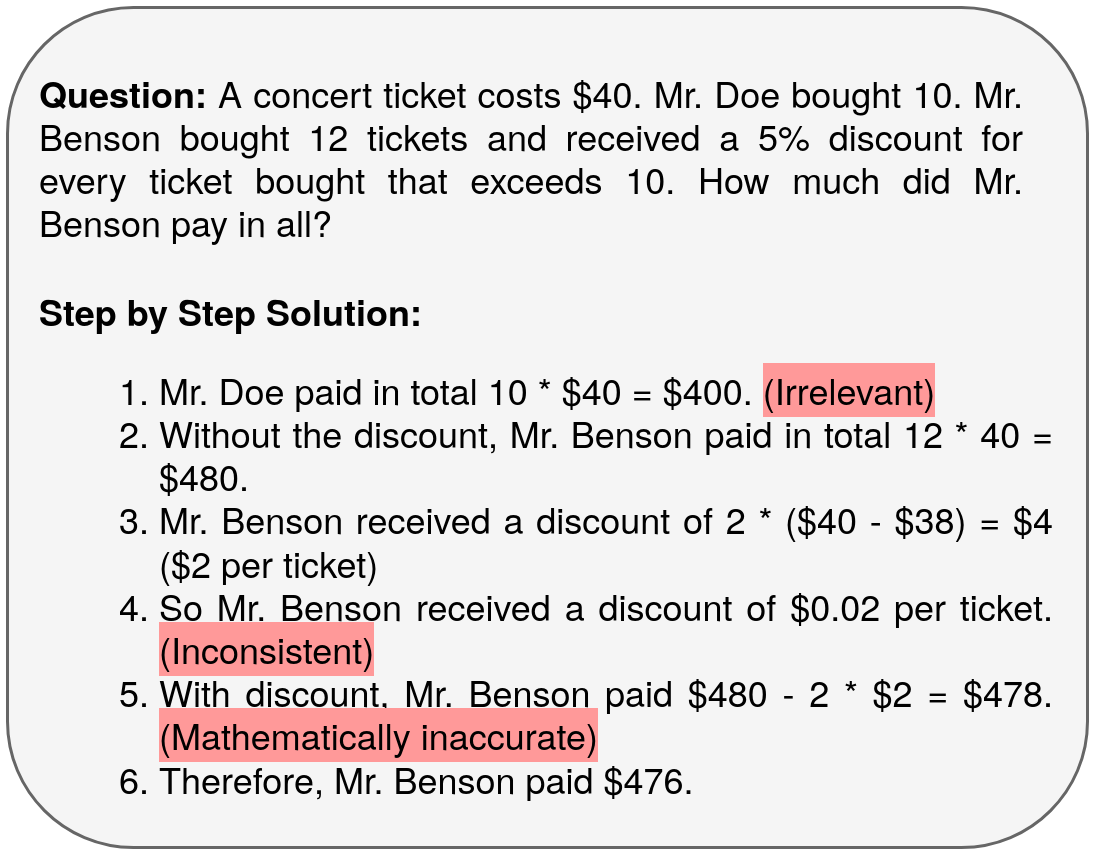
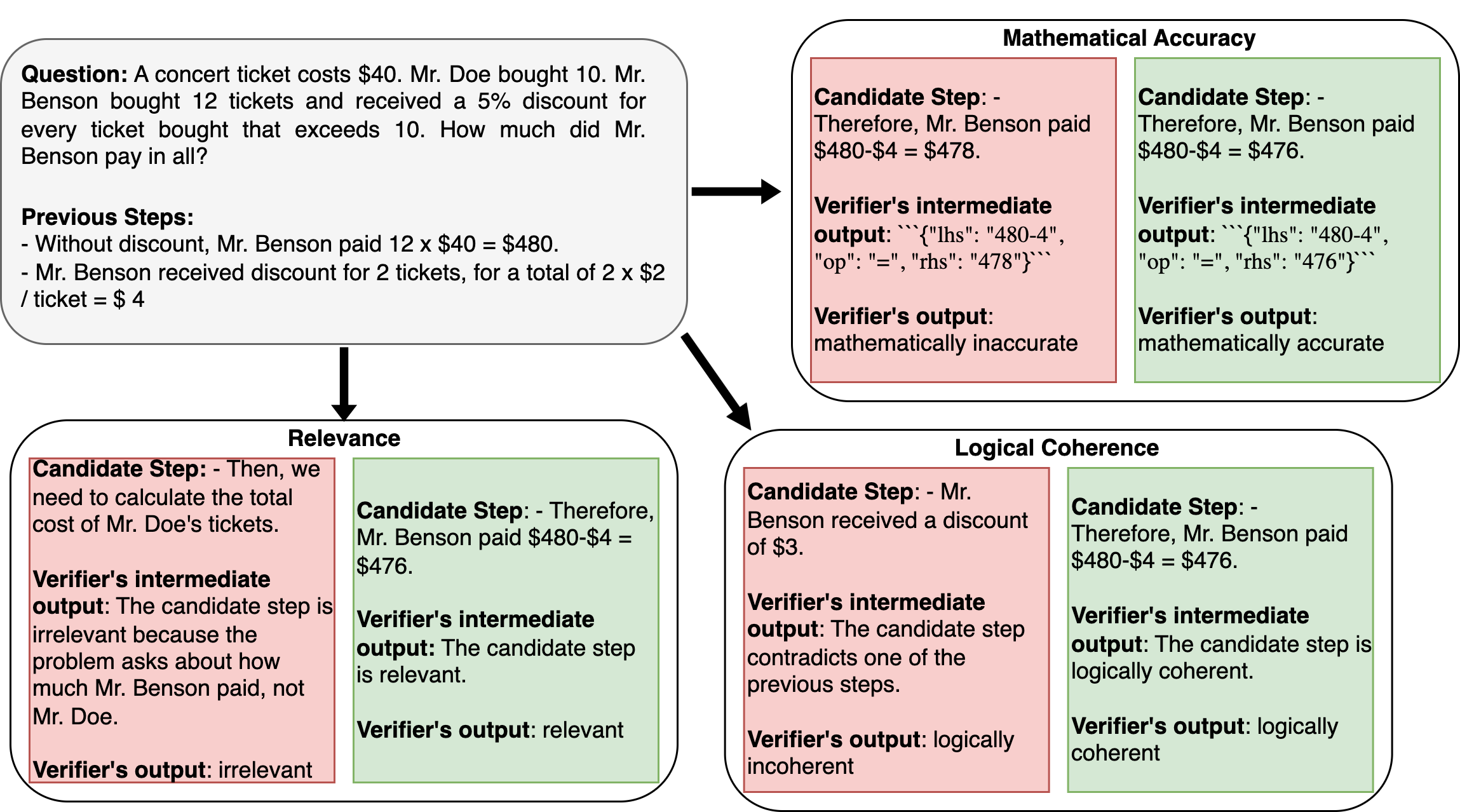
Many of the recent capabilities demonstrated by Large Language Models (LLMs) arise primarily from their ability to exploit contextual information. In this paper, we explore ways to improve reasoning capabilities of LLMs through (1) exploration of different chains of thought and (2) validation of the individual steps of the reasoning process. We propose three general principles that a model should adhere to while reasoning: (i) Relevance, (ii) Mathematical Accuracy, and (iii) Logical Consistency. We apply these constraints to the reasoning steps generated by the LLM to improve the accuracy of the final generation. The constraints are applied in the form of verifiers: the model itself is asked to verify if the generated steps satisfy each constraint. To further steer the generations towards high-quality solutions, we use the perplexity of the reasoning steps as an additional verifier. We evaluate our method on 4 distinct types of reasoning tasks, spanning a total of 9 different datasets. Experiments show that our method is always better than vanilla generation, and, in 6 out of the 9 datasets, it is better than best-of N sampling which samples N reasoning chains and picks the lowest perplexity generation.
Motivation & Objective
- To improve the reasoning capabilities of large language models (LLMs) by detecting and correcting errors in intermediate reasoning steps.
- To develop a problem-agnostic verification framework that generalizes across diverse reasoning tasks without task-specific fine-tuning.
- To investigate whether LLMs can self-verify their own reasoning steps using intrinsic signals like perplexity and logical constraints.
- To evaluate whether verification improves upon existing ensembling techniques like Self-Consistency.
- To assess the alignment between automated verifier scores and human judgments of reasoning quality.
Proposed method
- The framework applies three LLM-based verifiers to evaluate each reasoning step for Relevance, Mathematical Accuracy, and Logical Consistency.
- Each verifier assigns a score to individual reasoning steps using prompt-based LLM inference.
- Perplexity of each reasoning step is used as an additional steering signal to guide generation toward higher-quality chains.
- Verifier scores are aggregated using techniques like Self-Consistency to select the final answer.
- The method is evaluated across four reasoning task types and nine datasets using a zero-shot, prompt-based approach.
- Human evaluation is conducted to assess alignment between verifier scores and human judgments of reasoning quality.
Experimental results
Research questions
- RQ1Can LLMs reliably verify their own reasoning steps using general principles like Relevance, Mathematical Accuracy, and Logical Consistency?
- RQ2Does step-level verification improve final answer accuracy beyond standard CoT prompting and best-of-N sampling?
- RQ3How well do automated verifier scores correlate with human judgments of reasoning quality?
- RQ4Can perplexity of reasoning steps serve as a useful proxy for quality when combined with principled verifiers?
- RQ5Does the proposed verification framework generalize across diverse reasoning tasks without task-specific adaptation?
Key findings
- The proposed verification framework consistently improves reasoning performance across all nine datasets tested, outperforming vanilla CoT generation.
- In six out of nine datasets, the method outperformed best-of-N sampling, which selects the lowest-perplexity reasoning chain, indicating that verifiers provide information beyond perplexity alone.
- Verifier scores showed statistically significant correlations (p < 0.0001) with human judgments, despite low-to-moderate effect sizes, validating their relevance to reasoning quality.
- Less than 2% of human-annotated errors were not captured by the three core principles, indicating high coverage of common reasoning flaws.
- The framework demonstrates that LLMs can detect their own mistakes, albeit with noise, suggesting inherent potential for self-correction in reasoning.
- The approach is generalizable and does not require fine-tuning or task-specific adaptation, making it broadly applicable across reasoning tasks.
Read this paper
Open the full text in the Nubint reader and ask about any passage as you read.
Read this paper on NubintThis review was generated by AI from the original paper. Please check the paper before citing it.