
[Paper Review] Generalized Zeno effect and entanglement dynamics induced by fermion counting
This paper investigates how fermion counting—continuous monitoring of particle exchange with reservoirs—induces a generalized Zeno effect in one-dimensional free fermions, suppressing entanglement growth despite rapid state fluctuations. Using replica Keldysh field theory and numerical quantum trajectory simulations, it shows that fermion counting and local occupation measurements yield nearly identical entanglement and correlation properties due to a universal SU(R) nonlinear sigma model description, with no critical phase exhibiting conformal invariance at finite measurement rates.
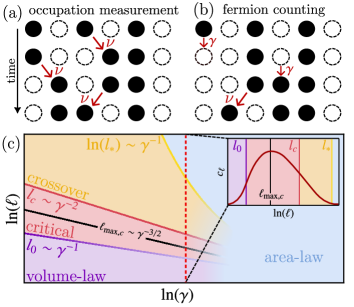
We study a one-dimensional lattice system of free fermions subjected to a generalized measurement process: the system exchanges particles with its environment, but each fermion leaving or entering the system is counted. In contrast to the freezing of dynamics due to frequent measurements of lattice site occupation numbers, a high rate of fermion counts induces fast fluctuations in the state of the system. Still, through numerical simulations of quantum trajectories and an analytical approach based on replica Keldysh field theory, we find that instantaneous correlations and entanglement properties of free fermions subjected to fermion counting and local occupation measurements are strikingly similar. We explain this similarity through a generalized Zeno effect induced by fermion counting and a universal long-wavelength description in terms of a nonlinear sigma model. The physical requirements underlying this universal emergent behavior are conservation of the total number of particles in the system and its environment, and conservation of the purity of the state of the system by keeping a full record of all measurement outcomes. For both types of measurement processes, we present strong evidence against the existence of a critical phase with logarithmic entanglement and conformal invariance. Instead, we identify a finite critical range of length scales on which signatures of conformal invariance are observable. While area-law entanglement is established beyond a scale that is exponentially large in the measurement rate, the upper boundary of the critical range is only algebraically large and thus numerically accessible. Our finding that these properties do not rely on particle number conservation has far reaching implications for measurement-induced phenomena beyond noninteracting fermions, such as charge sharpening in random quantum circuits or generic interacting systems.
Motivation & Objective
- To understand the dynamical and entanglement consequences of continuous fermion counting in a 1D lattice of free fermions.
- To compare fermion counting with generalized measurements of local occupation numbers, despite their differing dynamics.
- To determine whether a critical phase with logarithmic entanglement and conformal invariance exists at finite measurement rates.
- To establish a universal long-wavelength effective field theory description for both measurement protocols.
- To resolve conflicting prior claims about measurement-induced entanglement transitions in free fermionic systems.
Proposed method
- Employing replica Keldysh field theory to derive a long-wavelength effective action for the system under fermion counting and occupation measurements.
- Deriving a universal SU(R) nonlinear sigma model (NLSM) effective field theory that captures the universal low-energy behavior of both measurement protocols.
- Performing numerical simulations of quantum trajectories to compute entanglement entropy and correlation functions for both models.
- Expanding the effective action to second order in massive modes (θ, φ, Θ) to extract universal scaling behavior and suppress non-universal terms.
- Using symmetry arguments to eliminate redundant field modes (e.g., RΦ rotations) and focus on the replica-symmetric and replicon sectors.
- Comparing the measurement Lagrangians for fermion counting and occupation measurements to identify differences in the effective action and their physical consequences.
Experimental results
Research questions
- RQ1Does continuous fermion counting induce a generalized Zeno effect that suppresses entanglement growth despite rapid state fluctuations?
- RQ2To what extent are the entanglement and correlation properties of fermion counting and local occupation measurements quantitatively similar?
- RQ3Is there a critical phase with logarithmic entanglement entropy and conformal invariance at finite measurement rates in 1D free fermions?
- RQ4What is the universal long-wavelength effective field theory that describes both fermion counting and occupation measurement protocols?
- RQ5How does the upper boundary of the critical range for conformal-like behavior scale with measurement rate γ?
Key findings
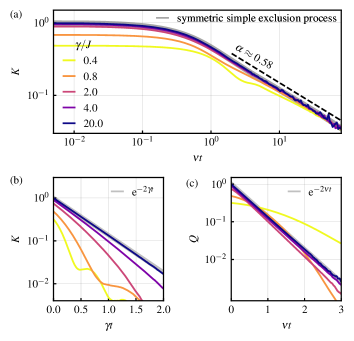
- Fermion counting induces a generalized Zeno effect that suppresses entanglement growth, despite rapid quantum jumps due to particle counting.
- Despite vastly different dynamics—fluctuating states under fermion counting versus frozen states under repeated projective measurements—the steady-state entanglement and correlation functions are nearly indistinguishable.
- A universal long-wavelength description in terms of an SU(R) nonlinear sigma model explains the universality of the entanglement and correlation properties across both measurement protocols.
- There is strong evidence against the existence of a critical phase with logarithmic entanglement and conformal invariance at finite measurement rates γ.
- The critical range on which conformal-like signatures are observable is finite and algebraically large in γ, not exponentially large, making it numerically accessible.
- Beyond a length scale exponentially large in γ, area-law entanglement is strictly established, confirming the stabilization of short-range correlations under any nonzero measurement rate.
Read this paper
Open the full text in the Nubint reader and ask about any passage as you read.
Read this paper on NubintThis review was generated by AI from the original paper. Please check the paper before citing it.