
[Paper Review] Global transformer overheating from geomagnetic storms
This paper develops a global-scale framework to assess transformer overheating risks from geomagnetic storms using geoelectric fields, global conductivity models, and thermal simulations of high-voltage transformers. It estimates that a 1-in-10,000-year storm could cause long-term power outages affecting 0.99% of Europe’s population and 0.86% of North America’s, with over 7.4 million and 4.1 million people impacted respectively.
Geomagnetic storms occurring due to sustained, high-speed solar winds are known to induce currents in power distribution networks. These geomagnetically induced currents (GICs) can cause high voltage transformers (HVT) to overheat, thus resulting in a catastrophic electricity loss event (CELE). Since significant portions of infrastructures around the world rely heavily on access to electric power, it is essential to estimate the risks associated with GICs on a global scale. We assemble multiple methodologies across various scientific disciplines to develop a framework assessing the probability of a severe geomagnetic storm causing a long-term, widespread power outage. Our model incorporates thermal models of HVT tie bar hot spots, historical geoelectric field estimates, and a global conductivity model to estimate the risk of long-term power outage for regions between -70 degrees and 80 degrees geomagnetic latitude due to transformer overheating failure. Assuming a uniform 33% HVT spare capacity, our analysis indicates that a 1 in 10,000 year storm would result in approximately 1% of the population in Europe and North America experiencing a long-term (months to years) electricity loss.
Motivation & Objective
- To address the lack of global-scale risk assessment for geomagnetically induced currents (GICs) on power grids.
- To quantify the probability and population impact of catastrophic electricity loss (CEL) due to transformer overheating from severe geomagnetic storms.
- To develop an open-source, scalable modeling framework applicable to any region with sufficient grid and geophysical data.
- To inform policymakers and infrastructure planners about global catastrophic risks from space weather.
Proposed method
- Integrates historical geomagnetic field data from ground stations and magnetotelluric (MT) transfer functions to estimate geoelectric fields.
- Applies a global conductivity model to extrapolate geoelectric field estimates across regions with limited data.
- Uses thermal models of high-voltage transformer (HVT) tie bar hot spots to predict overheating failure under GIC exposure.
- Combines grid topology from OpenStreetMap and NERC/EPRI data with transformer failure probabilities to estimate regional power loss.
- Employs a log-normal fit to adjusted geoelectric field levels to estimate storm recurrence and intensity at reference locations.
- Executes the model in open-source Python code, deployable on standard hardware without supercomputing resources.
![Figure 2: Peak $60$ -second geoelectric field magnitude for a $1$ -in- $100$ year storm in Europe (top) and North America (bottom). The colour indicates the field level [V/km].](https://ar5iv.labs.arxiv.org/html/2403.18070/assets/x1.png)
Experimental results
Research questions
- RQ1What is the global risk of transformer overheating due to geomagnetic storms, particularly for extreme events?
- RQ2How does the population in Europe and North America scale with long-term power outage probability under a 1-in-10,000-year storm?
- RQ3To what extent can geoelectric field estimates be extrapolated globally using limited magnetotelluric data?
- RQ4How do variations in transformer spare capacity and grid topology affect the likelihood of widespread power outages?
- RQ5Can a unified, open-source modeling framework be developed to assess GIC-induced transformer failure at scale?
Key findings
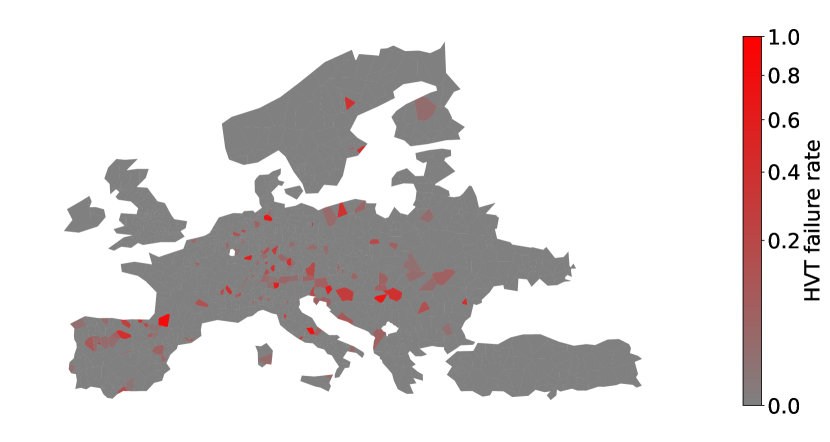
- A 1-in-10,000-year geomagnetic storm would result in approximately 0.99% of Europe’s population (over 7.4 million people) experiencing long-term electricity loss.
- In North America, the same storm would affect 0.86% of the population (over 4.1 million people) with long-term outages.
- The model estimates total expected power loss at 49.71 GW in Europe and 56.12 GW in North America under such an extreme event.
- The framework is open-source and executable on standard personal computers, enabling broad accessibility and regional adaptation.
- The study identifies data limitations—especially in grid and magnetotelluric data—as the main constraint, not model structure.
- The model provides a foundational, scalable approach for global risk assessment of GIC-induced transformer failures, with potential for expansion to GDP and industrial impact metrics.
Better researchstarts right now
From reading papers to final review, dramatically reduce your research time.
No credit card · Free plan available
This review was created by AI and reviewed by human editors.