
[Paper Review] Graph-based Simultaneous Coverage and Exploration Planning for Fast Multi-robot Search
This paper proposes a unified graph-based planner, Pose Graph Aware Random Trees (PGART), and a hierarchical task allocator, HIGH, for fast multi-robot search in unknown environments. By grounding random trees in a pose graph from multi-robot SLAM, PGART reduces tree pruning and enables simultaneous exploration and coverage planning, while HIGH prioritizes high-information tasks using a hierarchical information heuristic. The approach achieves 20% higher coverage efficiency and 34.2% better sum of search times than state-of-the-art methods.
In large unknown environments, search operations can be much more time-efficient with the use of multi-robot fleets by parallelizing efforts. This means robots must efficiently perform collaborative mapping (exploration) while simultaneously searching an area for victims (coverage). Previous simultaneous mapping and planning techniques treat these problems as separate and do not take advantage of the possibility for a unified approach. We propose a novel exploration-coverage planner which bridges the mapping and search domains by growing sets of random trees rooted upon a pose graph produced through mapping to generate points of interest, or tasks. Furthermore, it is important for the robots to first prioritize high information tasks to locate the greatest number of victims in minimum time by balancing coverage and exploration, which current methods do not address. Towards this goal, we also present a new multi-robot task allocator that formulates a notion of a hierarchical information heuristic for time-critical collaborative search. Our results show that our algorithm produces 20% more coverage efficiency, defined as average covered area per second, compared to the existing state-of-the-art. Our algorithms and the rest of our multi-robot search stack is based in ROS and made open source
Motivation & Objective
- Address the inefficiency of treating exploration and coverage as separate problems in multi-robot search for disaster response.
- Reduce computational cost and improve consistency in online multi-robot search by unifying exploration and coverage planning.
- Develop a task allocator that prioritizes high-information areas without prior knowledge of victim distribution.
- Enable real-time, scalable, and repeatable multi-robot search with minimal backtracking and dynamic map adaptation.
- Demonstrate superior performance in both simulation and real-world experiments compared to existing state-of-the-art methods.
Proposed method
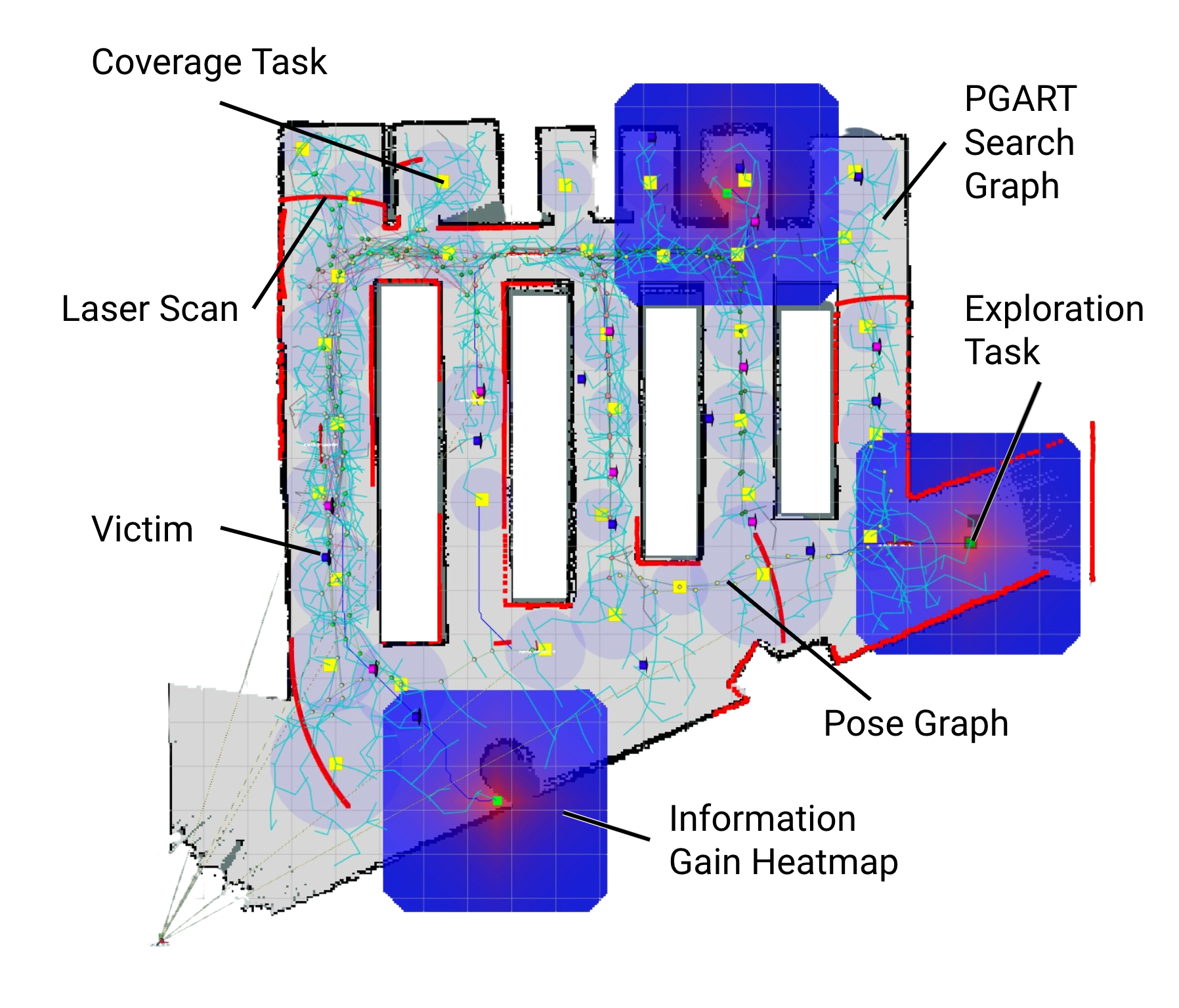
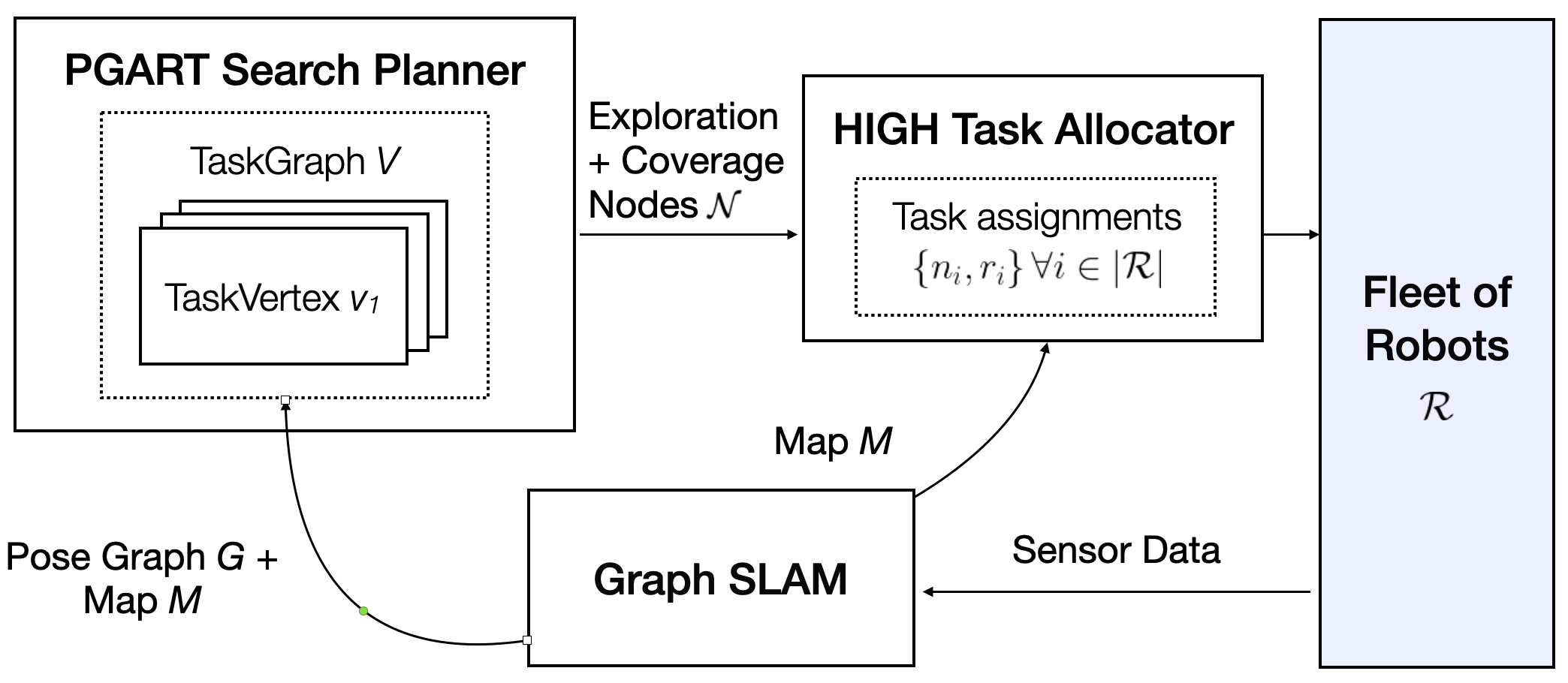
- PGART constructs random trees rooted on a pose graph generated by graph-based SLAM, enabling persistent task representation despite loop closures.
- The pose graph acts as a stable, shared memory for the fleet, reducing redundant tree construction and minimizing pruning during map updates.
- PGART generates both exploration (frontier) and coverage (area-sweeping) tasks by growing trees from pose graph nodes, ensuring no backtracking into already covered regions.
- The HIGH allocator uses a hierarchical information heuristic tree to estimate victim distribution and assign relative importance to tasks based on information gain, distance cost, and coverage/exploration balance.
- A custom reward function in HIGH optimizes task allocation by balancing information utility, travel cost, and task priority, enabling faster victim detection.
- The system is implemented in ROS and open-sourced, supporting real-time operation with Khepera IV robots in real-world indoor environments.
Experimental results
Research questions
- RQ1Can a unified planner effectively balance exploration and coverage in unknown multi-robot search without treating them as separate problems?
- RQ2How can a pose graph-based tree-growing method reduce tree pruning and improve task persistence in dynamic SLAM environments?
- RQ3To what extent can a hierarchical information heuristic improve task allocation in time-critical search when victim distribution is unknown?
- RQ4How does the proposed PGART and HIGH framework compare to state-of-the-art methods in terms of coverage efficiency and victim detection speed?
- RQ5Can the proposed system generalize across diverse environments and transfer effectively from simulation to real-world deployment?
Key findings
- PGART achieved 20% higher coverage efficiency (defined as average covered area per second) compared to the state-of-the-art RRT and NBVP methods.
- PGART reduced node pruning rate to 5.3% compared to 26.7% for RRT, indicating significantly more consistent tree expansion and task retention.
- HIGH reduced the sum of search times (SST) by 34.2% compared to NBVP, demonstrating faster victim detection despite similar victim detection rates.
- HIGH achieved a 96.9% victim detection rate, outperforming NBVP (91.6%) and RRT (91.1%), showing superior coverage and exploration balance.
- HIGH had a 47.1% lower standard deviation in SST than NBVP, indicating more consistent and repeatable performance across runs.
- In real-world experiments with five Khepera IV robots, HIGH achieved 20.0% better search efficiency and 30.1% better SST than NBVP, validating sim-to-real transferability.
Read this paper
Open the full text in the Nubint reader and ask about any passage as you read.
Read this paper on NubintThis review was generated by AI from the original paper. Please check the paper before citing it.