
[Paper Review] Gravitational waves from binary black holes in a self-interacting scalar dark matter cloud
This paper investigates how gravitational wave (GW) signals from binary black holes are modified when embedded in self-interacting scalar dark matter clouds, where repulsive self-interactions balance gravitational collapse. It identifies distinct post-Newtonian corrections—-3PN from cloud gravity, -4PN/-5.5PN from accretion, and -5.5PN from dynamical friction—that could be detectable by LISA and DECIGO, offering a unique probe of dark matter properties in sub-0.1 pc solitons.
We investigate the imprints of accretion and dynamical friction on the gravitational-wave signals emitted by binary black holes embedded in a scalar dark matter cloud. As a key feature in this work, we focus on scalar fields with a repulsive self-interaction that balances against the self-gravity of the cloud. To a first approximation, the phase of the gravitational-wave signal receives extra correction terms at $-3$PN, $-4$PN and $-5.5$PN orders, relative to the prediction of vacuum general relativity, due to cloud gravity, accretion and dynamical friction. Future observations by LISA and B-DECIGO have the potential to detect these effects for a large range of scalar masses~$m_\mathrm{DM}$ and self-interaction couplings~$λ_4$. This would correspond to scenarios with dark matter clouds smaller than $0.1$ pc, which would be difficult to detect by other probes.
Motivation & Objective
- To investigate the impact of self-interacting scalar dark matter clouds on gravitational wave signals from binary black holes.
- To model how cloud gravity, accretion, and dynamical friction alter the orbital evolution and GW waveform beyond general relativity predictions.
- To assess the detectability of these effects with future space-based GW detectors like LISA and DECIGO.
- To constrain dark matter parameters such as scalar mass, self-interaction coupling, and soliton density from GW observations.
- To identify a previously unexplored probe for small, dense dark matter solitons (<0.1 pc) that evade detection by other methods.
Proposed method
- Model the scalar dark matter cloud as a soliton supported by a balance between self-gravity and repulsive quartic self-interaction.
- Compute the gravitational potential of the cloud to derive its -3PN correction to the GW phase, using the Poisson equation for the scalar field.
- Calculate accretion drag forces on black holes using a fluid-dynamical approach, deriving -4PN and -5.5PN corrections depending on frequency regime.
- Model dynamical friction via gravitational wake formation behind moving black holes, yielding a -5.5PN correction in the supersonic regime.
- Use post-Newtonian effective field theory techniques to compute the cumulative phase shift in the GW signal due to these three effects.
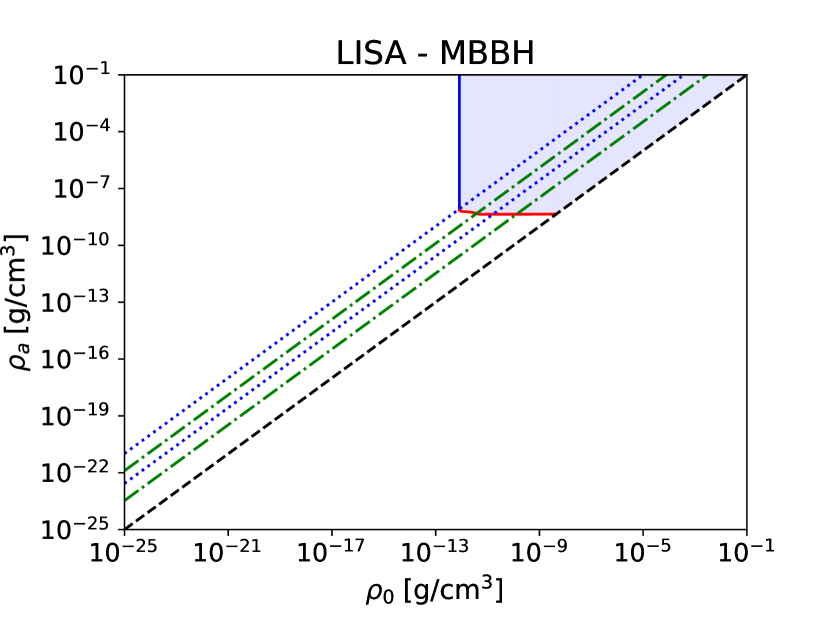
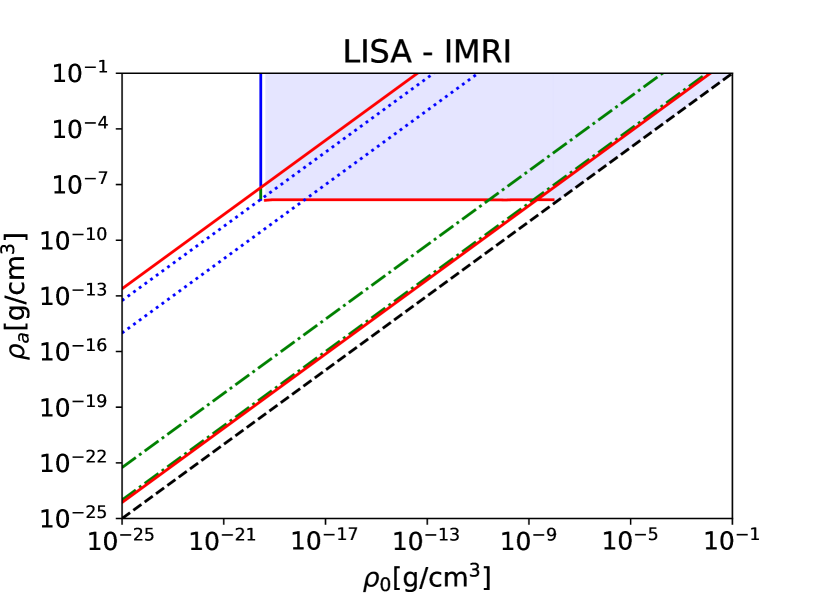
- Perform signal-to-noise ratio estimates for LISA and DECIGO to assess detectability across the scalar dark matter parameter space.
Experimental results
Research questions
- RQ1How do self-interacting scalar dark matter clouds modify the gravitational wave phase of binary black hole systems beyond general relativity predictions?
- RQ2What are the relative contributions of cloud gravity, accretion, and dynamical friction to the post-Newtonian corrections in the GW signal?
- RQ3For which ranges of scalar mass and self-interaction coupling can these effects be detected by LISA and DECIGO?
- RQ4Can GW observations distinguish between self-interacting scalar dark matter and other environmental effects like gaseous clouds?
- RQ5What constraints can be placed on soliton size, central density, and dark matter bulk density from detectable GW deviations?
Key findings
- The cloud's gravity introduces a -3PN correction to the gravitational wave phase, arising from the scalar field's background potential.
- Accretion of dark matter onto black holes contributes a -4PN correction at low frequencies and a -5.5PN correction at high frequencies.
- Dynamical friction produces a -5.5PN correction in the supersonic regime, due to gravitational wake formation in the scalar fluid.
- These corrections are non-degenerate with standard relativistic post-Newtonian terms, enabling unique detection of dark matter effects.
- LISA and DECIGO can detect these effects for dark matter solitons smaller than 0.1 pc, provided the central density exceeds ~1 g/cm³.
- The detection would constrain the soliton’s central density ρ₀ and the combination mₐₘ⁴/λ₄, offering indirect estimates of soliton size Rₛₒₗ.
Read this paper
Open the full text in the Nubint reader and ask about any passage as you read.
Read this paper on NubintThis review was generated by AI from the original paper. Please check the paper before citing it.