
[Paper Review] GridShift: A Faster Mode-seeking Algorithm for Image Segmentation and Object Tracking
This paper proposes GridShift (GS), a faster mode-seeking algorithm for image segmentation and object tracking that accelerates mean shift clustering via a grid-based neighbor search and centroid-based shifting of active grid cells. GS achieves linear time complexity in data points and exponential in features, outperforming MS++, CamShift, and state-of-the-art methods in speed (up to 40x faster than MS++) and accuracy on benchmark datasets.
In machine learning and computer vision, mean shift (MS) qualifies as one of the most popular mode-seeking algorithms used for clustering and image segmentation. It iteratively moves each data point to the weighted mean of its neighborhood data points. The computational cost required to find the neighbors of each data point is quadratic to the number of data points. Consequently, the vanilla MS appears to be very slow for large-scale datasets. To address this issue, we propose a mode-seeking algorithm called GridShift, with significant speedup and principally based on MS. To accelerate, GridShift employs a grid-based approach for neighbor search, which is linear in the number of data points. In addition, GridShift moves the active grid cells (grid cells associated with at least one data point) in place of data points towards the higher density, a step that provides more speedup. The runtime of GridShift is linear in the number of active grid cells and exponential in the number of features. Therefore, it is ideal for large-scale low-dimensional applications such as object tracking and image segmentation. Through extensive experiments, we showcase the superior performance of GridShift compared to other MS-based as well as state-of-the-art algorithms in terms of accuracy and runtime on benchmark datasets for image segmentation. Finally, we provide a new object-tracking algorithm based on GridShift and show promising results for object tracking compared to CamShift and meanshift++.
Motivation & Objective
- To address the high computational cost of traditional mean shift (MS) clustering, which scales quadratically with data size, limiting its use in large-scale image segmentation and tracking.
- To develop a scalable, efficient alternative to MS and its variants (e.g., MS++, CamShift) that maintains high accuracy while drastically reducing runtime.
- To enable robust, real-time object tracking in dynamic environments with changing lighting and color conditions, overcoming limitations of histogram-based trackers like CamShift.
- To introduce a grid-based framework that accelerates neighbor search and enables efficient, adaptive tracking window updates for fast-moving objects.
Proposed method
- GridShift partitions the feature space into a fixed grid, assigning each data point to a grid cell, reducing neighbor search complexity from O(n²) to O(n) by only checking neighboring grid cells.
- Instead of shifting individual data points, GridShift computes and updates the centroid (weighted mean) of all points in each active grid cell, reducing the number of points to process over iterations.
- The algorithm iteratively shifts active grid cell centroids toward higher-density regions using a mean shift-like update, leveraging the grid structure to accelerate convergence.
- GridShift incorporates a dynamic window adaptation scheme that expands or contracts the tracking window based on object size changes or motion, improving robustness to fast movement.
- For object tracking, GS replaces the static color histogram in CamShift with a dynamic grid cell binning system, enabling real-time adaptation to scene changes and similar-colored distractors.
- The method is designed for low-dimensional, large-scale data, making it ideal for image segmentation and video tracking applications.
Experimental results
Research questions
- RQ1Can a grid-based approach significantly reduce the computational complexity of mean shift clustering while preserving or improving segmentation accuracy?
- RQ2How does GridShift compare to MS++, CamShift, and other state-of-the-art segmentation algorithms in terms of runtime and accuracy on benchmark datasets?
- RQ3Can GridShift enable robust, real-time object tracking in challenging scenarios with similar-colored distractors and changing lighting conditions?
- RQ4Does the use of dynamic grid cell bins instead of fixed histograms improve tracking robustness and adaptability to scene changes?
- RQ5Can GridShift be effectively integrated into existing tracking pipelines to enhance performance without increasing computational overhead?
Key findings
- GridShift achieves up to 40x speedup over MS++ and 40,000x speedup over vanilla mean shift, with runtime linear in the number of active grid cells and exponential in feature dimension.
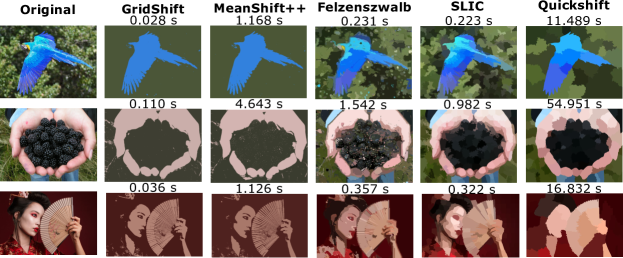
- On image segmentation benchmarks, GridShift outperforms SLIC, Quickshift, Felzenszwalb, and MS++ in both accuracy and runtime, with results 8x to 500x faster than these methods.
- In object tracking, GridShift-based tracker (USOT-GS) achieves an AUC of 0.651 and precision P of 0.872 on OTB100, outperforming 12 state-of-the-art trackers including SiamRPN and USOT.
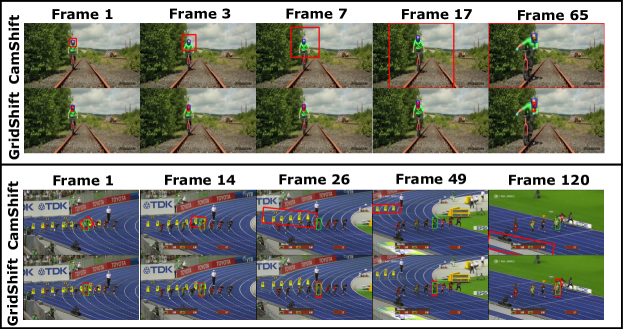
- GridShift successfully tracks objects in challenging conditions—such as low lighting or similar-colored distractors—where CamShift fails due to reliance on static color histograms.
- The dynamic window adaptation and grid cell binning in GS enable effective tracking of fast-moving objects, resolving a key limitation of MS++.
- Integrating GS into the USOT tracker (USOT-GS) improves performance over both USOT and USOT*, demonstrating GS’s effectiveness as a plug-in module for existing tracking frameworks.
Read this paper
Open the full text in the Nubint reader and ask about any passage as you read.
Read this paper on NubintThis review was generated by AI from the original paper. Please check the paper before citing it.