
[Paper Review] Growing Convex Collision-Free Regions in Configuration Space using Nonlinear Programming
IRIS-NP extends IRIS to configuration space by using nonlinear optimization to grow convex, collision-free regions that respect nonlinear kinematics, enabling probabilistic certification and seeding for C-IRIS.
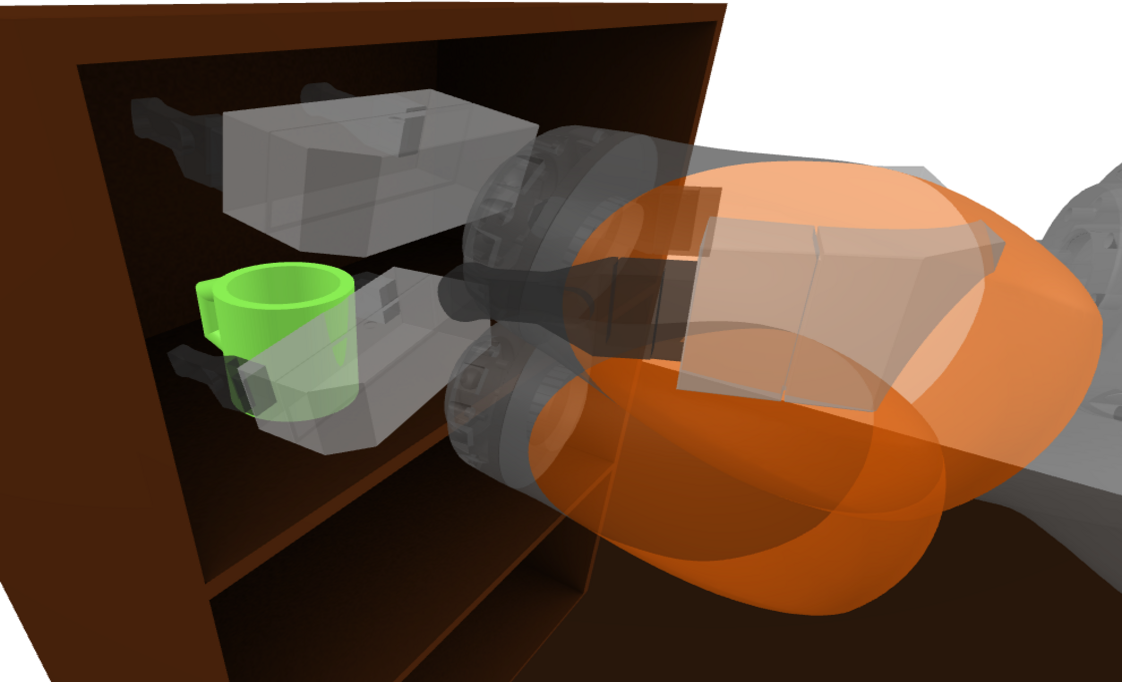
One of the most difficult parts of motion planning in configuration space is ensuring a trajectory does not collide with task-space obstacles in the environment. Generating regions that are convex and collision free in configuration space can separate the computational burden of collision checking from motion planning. To that end, we propose an extension to IRIS (Iterative Regional Inflation by Semidefinite programming) [5] that allows it to operate in configuration space. Our algorithm, IRIS-NP (Iterative Regional Inflation by Semidefinite & Nonlinear Programming), uses nonlinear optimization to add the separating hyperplanes, enabling support for more general nonlinear constraints. Developed in parallel to Amice et al. [1], IRIS-NP trades rigorous certification that regions are collision free for probabilistic certification and the benefit of faster region generation in the configuration-space coordinates. IRIS-NP also provides a solid initialization to C-IRIS to reduce the number of iterations required for certification. We demonstrate that IRIS-NP can scale to a dual-arm manipulator and can handle additional nonlinear constraints using the same machinery. Finally, we show ablations of elements of our implementation to demonstrate their importance.
Motivation & Objective
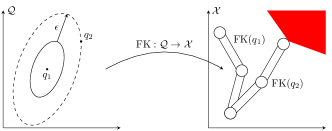
- Motivate collision-free motion planning in configuration space where task-space convex obstacles map to nonconvex C-space.
- Develop an iterative method (IRIS-NP) that uses nonlinear optimization to add separating hyperplanes and grow collision-free regions.
- Provide probabilistic certification and seeding capability for C-IRIS while handling nonlinear forward kinematics.
- Demonstrate scalability to high-DOF manipulators and support for additional nonlinear constraints.
Proposed method
- Extend IRIS by replacing the separating hyperplane step with a nonlinear counterexample search that accounts for forward kinematics.
- Represent region as an inscribed ellipse within a polytope; maximize ellipse volume (via det(C)) subject to collision separation constraints.
- Solve counterexample search with a nonlinear program to find configurations on the ellipse boundary that collide, then add tangent hyperplanes (with a configuration-space margin) to the polytope.
- Compute the largest inscribed ellipse inside the polytope via a semidefinite program (maximize log det tilde C with linearized constraints).
- Optionally seed and accelerate C-IRIS by providing initial configuration-space regions from IRIS-NP and using regions to refine or reparameterize for certification.
- Enable handling of additional nonlinear inequality constraints g(q) ≤ 0 alongside collision constraints; and support region coverage strategies to reduce overlap between multiple regions.
Experimental results
Research questions
- RQ1Can IRIS-NP generate large convex, collision-free regions in configuration space despite nonlinear forward kinematics?
- RQ2How does nonlinear counterexample search influence region growth, certification probability, and runtime?
- RQ3Can IRIS-NP scale to high-DOF manipulators and accommodate extra nonlinear constraints?
- RQ4How do initialization, obstacle ordering, and region-coverage strategies affect performance and coverage?
Key findings
- IRIS-NP can grow convex collision-free regions in configuration space with nonlinear forward kinematics.
- The method remains scalable to high-DOF robots (e.g., 14-DOF dual-arm setup) with region generation times ranging from about 1 to 20 minutes depending on openness of the region.
- Ordering collision pairs by task-space distance from the seed improves runtime and reduces polytope faces without significantly affecting the maximum inscribed ellipse volume.
- Increasing the number of consecutive infeasible counterexample solves reduces the observed fraction of collisions inside regions, providing a tunable probabilistic certificate.
- IRIS-NP supports additional nonlinear inequality constraints and can seed C-IRIS to obtain quickly certified regions.
- Region refinement can adapt existing regions to changes in the environment without full regeneration.
Read this paper
Open the full text in the Nubint reader and ask about any passage as you read.
Read this paper on NubintThis review was generated by AI from the original paper. Please check the paper before citing it.