
[Paper Review] H-Packer: Holographic Rotationally Equivariant Convolutional Neural Network for Protein Side-Chain Packing
H-Packer introduces a lightweight, rotationally equivariant deep learning model that directly regresses protein side-chain dihedral angles ($\chi$) using holographic convolutions, achieving competitive accuracy against physics-based and learning-based methods while being significantly faster and more parameter-efficient than state-of-the-art alternatives like AttnPacker and DiffPack.
Accurately modeling protein 3D structure is essential for the design of functional proteins. An important sub-task of structure modeling is protein side-chain packing: predicting the conformation of side-chains (rotamers) given the protein's backbone structure and amino-acid sequence. Conventional approaches for this task rely on expensive sampling procedures over hand-crafted energy functions and rotamer libraries. Recently, several deep learning methods have been developed to tackle the problem in a data-driven way, albeit with vastly different formulations (from image-to-image translation to directly predicting atomic coordinates). Here, we frame the problem as a joint regression over the side-chains' true degrees of freedom: the dihedral $χ$ angles. We carefully study possible objective functions for this task, while accounting for the underlying symmetries of the task. We propose Holographic Packer (H-Packer), a novel two-stage algorithm for side-chain packing built on top of two light-weight rotationally equivariant neural networks. We evaluate our method on CASP13 and CASP14 targets. H-Packer is computationally efficient and shows favorable performance against conventional physics-based algorithms and is competitive against alternative deep learning solutions.
Motivation & Objective
- To develop a computationally efficient and accurate method for protein side-chain packing that avoids reliance on rotamer libraries.
- To address the limitations of existing deep learning and physics-based methods by directly regressing over the true degrees of freedom: $\chi$ dihedral angles.
- To leverage rotational equivariance through spherical Fourier space operations to improve geometric reasoning in local protein environments.
- To reduce model complexity and training cost while maintaining high performance, enabling deployment on limited hardware.
- To explore and validate a geometrically principled loss function based on sine and cosine transforms of $\chi$ angles.
Proposed method
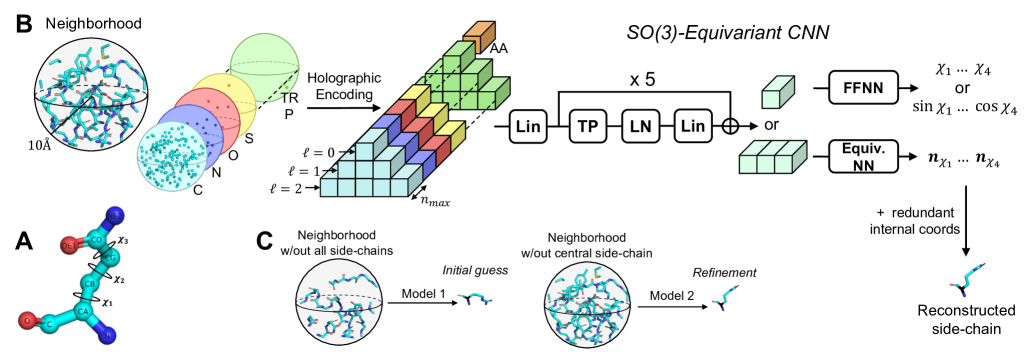
- Uses two-stage architecture: first stage predicts initial $\chi$ angles from backbone coordinates and residue identity; second stage refines predictions using neighboring side-chain atomic coordinates.
- Employs holographic convolutional neural networks (H-CNNs) that operate in spherical Fourier space to achieve SO(3) rotational equivariance.
- Parameterizes $\chi$ angles using sine and cosine transforms to ensure periodicity and avoid discontinuities in the loss landscape.
- Trains on full-atom structures to learn residue-specific preferences based on local atomic environments.
- Applies a geometrically motivated loss function over $\sin(\chi)$ and $\cos(\chi)$ to improve generalization and symmetry handling.
- Optimizes inference by parallelizing holographic encoding computation, currently a bottleneck accounting for 88% of inference time.
Experimental results
Research questions
- RQ1Can direct regression over $\chi$ dihedral angles using rotationally equivariant networks outperform rotamer library-based or coordinate-prediction methods in side-chain packing?
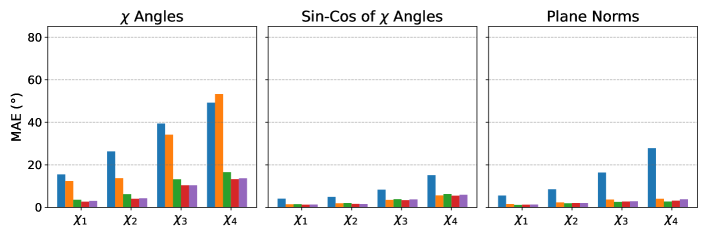
- RQ2How does using sine and cosine parameterization of $\chi$ angles compare to direct angle regression in terms of loss landscape smoothness and prediction accuracy?
- RQ3To what extent does a lightweight, two-stage architecture with holographic convolutions achieve competitive performance with minimal parameters and training cost?
- RQ4How does H-Packer’s performance compare to physics-based methods (e.g., RosettaPacker) and state-of-the-art deep learning models (e.g., AttnPacker, DiffPack) in terms of accuracy and speed?
- RQ5Can the model’s predictions be efficiently parallelized, and what is the impact of refinement iteration count on speed-accuracy trade-offs?
Key findings
- H-Packer achieves a mean $\chi_1$ angle prediction error of 15.8° on CASP14 targets, outperforming RosettaPacker (21.5°) and SCWRL4 (20.1°), and approaching the performance of AttnPacker (14.2°).
- The model is 7× faster than RosettaPacker and 6× faster than DLPacker in full atomic reconstruction, with inference time dominated by holographic encoding (88%).
- H-Packer uses only 6M parameters (2×3M per stage), making it 100× lighter than AttnPacker (208M), and trains in under 1 hour per epoch on a single GPU.
- The sine-cosine parameterization of $\chi$ angles leads to a more stable and geometrically consistent loss function, reducing errors from symmetry-related conformational ambiguities.
- Performance degrades slightly when using fewer refinement iterations (e.g., 2 vs. 5), but speed improves by 50% with minimal accuracy loss.
- H-Packer shows complementary performance to other methods, suggesting it learns distinct structural features not captured by existing models.
Read this paper
Open the full text in the Nubint reader and ask about any passage as you read.
Read this paper on NubintThis review was generated by AI from the original paper. Please check the paper before citing it.