
[Paper Review] Hardware Trojan Detection using Graph Neural Networks
This paper proposes a golden reference-free Hardware Trojan (HT) detection method using Graph Neural Networks (GNNs) to analyze Data Flow Graphs (DFGs) of RTL and gate-level netlists. By automatically learning circuit behavior from graph representations, the approach achieves 97% recall in 21.1ms for RTL and 84% recall in 13.42s for gate-level netlists, enabling fast, scalable detection of both known and unknown HTs without relying on reference designs.
The globalization of the Integrated Circuit (IC) supply chain has moved most of the design, fabrication, and testing process from a single trusted entity to various untrusted third-party entities around the world. The risk of using untrusted third-Party Intellectual Property (3PIP) is the possibility for adversaries to insert malicious modifications known as Hardware Trojans (HTs). These HTs can compromise the integrity, deteriorate the performance, and deny the functionality of the intended design. Various HT detection methods have been proposed in the literature; however, many fall short due to their reliance on a golden reference circuit, a limited detection scope, the need for manual code review, or the inability to scale with large modern designs. We propose a novel golden reference-free HT detection method for both Register Transfer Level (RTL) and gate-level netlists by leveraging Graph Neural Networks (GNNs) to learn the behavior of the circuit through a Data Flow Graph (DFG) representation of the hardware design. We evaluate our model on a custom dataset by expanding the Trusthub HT benchmarks \cite{trusthub1}. The results demonstrate that our approach detects unknown HTs with 97% recall (true positive rate) very fast in 21.1ms for RTL and 84% recall in 13.42s for Gate-Level Netlist.
Motivation & Objective
- To address the growing risk of Hardware Trojans (HTs) in untrusted third-party IP (3PIP) and EDA tools within the globalized IC supply chain.
- To overcome limitations of existing HT detection methods that rely on golden references, manual code review, or fail to scale with modern, complex designs.
- To develop a scalable, automated, and generalizable HT detection framework capable of identifying both known and unknown HTs in RTL and gate-level netlists.
- To enable early-stage pre-silicon security verification by leveraging graph-based representations and machine learning for efficient and accurate HT detection.
Proposed method
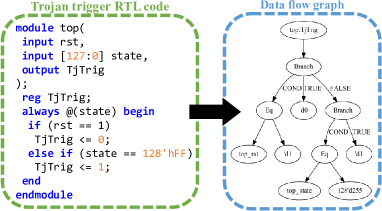
- The method constructs Data Flow Graphs (DFGs) from RTL and gate-level netlist designs to represent data and control flow between signals, registers, and combinational logic.
- Graph Neural Networks (GNNs) are trained on these DFGs to learn intrinsic circuit behaviors, distinguishing normal from malicious patterns automatically.
- The GNN model performs end-to-end feature extraction and classification without requiring manual feature engineering or golden reference circuits.
- The approach uses a custom dataset expanded from the Trusthub HT benchmarks to train and evaluate models on diverse HT variants.
- The model is optimized for inference speed, achieving detection in 21.1ms for RTL and 13.42s for gate-level netlists.
- The method supports generalization to unknown HTs by learning behavioral patterns rather than matching known HT signatures.

Experimental results
Research questions
- RQ1Can a golden reference-free HT detection method achieve high recall and fast inference on both RTL and gate-level netlists?
- RQ2Can GNNs effectively learn and generalize from DFG representations to detect unknown HTs without prior knowledge of malicious patterns?
- RQ3How does the performance of the GNN-based method compare to existing HT detection techniques in terms of scalability, speed, and accuracy?
- RQ4To what extent can the model generalize to unseen HTs that differ in structure or trigger mechanism from known examples?
- RQ5Can the DFG-based GNN approach scale to large, industrial-sized designs with high node counts and complex interconnections?
Key findings
- The proposed GNN-based method achieves 97% recall and 94% F1-score for Hardware Trojan detection in RTL netlists, with an average detection time of 21.1ms.
- For gate-level netlists, the method achieves 84% recall and 86% F1-score, with an average detection time of 13.42 seconds.
- The model successfully detects unknown HTs without requiring golden reference circuits, demonstrating generalization capability beyond known HT patterns.
- The approach outperforms traditional methods that rely on manual feature engineering or subgraph matching, which are time-consuming and limited to known HT signatures.
- The use of DFGs enables effective modeling of data and control flow, allowing the GNN to capture behavioral anomalies indicative of malicious logic.
- The method is scalable and efficient, making it suitable for integration into pre-silicon hardware verification flows in industrial design environments.
Read this paper
Open the full text in the Nubint reader and ask about any passage as you read.
Read this paper on NubintThis review was generated by AI from the original paper. Please check the paper before citing it.