
[Paper Review] High angular momentum coupling for enhanced Rydberg-atom sensing in the VHF band
This paper introduces the High Angular Momentum Matching Excited Raman (HAMMER) method to enhance Rydberg-atom sensing in the VHF band, achieving a sensitivity of 100 μV/m/√Hz in rubidium vapor cells. By leveraging high-angular momentum coupling to amplify Stark shifts, HAMMER enables superior detection of low-frequency signals like AIS waveforms, outperforming traditional AC Stark effect methods in sensitivity and range prediction for maritime RF sensing applications.
Recent advances in Rydberg atom electrometry detail promising applications in radio frequency (RF) communications. Presently, most applications use carrier frequencies greater than 1~GHz where resonant Autler-Townes splitting provides the highest sensitivity. This letter documents a series of experiments with Rydberg atomic sensors to collect and process waveforms from the automated identification system (AIS) used in maritime navigation in the Very High Frequency (VHF) band. Detection in this band is difficult with conventional resonant Autler-Townes based Rydberg sensing and requires a new approach. We show the results from a new method called High Angular Momentum Matching Excited Raman (HAMMER), which enhances low frequency detection and exhibits superior sensitivity compared to the traditional AC Stark effect. From measurements of electromagnetically induced transparency (EIT) in rubidium and cesium vapor cells, we show the relationship between incident electric field strength and observed signal-to-noise ratio and find that the sensitivity of the HAMMER scheme in rubidium achieved an equivalent single VHF tone sensitivity of $\mathrm{100~μV/m/\sqrt{Hz}}$. With these results, we estimate the usable range of the atomic vapor cell antenna for AIS waveforms given current technology and detection techniques.
Motivation & Objective
- To address the challenge of low-sensitivity detection of VHF-band signals (50–300 MHz) using conventional Rydberg atom sensors, which rely on high principal quantum numbers and suffer from decoherence.
- To develop a new sensing mechanism that enhances sensitivity in the VHF band without requiring high-n Rydberg states.
- To demonstrate the feasibility of using Rydberg atoms as traceable, low-SWaP antennas for real-world RF communication signals like AIS.
- To compare the performance of the HAMMER method with traditional AC Stark effect sensing in terms of signal-to-noise ratio and detectable field strength.
- To estimate the usable operational range of atomic vapor cell antennas for AIS waveforms under current technological constraints.
Proposed method
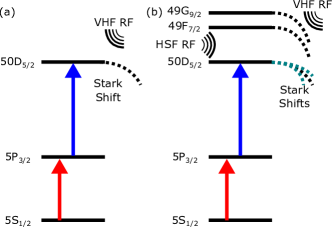
- The HAMMER method uses a dressing RF field to couple a Rydberg state to a nearby higher angular momentum Rydberg state (e.g., 50D → 49F or 49G) via a resonant SHF transition.
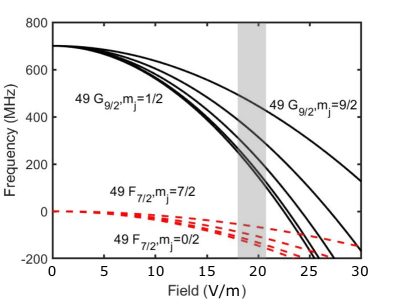
- A strong VHF local oscillator (LO) is applied to Stark shift the F and G states so that the F→G transition becomes resonant with the incident VHF signal field.
- The enhanced polarizability of high-j states (e.g., 49G with 5.5 MHz/(V/m)² in Rb) increases sensitivity to weak electric fields.
- Electromagnetically induced transparency (EIT) is used to probe the system, with the signal-to-noise ratio (SNR) measured as a function of incident electric field strength.
- The method is experimentally validated using rubidium and cesium vapor cells, with field calibration performed using parallel copper plates driven by an SDR.
- Range predictions are derived using Friis and VTRPE propagation models, assuming a Class A AIS transmitter at 12.5 W and 5 m antenna height.
Experimental results
Research questions
- RQ1Can high-angular momentum coupling in Rydberg states significantly enhance sensitivity for VHF-band RF detection?
- RQ2How does the HAMMER method compare to traditional AC Stark effect sensing in terms of SNR and detectable field strength?
- RQ3What is the effective operational range of a Rydberg-atom-based antenna for AIS signals in open-sea conditions?
- RQ4To what extent does the choice of atomic species (Rb vs. Cs) affect the sensitivity and performance of the HAMMER method?
- RQ5How do quantization noise and receiver chain characteristics influence the observed SNR in real-world SDR implementations?
Key findings
- The HAMMER method achieved an equivalent single-tone sensitivity of 100 μV/m/√Hz in rubidium vapor cells, significantly outperforming traditional AC Stark effect methods.
- The signal-to-noise ratio (SNR) in the HAMMER system reached 11 dB at a 10% packet detection success rate, consistent with theoretical expectations based on bit error rate modeling.
- For a 17 mV/m incident field, the predicted effective range of the atomic vapor cell antenna approaches 1 km using the VTRPE propagation model, depending on environmental conditions.
- The calibration of Rb and Cs systems agreed within a factor of two, despite large differences in polarizability and experimental complexity.
- The observed 2.4 dB discrepancy between the ADC noise floor and spectrum analyzer noise floor was attributed to quantization noise in the SDR, justifying the higher-than-expected SNR.
- The HAMMER method enables high-sensitivity detection in the VHF band without requiring high principal quantum numbers, avoiding deleterious decoherence effects.
Better researchstarts right now
From reading papers to final review, dramatically reduce your research time.
No credit card · Free plan available
This review was created by AI and reviewed by human editors.