
[Paper Review] High-efficiency single-photon source above the loss-tolerant threshold for efficient linear optical quantum computing
The paper reports a resonantly excited quantum-dot single-photon source in a tunable open microcavity achieving end-to-end system efficiency above the loss-tolerant threshold, with high purity and indistinguishability.
Photon loss is the biggest enemy for scalable photonic quantum information processing. This problem can be tackled by using quantum error correction, provided that the overall photon loss is below a threshold of 1/3. However, all reported on-demand and indistinguishable single-photon sources still fall short of this threshold. Here, by using tailor shaped laser pulse excitation on a high-quantum efficiency single quantum dot deterministically coupled to a tunable open microcavity, we demonstrate a high-performance source with a single-photon purity of 0.9795(6), photon indistinguishability of 0.9856(13), and an overall system efficiency of 0.712(18), simultaneously. This source for the first time reaches the efficiency threshold for scalable photonic quantum computing. With this source, we further demonstrate 1.89(14) dB intensity squeezing, and consecutive 40-photon events with 1.67 mHz count rate.
Motivation & Objective
- Motivate scalable photonic quantum computing by overcoming photon loss with high-efficiency single-photon sources.
- Demonstrate an on-demand single-photon source that simultaneously achieves high purity, high indistinguishability, and high overall efficiency.
- Show that the achieved efficiency surpasses the loss-tolerant threshold for fault-tolerant linear optical quantum computing.
Proposed method
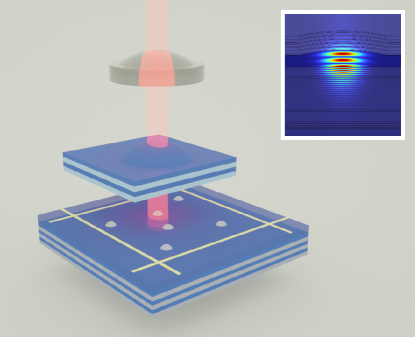
- Use tailor-shaped laser pulse excitation to resonantly drive a single quantum dot deterministically coupled to a tunable open microcavity.
- Employ a mode-splitting cavity to enable polarization-selective excitation and emission collection.
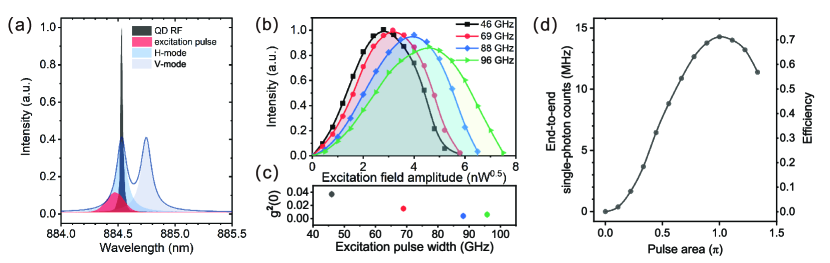
- Implement 4f pulse shaping to narrow the excitation bandwidth and maximize coherent QD-cavity coupling.
- Measure purity with Hanbury Brown and Twiss (HBT) and indistinguishability with non-postselective Hong-Ou-Mandel (HOM) interferometry, including corrections for multi-photon events.
- Quantify system efficiency from end-to-end counts, accounting for detector efficiency and repetition rate, achieving the 0.712(18) benchmark.
Experimental results
Research questions
- RQ1Can a quantum-dot single-photon source simultaneously achieve high purity, high indistinguishability, and end-to-end efficiency above the loss-tolerant threshold?
- RQ2How does open-cavity tunability and pulse shaping influence resonant excitation efficiency and photon statistics?
- RQ3What are the limits of indistinguishability over time delay for a near-transform-limited, high-efficiency source?
Key findings
- Single-photon purity of 0.9795(6).
- Indistinguishability of 0.9856(13).
- System efficiency of 0.712(18).
- Intensity squeezing of 1.89(14) dB under π-pulse excitation.
- Observed 40 consecutive-photon events at 1.67 mHz count rate.
- Duty to exceed the loss-tolerant threshold for scalable photonic quantum computing.
Better researchstarts right now
From reading papers to final review, dramatically reduce your research time.
No credit card · Free plan available
This review was created by AI and reviewed by human editors.