
[Paper Review] Histopathological Cancer Detection Using Hybrid Quantum Computing
The paper compares classical transfer-learning models with hybrid classical-quantum models using variational quantum circuits for histopathological cancer detection, achieving AUC ~0.93 and ResNet18HQC performance comparable to classical ResNet18.
We present an effective application of quantum machine learning in the field of healthcare. The study here emphasizes on a classification problem of a histopathological cancer detection using quantum transfer learning. Rather than using single transfer learning model, the work model presented here consists of multiple transfer learning models especially ResNet18, VGG-16, Inception-v3, AlexNet and several variational quantum circuits (VQC) with high expressibility. As a result, we provide a comparative analysis of the models and the best performing transfer learning model with the prediction AUC of approximately 93 percent for histopathological cancer detection. We also observed that for 1000 images with Resnet18, Hybrid Quantum and Classical (HQC) provided a slightly better accuracy of 88.5 percent than classical of 88.0 percent.
Motivation & Objective
- Motivate the use of hybrid quantum machine learning in medical image classification.
- Evaluate multiple transfer learning backbones (ResNet-18, VGG-16, Inception-v3, AlexNet) in a quantum-assisted framework.
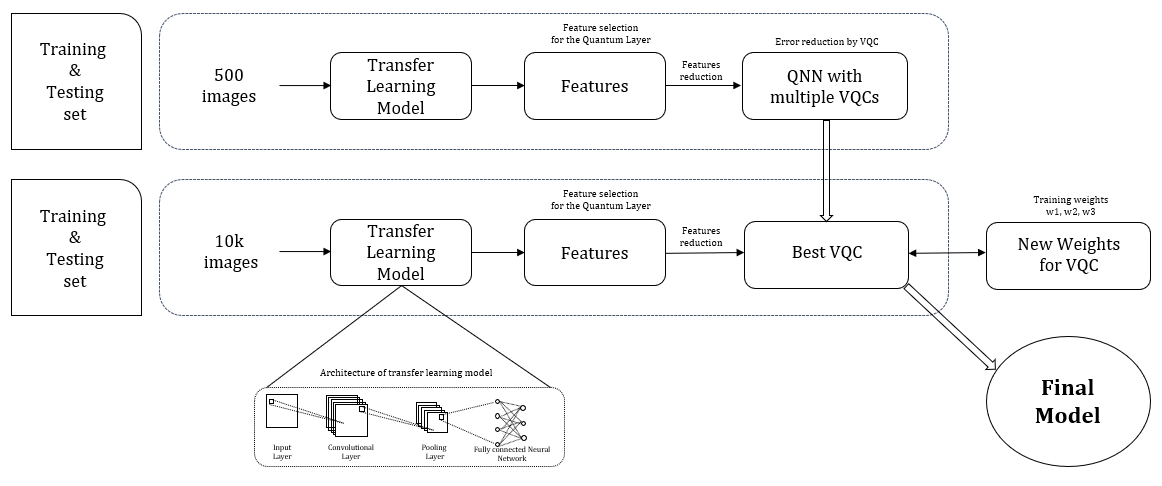
- Integrate variational quantum circuits with pre-trained CNN features to form a QNN.
- Assess performance across varying data sizes and VQC configurations.
- Provide a roadmap for future hardware experiments and robustness considerations in quantum medical imaging.
Proposed method
- Input histopathology patches from PatchCamelyon (PCam) dataset split into train/test/validation sets.
- Fine-tune pre-trained transfer learning models (ResNet-18, VGG-16, Inception-v3, AlexNet) on ImageNet with modified final layers.
- Insert a QNN (VQC-based) between CNN feature extractor and final classifier, with softmax as final layer.
- Test multiple VQC configurations (single-qubit rotations, two-qubit gates) and select the best by expressibility.
- Tune hyperparameters: number of qubits, batch size, learning rate, optimizers (Adam/SGD), tanh activation before VQC, softmax after QNN.
- Evaluate both classical and hybrid models using accuracy and AUC metrics; compare reliability and ROC/PR curves.
Experimental results
Research questions
- RQ1Can hybrid quantum-classical transfer learning achieve competitive AUC for histopathological cancer detection?
- RQ2Which classic CNN backbone provides the best compatibility with a variational quantum circuit for this task?
- RQ3How do different variational quantum circuit configurations and qubit counts affect performance?
- RQ4Does HQC offer any accuracy advantage over purely classical models at small training sizes?
Key findings
- Best performing transfer learning model with QNN achieves AUC ≈ 0.93.
- For 1000 images, Hybrid HQC with ResNet18 yields accuracy 88.50% and AUC 0.93, compared to 88.00% accuracy and 0.95 AUC for classical ResNet18 on 1000 images.
- ResNet18-10000 conventional model achieves 89.90% accuracy and 0.96 AUC.
- Some hybrid configurations (e.g., HQC ResNet18 with 10000 images) reach 0.90 accuracy and 0.90 AUC with specific VQC settings.
- VQC-based QNNs provide expressibility-driven performance and can match classical models under certain configurations.
- The study uses Pennylane simulators; future work includes testing on real quantum hardware and robustness to adversarial attacks.
Better researchstarts right now
From reading papers to final review, dramatically reduce your research time.
No credit card · Free plan available
This review was created by AI and reviewed by human editors.