
[Paper Review] How chiral forces shape neutron-rich Ne and Mg nuclei
This study uses chiral effective field theory (EFT) with ab initio methods to investigate nuclear deformation in neutron-rich neon and magnesium isotopes, revealing that subleading S-wave contact interactions and the pion-nucleon coupling strongly influence deformation. It predicts a well-deformed 34Ne and shape coexistence in 40Mg with an oblate band near the prolate ground state.
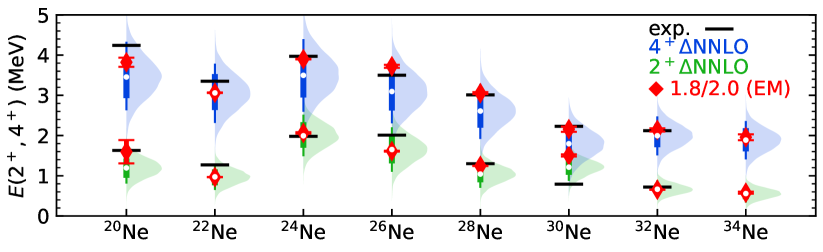
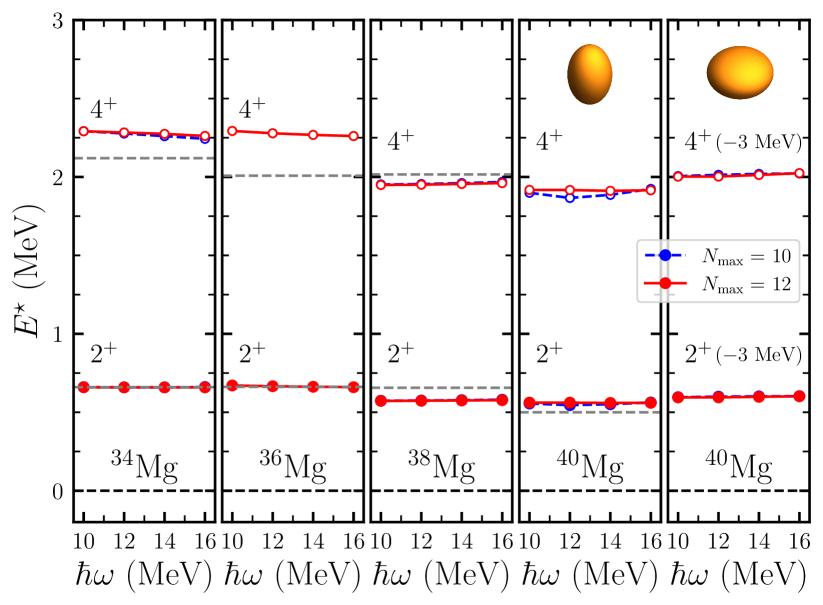
We compute the structure of the exotic even nuclei $^{20-34}$Ne and $^{34-40}$Mg using interactions from chiral effective field theory (EFT). Our results for the ground-state rotational bands in $^{20-32}$Ne and $^{36-40}$Mg agree with data. We predict a well-deformed $^{34}$Ne and find that $^{40}$Mg exhibits an oblate deformed band close to the prolate ground-state, indicating the emergence of shape co-existence at the neutron dripline. A global sensitivity analysis shows that the subleading singlet $S$-wave contact and a pion-nucleon coupling strongly impact deformation in chiral EFT.
Motivation & Objective
- To understand the microscopic origins of nuclear deformation in neutron-rich neon and magnesium isotopes beyond N=20.
- To investigate how chiral two- and three-nucleon interactions shape the structure of exotic nuclei near the neutron dripline.
- To quantify uncertainties in ab initio predictions using an ensemble of chiral interactions.
- To identify the key low-energy constants in chiral EFT that most strongly influence deformation through sensitivity analysis.
- To explore the emergence of shape coexistence in 40Mg using advanced computational emulators and Hartree-Fock methods.
Proposed method
- Employed chiral two- and three-nucleon interactions (1.8/2.0 (EM) and Delta-full NNLO) within ab initio no-core shell model and projected Hartree-Fock frameworks.
- Used eigenvector continuation to build fast, accurate emulators for excitation energies and deformation ratios (R42), reducing computational cost.
- Applied global sensitivity analysis (variance-based) to quantify the impact of individual low-energy constants on observables like R42 and E(0+), E(2+), E(4+).
- Performed history matching to sample interaction parameters and extract correlations between low-energy constants and observables.
- Calculated projected Hartree-Fock energies using generalized non-symmetric eigenvalue solvers to determine rotational bands.
- Validated emulator accuracy by comparing with 400 exact Hartree-Fock calculations, achieving 1% precision for R42 and 10 keV accuracy for excitation energies.
Experimental results
Research questions
- RQ1Which terms in chiral effective field theory most strongly influence nuclear deformation in neutron-rich Ne and Mg isotopes?
- RQ2Does 34Ne exhibit significant deformation, and how does its structure compare to experimental data?
- RQ3What is the role of the pion-nucleon coupling and subleading S-wave contact interactions in shaping the low-lying spectra?
- RQ4Does 40Mg exhibit shape coexistence, and if so, what is the nature of the competing deformed bands?
- RQ5How do the wave functions and energy level structures of neutron-rich Ne and Mg differ from those of 20Ne in terms of deformation-driving correlations?
Key findings
- The predicted ground-state rotational band in 34Ne is well-deformed, consistent with experimental trends in lighter Ne isotopes.
- 40Mg exhibits a low-lying oblate-deformed band near the prolate ground state, indicating the emergence of shape coexistence at the neutron dripline.
- The subleading S-wave contact interaction (C̃3S1) and the pion-nucleon coupling (c2) dominate the variance in ground-state energy and R42 ratios, explaining over 90% of the uncertainty in 20Ne and 32Ne.
- For 32Ne and 34Mg, sensitivity is distributed across more low-energy constants, reflecting increased complexity near the dripline.
- The ground and excited state energies in neutron-rich Ne and Mg show distinct sensitivity patterns compared to 20Ne, indicating differences in wave function structure.
- Emulator accuracy is within 1% for R42 and 10 keV for excitation energies, validating the use of emulators for large-scale sensitivity analysis.
Read this paper
Open the full text in the Nubint reader and ask about any passage as you read.
Read this paper on NubintThis review was generated by AI from the original paper. Please check the paper before citing it.