
[Paper Review] How Good Are GPT Models at Machine Translation? A Comprehensive Evaluation
The paper evaluates GPT models (ChatGPT, text-davinci-003, text-davinci-002) for machine translation across 18 language directions, showing strong performance for high-resource languages, limited capability for low-resource languages, and benefits from prompting strategies, document-level translation, and hybrid GPT+NMT approaches.
Generative Pre-trained Transformer (GPT) models have shown remarkable capabilities for natural language generation, but their performance for machine translation has not been thoroughly investigated. In this paper, we present a comprehensive evaluation of GPT models for machine translation, covering various aspects such as quality of different GPT models in comparison with state-of-the-art research and commercial systems, effect of prompting strategies, robustness towards domain shifts and document-level translation. We experiment with eighteen different translation directions involving high and low resource languages, as well as non English-centric translations, and evaluate the performance of three GPT models: ChatGPT, GPT3.5 (text-davinci-003), and text-davinci-002. Our results show that GPT models achieve very competitive translation quality for high resource languages, while having limited capabilities for low resource languages. We also show that hybrid approaches, which combine GPT models with other translation systems, can further enhance the translation quality. We perform comprehensive analysis and human evaluation to further understand the characteristics of GPT translations. We hope that our paper provides valuable insights for researchers and practitioners in the field and helps to better understand the potential and limitations of GPT models for translation.
Motivation & Objective
- Assess the translation quality of GPT models across high-resource and low-resource languages.
- Explore prompting strategies (zero-shot, few-shot) and their impact on translation performance.
- Evaluate document-level translation capabilities and robustness under domain shifts.
- Compare GPT models against state-of-the-art research and commercial systems.
- Investigate the potential benefits of combining GPT with conventional NMT systems.
Proposed method
- Compare GPT variants (text-davinci-002, text-davinci-003, ChatGPT) against WMT-Best and Microsoft Translator across 18 language pairs.
- Use zero-shot and few-shot prompting to assess in-context learning effects.
- Employ neural MT metrics (COMET-22, COMETkiwi) and lexical metrics (BLEU, ChrF) for evaluation, plus document-level adaptations (Doc-COMETkiwi).
- Adapt COMET-kiwi for document-level evaluation via sliding-window overlap (Doc-COMETkiwi).
- Conduct human evaluations to supplement metric-based assessments.
- Analyze prompt design (quality and relevance) and their influence on translation outcomes.
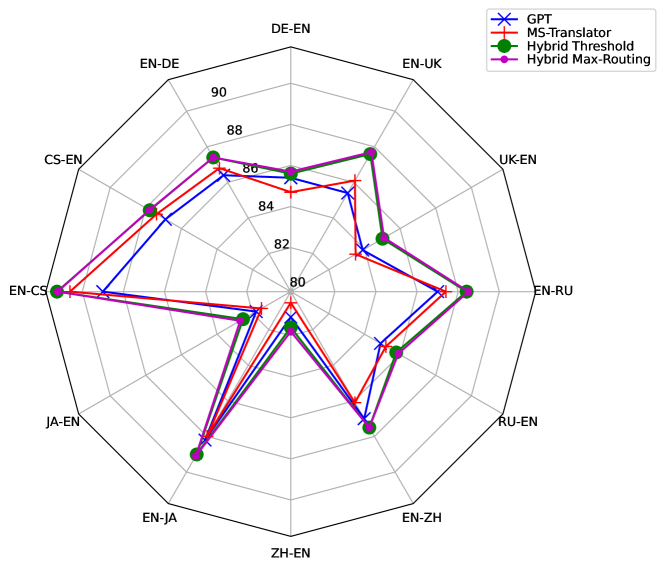
Experimental results
Research questions
- RQ1How do GPT models perform on machine translation compared with state-of-the-art research and commercial systems across diverse language pairs?
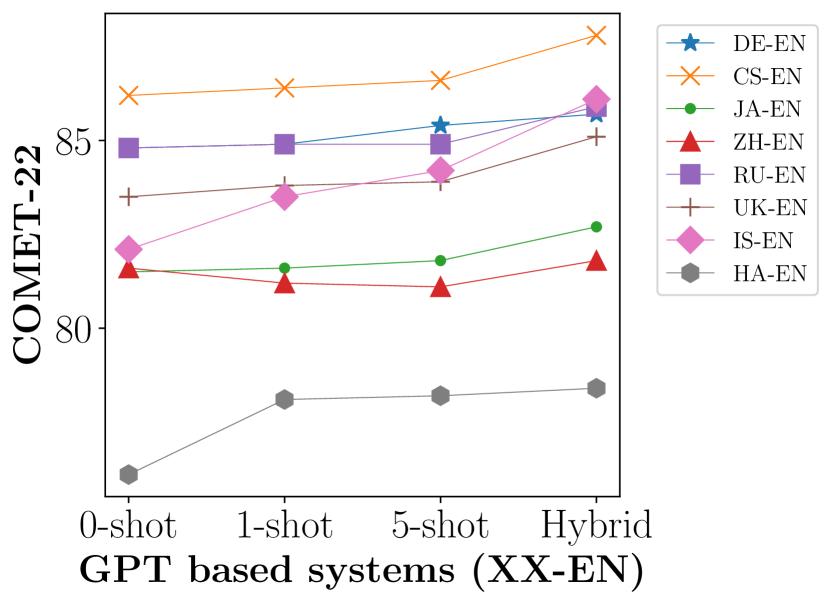
- RQ2What is the impact of prompting strategies (zero-shot vs few-shot, shot quality and relevance) on GPT translation quality?
- RQ3Can GPT models effectively translate at the document level and how does context influence performance?
- RQ4How robust are GPT translations to domain shifts and non-English-centric translations, and do GPTs complement traditional NMT systems?
- RQ5What are the characteristics and limitations of GPT translations compared to NMT, including artifacts and potential cross-language advantages?
Key findings
- GPT models achieve very competitive translation quality for high-resource languages but have limited capabilities for low-resource languages.
- Prompting strategies, especially few-shot high-quality shots, can improve performance in some directions, particularly when translating from English to other languages.
- Document-level translation with GPT can leverage broader context and, with appropriate evaluation, can approach or surpass some baseline systems, depending on metrics.
- Hybrid approaches that combine GPT models with conventional NMT systems can further enhance translation quality.
- Human evaluation and detailed analysis reveal strengths and weaknesses of GPT translations and provide insights into artifact patterns and cross-language behavior.
Read this paper
Open the full text in the Nubint reader and ask about any passage as you read.
Read this paper on NubintThis review was generated by AI from the original paper. Please check the paper before citing it.